Mar 15

How, and how not, to predict a basketball season

Here is a “best practices” guide for preparing for a casual interview with a coach about an upcoming basketball season.

  • OMG I can’t watch: “Coach, tell me about this year’s team.”
  • Shooting for .500: “Coach, what are you looking forward to this year?”
  • Bye in the Big 12 tournament/maybe NCAAs: “I think this could be a decent team.”
  • NCAAs for sure: “I think we have an NCAA Tournament level team.”
  • Big 12 semis/Sweet 16 is a floor: “I think this can be a really good team.”
  • Big 12 champ game/Sky’s the limit: “I think this could be a really special team.”

What you do not under any circumstance let escape your lips, especially in October, and especially especially because Iowa State fandom is about meditation on the existence of suffering: “This is a Final Four, national championship caliber basketball team.”

When I heard Chris Williams say that about the 2022-23 Cyclone women’s basketball team I screamed JINX JINX JINX into the crisp fall air on the trail and probably scared a squirrel.

The Iowa State women missed out on a regular-season Big 12 championship, but defeated Baylor, Oklahoma, and Texas to win the last Big 12 women’s tournament at Municipal Auditorium. Postgame video here. (The Kansas City Star says the tournament will move a week earlier to the other arena in KC, and will also be on nonconsecutive days due to BYU entering the Big 12.)

The Cyclones missed out on hosting NCAA tournament games and instead will be playing Dayton in Knoxville, Tennessee. A potential second-round matchup exists against a team Iowa State has never played: the Lady Volunteers. A potential second-round matchup in 2009 was thwarted when the defending national champion Lady Vols were upset in the first round for the first time.

To the Orange Palace of Doom it is. Go Cyclones. (And go Cyclone men, who play on a completely different day this time.)

PS: Everyone involved in scheduling the Oscars on Selection Sunday should be fired.

PPS: They should go back to giving the women’s tournament its own selection night on Monday.

Posted in Sports | Comments Off on How, and how not, to predict a basketball season
Mar 13

B is for Beaver


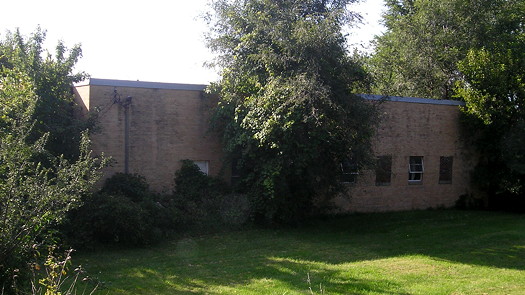
April 17, 2016: “Tuesday last the contract was let for the new school house in Beaver. D.C. Ferrell of Omaha got the contract for $40,740.00, M.J. Madison got the contract for plumbing for $700.” — Grand Junction Globe, February 26, 1920

The Beaver school is a bit like Brigadoon: You can only see it at certain times. When the trees are in leaf, it’s hard to see the abandoned building on 2nd Street.

A history of the Beaver school district was presented at the school’s last assembly. That history, compiled by Archie Sparks of the Boone County Historical Society, and printed in the January 9, 1969, Globe-Free Press, is where the following information comes from.

The Beaver school building opened in fall 1921. The last high school class was in 1946, and the last eighth-grade class was in 1962. Beaver was attached to the Ogden school district in 1966, as one of the mandatory assignments at the K-12 deadline.

“The Ogden Schools used the Beaver brick building for fifth and sixth grade classes until December 19, 1968, when these classes were transferred to the old junior high school building at Ogden, and the new high school building at Ogden was occupied.”

The Beaver school was a school for 47½ years. It’s been not-a-school for 55.

Posted in Schools, Sequences | Comments Off on B is for Beaver
Mar 10

North Tama bond issue fails by six votes

Based on my research, the core school building in Traer is likely among the 50 oldest in use in Iowa. Following Tuesday’s failed bond referendum, it’s going to be that way for a while longer.

A $14.25 million bond issue for new construction, the first step toward replacing the 1917-18 building, missed clearing a supermajority by six votes, the North Tama Telegraph reports. A separate levy vote also failed. The breakdown by area shows that the southern part of the district opposed it the most.

The North Tama board started this process nearly two years ago. It went through a lot of effort on this referendum, combing through a boatload of plans and repeatedly stressing that the “do nothing” option would still be $13 million. (Keep in mind, that’s in 2022 dollars.) A significant amount of that is compliance with the Americans With Disabilities Act, which is what happens when 1990 and later standards get imposed on 1917-18, 1955-56, and 1964 facilities.

The NT bond failure margin beats out HMS’s bond failure in 2017 (seven votes), which succeeded on its fourth try. I hope the school district doesn’t have to start its plans from scratch, but the whole public process has to be redone. Due to a quirk in the calendar, September is out as the month for the next attempt.

Given that this was the first step in what could be/could have been a multi-decade multi-bond process, those six votes loom large in North Tama’s future. The last entry about the school in Traer’s sesquicentennial book will be another mention of a failed bond issue.

Benton Community’s bond issue on Tuesday, which would have built an elementary in Van Horne and closed Keystone and Norway, got a supermajority in the wrong direction, 64%-36% against.

Posted in Schools, Tama County | Comments Off on North Tama bond issue fails by six votes
Mar 08

A floating museum with screen time

Monday’s episode of “Quantum Leap” was set in 1989 aboard what the script and visual effects intend to be the USS Montana, BB-77. According to the US Navy’s battleships page, that vessel doesn’t exist, although Wikipedia says that “Montana-class battleships” reached the design stage.

Due to a few seconds of video that technically creates a continuity error, I can tell that at least some of the action was filmed on a real battleship, one that just so happens to be docked in Los Angeles.

That’s BB-61, the Battleship of Presidents, the USS Iowa.

Posted in Iowa Miscellaneous | Comments Off on A floating museum with screen time
Mar 06

C is for Coburg


September 17, 2014: The addition to the Coburg school in southern Montgomery County was used for less than 15 years (1956-57 to 1968-69). This is what’s visible of what’s left; the original school was demolished in 1979.

The Coburg and Essex school districts really wanted to get together. However, the consolidation (Es-Co? Cossex?) wasn’t meant to be.

The plan began in late 1957, only to be rejected by county boards of education in early 1958. At the time, each county had a board and every reorganization required approval from the counties involved.

Another attempt came months later, and from the news story below, you can tell it’s a big deal.

Joint meeting Page, Mont’y school boards
ESSEX — A free baby sitting service has been offered parents who plan to attend the Coburg-Essex school reorganization hearing this Saturday afternoon, June 21, at Clarinda.
Offering the service are three Essex girls, Karla Hummel, Berna Franks and Dorothy Dukeshier.
The girls will take care of the children in the town park from 11:30 a.m. until the parents return from the hearing. In case of bad weather they will take the children to the school.
All stores will close at noon for the hearing, which starts at 1:30 in the court room. A caravan to Clarinda is planned from here.
Red Oak Express, June 19, 1958

This proposal passed the county boards, only to get struck down by the state when bordering districts objected. This began a multi-year process of appeals, reversals, and re-petitioning that did not end until the middle of 1963.

In 1960, during that long litigation process, Coburg shut down its high school. Its last graduating classes had 7, 9, and 11 students each. That same year, the Red Oak Community School District was formed.

The final step came involuntarily. A vote to consolidate Red Oak, Coburg, and Stennett (a district centered on IA 48 between Red Oak and Elliott) overwhelmingly lost in Feburary 1967. Stennett had objected to the plan for a seven-member school board that had five director districts and two at-large members with all voters voting on all seats, preferring seven director districts where only those in each district voted for their candidates.

In July, Montgomery County assigned the lion’s share of the latter two non-high-school districts, along with West Township No. 9 in the far southwest corner of the county, to Red Oak. Coburg would host grades K-4 and 8, Stennett 7. This allowed for demolition of Red Oak Junior High (1898) in October. The reorganization is not in the state’s post-1965 timeline. Stennett’s objection had only prolonged the situation; in the September 1967 Red Oak school board election, voting was not restricted by director district.

The Red Oak school district closed the Coburg and Stennett buildings in 1969, and followed that with Wales a year later. The Wales-Lincoln (Township) building remains, where M47 intersects 130th Street in far northwest Montgomery County.

Nothing remains of Stennett, an extinct map dot east of IA 48 where H20 goes gravel at 145th Street and the East Nishnabotna River. The gymnasium, built in 1952-53 and dedicated with a time capsule, went up in flames in May 2000. Aerial photos show that what remained was left untouched until the main school’s roof collapsed in 2009-10 and then it all was turned to rubble.

Information for this blog post comes from Red Oak Express archives.

Posted in Schools, Sequences | Comments Off on C is for Coburg
Mar 03

Virtual radio, virtual article

Eagle Grove has a new radio station. Sort of.

“Eagle Grove Classic Hits” is an online-only radio station (link here). Its music collection is “classic rock, classic country, and oldies”, according to a story at the Eagle Grove Eagle.

But this isn’t an ordinary small-town newspaper article, according to the editor’s note. You see, the newspaper’s editor is also the founder of the radio station. “I found it pretty hard to interview myself,” he wrote, so he let ChatGPT write the article and he edited it.

My profession is endangered enough as it is. If artificial intelligence is writing the stories as well, it’s only a matter of time before we’re overwhelmed with pro-AI propaganda.

… as soon as we started thinking for you, it really became our civilization

(Wearing latex in the Matrix isn’t going to be as sweaty and smelly as in the real world, right?)

Posted in Iowa Miscellaneous | Comments Off on Virtual radio, virtual article
Mar 01

Woodbury County exit takes another step

A new exit on I-29 about halfway between Sergeant Bluff and Salix is in progress, but construction is a ways off.

KTIV reports the Woodbury County supervisors Tuesday approved money to build the “Southbridge Interchange”. According to a KTIV story from September, it will cost $25 million.

The Federal Highway Administration’s “Finding of No Significant Impact” PDF shows a diagram of the exit (p.8). It will be built between mile markers 138 and 139, just south of 235th Street.

This isn’t the first exit in the area to be built after initial construction of I-29. The Port Neal exit northwest of Salix opened September 11, 1970, according to a 1982 map detailing interstate openings.

Construction is not in the five-year plan. First up on I-29 in Woodbury County is replacing the IA 141 bridge over the interstate at Sloan. Also, the northbound rest area south of Sergeant Bluff will be removed. The southbound rest area was recommended for closure in the DOT’s 2020 plan, but it is of much newer construction.

Posted in Construction | Comments Off on Woodbury County exit takes another step
Feb 27

Did Grand Junction almost lose the Lincoln Highway?

While working on some updates for the 1920 highway series, I noticed a curious thing on the 1920 state map: IA 6 between Grand Junction and Ogden is in the wrong place.
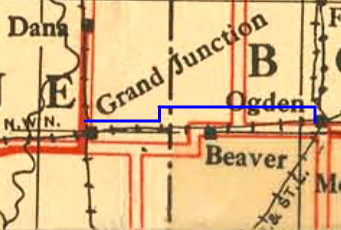
By “wrong”, I mean that the blue line I’ve drawn in, a mile north of present US 30 and then on the north side of the railroad near Grand Junction, was the official 1915 route of the Lincoln Highway. This is mentioned in the August 15, 1915, Grand Junction Globe, where a letter from Iowa State Consul W.F. Coan of Clinton confirmed the “north route” and said “It was an oversight in not notifying the Detroit office that Beaver was not on the official route …”. It’s also confirmed by the existence of three bridges — two Lincoln Highway-specific bridges built in 1915 and one Marsh rainbow arch from 1919 — on the north route.

But then a curious story appears in the June 4, 1919, Jefferson Bee:

Changes Lincolnway; Rumor Grand Jct. is cut off
Famous route now passes through south suburbs of that town on its way west.

According to an article in the Ogden Reporter there has been a change in the Lincoln Highway, through eastern Greene county, which takes the famous route off the main street of Grand Junction and puts it in the south suburbs thereof. …

“The route of the Lincoln Highway leading out of Ogden has recently undergone a radical change. The south road, or old Continental Trail has been selected from Ogden to a point one mile east of Beaver. Here the road will follow an entirely new course, following the Northwestern railroad on the south side through the J.R. Doran farm. Again taking up the old Trans-Continental road at the west of Beaver and following it to a point one mile east of the Greene county line. Here an entirely new course has been made. The road will take a course one mile south and thence west until it meets the road leading out of Grand Junction and straight west to Jefferson.

[“]Action upon the change in the route of the Lincoln Highway was made before any one in this community was aware of the fact that a change was contemplated. The contention of the highway commission is that it eliminates two dangerous grade crossings and shortens the distance between Ogden and Grand Junction nearly two miles. The elimination of grade crossings and the shortening of the route is going to be an iron clad policy of both the state highway commission and the Lincoln Highway Association.

[“]The change of the route will place the town of Beaver on the national highway and will practically leave Grand Junction off the road. The new route will carry the road along the extreme south side of Grand Junction, making a straight line with the road as it runs south from that town and west on a direct line to Jefferson.[“]

A similar story appeared the same day in the Jefferson Herald.

There’s a problem with this change: There was not, nor has there ever been, a road on the section line on the south side of Grand Junction. To follow this new route would have required four turns in a 1.5-mile segment using 228th Street. In addition, if this alignment depended on straightening the road at Beaver, and note the story says south side of the tracks and not the section line, that would not happen until later.

It’s very likely that in 1920, IA 17, coming up from Rippey on what’s now P46, would have turned west to skip across the “south suburbs” of Grand Junction on its way to Jefferson. But the Lincoln? I have my doubts. I believe the brown route shown on the map was used as both IA 6 and the Lincoln Highway in 1920.
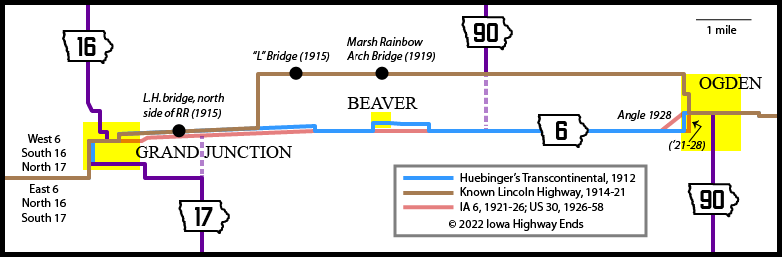
As you might imagine, this didn’t sit well with Grand Junction. The town immediately sought to get the highway back, and won, as reported in the Bee on September 1, 1920 and subsequent Greene County Supervisors minutes from September 23 printed in the Bee on October 13. At that meeting, the supervisors agreed to relocate the route back onto Grand Junction’s Main Street and east to Ogden, bypassing Beaver to the south.

The oldest Iowa Highway Commission blueprint from the area clearly marks the now-abandoned grade on the north side of the railroad “present road”, but I will allow the caveat that there is no hard date on it. The Bee on January 5, 1921 notes a deal between the Boone County supervisors and Justin Doran of Beaver (remember him above?) to allow the Lincoln Highway to go straight through his land “with the understanding that the road be constructed during the year 1921.” It might have taken another year, because the 1915 “north route” was not deleted from the Boone and Greene county maps until the end of 1922.

In conclusion, if a “south route” was used as the Lincoln Highway/IA 6 and not just proposed, it only happened for a very short period, and there’s the possibility that the IHC altered its routing but the LHA did not.

Posted in 1920 Highway Sytem | Comments Off on Did Grand Junction almost lose the Lincoln Highway?
Feb 24

Blairsburg school slightly older than initially thought

For a while now, I have been basing what I know about the Blairsburg school building on a student newspaper article. However, it turns out some of it was faulty, but in a potentially interesting way: I knew that its pitched roof made it old, but it’s slightly older than estimated before.

“There is a current trend of writing up one’s family tree and searching for one’s roots,” said a story December 1, 1977, in “The Trojan’s Lance”, the Northeast Hamilton student page in the Webster City Daily Freeman-Journal. That trend sprang from the success of Alex Haley’s book Roots and the TV series based on it. “After the first building of the Blairsburg school burned down, a new brick one was built, in 1913. The following year it became Blairsburg Consolidated which took some of the students from the country.”

The last sentence is correct: By a 97-27 vote on Valentine’s Day 1914 (Webster City Journal, Feb. 5 and 19), the Blairsburg school district expanded to cover 26 square miles. The sentence before it is wrong. I hadn’t had any reason to dispute it, because 1913 would have been the very end of the pitched-roof era. Then I discovered the Hamilton County IAGenWeb page had a photo it dated 1911 where the building looks to be in the final stages of construction. That photo is facing west, taken in the area that was used for an addition to Northeast Hamilton school in 2009-10. I went back to the Hamilton County newspaper archives and searched a little farther back.

From the Williams Wasp, a very interesting name for a paper:

Friday night at about 11 o’clock the Blairsburg school house burned to the ground. The exact cause of the fire is unknown, but it is thought the flames started from a defective flue. … The fire was discovered by a sled load of young people returning home from a party. (January 20, 1910)

School opened Monday, Nov. 21, in the new school building which is just completed. … Blairsburg can now boast of one of the neatest and most up-to-date school houses for a town of its size in Iowa. (November 23, 1910)

This information means the Blairsburg school started in the 1910-11 school year, and is in the middle of its 113th year. With this new information, I’ve tweaked some stuff on previous blog posts.

UPDATE: Just when I thought I had figured out a tidy window for architectural changes, here comes the Weldon school, built with a pitched roof and bell tower in 1918 (IAGenWeb). It replaced one that burned down on April 12, 1917 — three days after Traer’s did. Interestingly enough, on June 4, 1917, both Weldon and Van Wert voted bonds for new schools, but Van Wert’s was built in the flat-roofed symmetrical style.

Posted in Schools | Comments Off on Blairsburg school slightly older than initially thought
Feb 22

Special deliveries

First, the old: The Reinbeck Courier bound volume archives have been relocated to Reinbeck’s City Hall. The story (both at the Marshalltown Times-Republican and Sun-Courier websites, the latter with more photos) references “the now vacant halls of the Tama Newspaper office”, which indicates to me that the one location in Tama that the Tama-Grundy newspaper offices were folded into in 2018 has itself been shuttered. Some Gladbrook-Reinbeck students helped with the move: “For these students, 1998 was a long time ago.” [Ow. —Ed.] This rescue/preservation follows a similar mission for the Traer Star-Clipper bound volumes.

Next, the new: The reporter for the North Tama Telegraph and Sun-Courier — and I do mean the reporter — recently finished a project nine months in the making. Ruby McAllister also collected three Iowa Newspaper Association awards for 2022 at the INA convention in December, but those don’t demand nighttime feedings.

Posted in Tama County | Comments Off on Special deliveries