May 12

Central Iowa channels off Mediacom in Tama County

This website has a long-running side project in the Annex, charting the coverage areas of TV stations in Iowa and how they change periodically. It goes back to before the digital era. Today, network channels can still be received via an antenna — the TV has to be new enough — but through cable or satellite, you’re limited to what the provider offers.

Two weeks ago, Mediacom stopped the dual offering of central and eastern Iowa stations in the Tama-Toledo area. Mediacom says it’s a cost issue, and the company is technically correct.

Owners of local affiliates have been demanding more money from cable and satellite companies to carry the stations. The most notorious owner around these parts is Sinclair Broadcasting, which has repeatedly held KGAN and KDSM hostage. At the beginning of this year, my bill went up nearly $5 “to reflect changes in the rates we are charged by local broadcast stations.”

Because Tama County is officially in the eastern Iowa market, the central Iowa stations were a convenience that was no longer worth the price. To watch TV from Des Moines — like “SoundOff,” which had its 1000th episode Sunday — the TV input has to be switched to antenna, assuming it comes in.

I presume the same situation is happening in other border areas served by Mediacom across Iowa. It’s a sign of both the changing television era and the hidden prices we pay for so many things.

Posted in Tama County | Comments Off on Central Iowa channels off Mediacom in Tama County
May 11

North Carolina wants two more 2-digit interstates

Two weeks from now, the semi-annual AASHTO conference will be held in Des Moines. (I thought about trying to go but the upper-three-digit cost of admission put a stop to that.) The agenda for the numbering committee has been released, and there are some intriguing applications.

Iowa’s application to reroute US 6 is in there, with an effective date of July 1. (This may mean signs stay until then.) Fittingly, this meeting is being held in the Council Bluffs Room of the Des Moines Marriott Downtown. But this change is small potatoes compared to North Carolina.

In the past quarter-century, North Carolina has added Iowa’s entire population. With that population growth comes the need for transportation systems to accommodate it. Across the state, four-lane segments built in stages and even new interstate alignments, combined with the topography, make for a maze of fork interchanges and business routes.

North Carolina has played especially fast and loose with the rules for numbering US and interstate highways, and AASHTO has let it. It has a north-south even-numbered interstate (I-26), an odd-numbered beltway (I-540), duplication of US and interstate numbers on the same road (I-74/US 74), and a gross violation of the two-digit numbering grid (I-73, and I-74 again, which would require massive projects through the Appalachians and Ohio Valley to make sense).

North Carolina wants US 70 from Raleigh to Morehead City, on the Atlantic coast, to become I-36. Because I-40 takes a steep southward dive east of Raleigh to Wilmington (an extension that didn’t happen until 1984), I-36 is north of I-40 here, but in the larger picture the number makes sense in the location. US 70 would be almost but not quite redundant, since there would be 40 miles at the far east end remaining two lanes. I think after the designation is signed, US 70 should be moved back to the “business routes” where possible, but that won’t happen.

It’s the other course that gets wacky. The most recent highway bill make Raleigh-to-Norfolk VA via Elizabeth City a high-priority corridor. A significant portion of that is a general east-west alignment, even the part that’s US 17. After considering I-56 and other numbers, North Carolina wants to make the corridor a second I-89. The existing I-89 is way up in New Hampshire and Vermont, so this duplication wouldn’t cause confusion.

The Norfolk/Hampton Roads area doesn’t have a north-south interstate number serving it, and while it would be east of I-95, again in the larger picture the number makes a sort of sense. Virginia is not part of this application, and a significant portion of the North Carolina part is not interstate-grade yet, so the first part to get I-89 signs would be the east-west US 64 freeway. Part of it, from Raleigh to Rocky Mount, was designated I-495 two years ago, which violates numbering rules since the segment is a spur from I-95 to Raleigh and not a loop of anything.

Significant portions of these corridors haven’t been built to interstate standards, so by the time they are completed, the routes will be even more convoluted. The next question, then, is will, and HOW will, a mile-marker-based exit system be established for the interstates when the US routes they’re following have very different starting positions and distances pre- and post-bypass will be somewhat different?

(Also in the Iowa meeting application batch are closing the gap on  I-555 in Arkansas and I-14 in Texas, both of which I’ve covered.)

Posted in Highway Miscellaneous | Comments Off on North Carolina wants two more 2-digit interstates
May 10

The closest I’ve gotten to Alaska


September 14, 2015

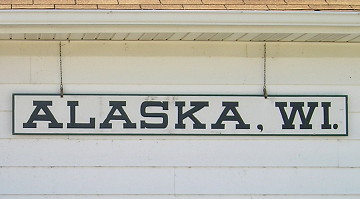
Alaska, Wisconsin, is an unincorporated village consisting of a post office and a couple other buildings on WI 42 near Kewaunee.

Since 2009, when I crossed Delaware and Nevada off my list, Alaska and Hawaii remain the only states I have never visited.

Posted in Uncategorized | Comments Off on The closest I’ve gotten to Alaska
May 09

The circus begins

Circus1986Frame1

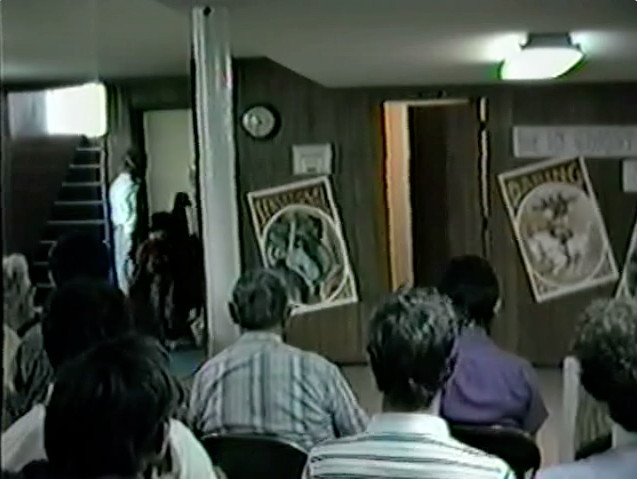
May 8, 1986: Preschool circus at St. Luke’s Lutheran Church basement in Traer. Event #1 on family videotape #1. The church building has been expanded since then, but this is how I remember the basement, from preschool to Scout meetings.

GoldfieldHouse

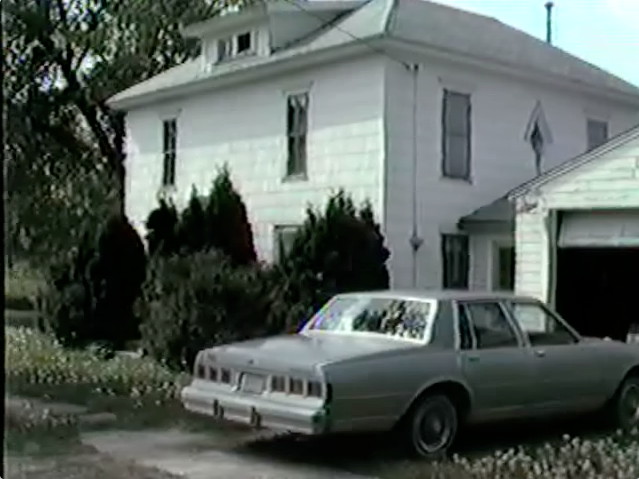
May 11, 1986: Ruth Lyons’ house in Goldfield, just before moving to Traer, and our car.

I digitized this video footage, which now takes place closer to the beginning of the interstate highway system than the present day, in 2010. I am now up to nearly 2,000 individual recordings, representing about that many family events, and just got into editing the year 2000. There are more than 50 hours of videotape from 2000 and 2001 apiece. In fact, my main issue now is getting those done to free up space for recording more on the hard drive (and finding the time to do so). Yes, I’m very slow at this.

Fifteen months ago, the World’s Best Peripheral stopped being sold in the U.S., and one week before I needed to re-up a subscription for TV listings, the software was sold to another company. The most recent version of the software is needed to continue with that, and I gave serious consideration to forgoing listings if I had to in order to continue digitizing tapes. Happily, my situation appears to be resolved with minimal inconvenience.

Posted in Uncategorized | Comments Off on The circus begins
May 06

O is for Otranto


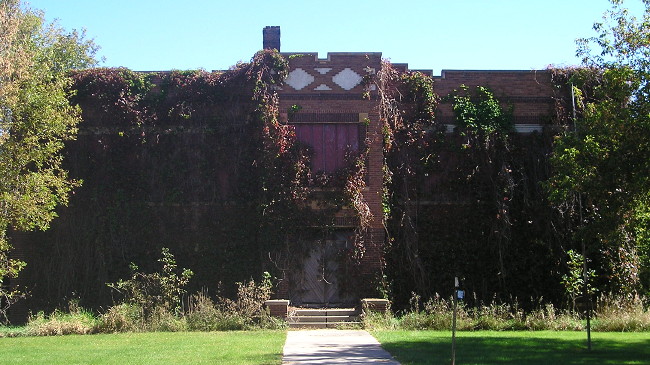
September 29, 2015: Iowa’s Prairie Castle of Otranto. The vines certainly add a gothic touch.

The school in tiny Otranto, just south of the Minnesota border, was in use for 50 years and closed in 1966, according to a reprinted article on the Mitchell County IAGenWeb site. That makes this structure a century old this year. According to a Mitchell County Press-News article from 2006 about an all-school reunion for Otranto,* the last high school class graduated in 1943 and after that it was an elementary school. Otranto rejected consolidation with St. Ansgar in 1956, which created a minor problem when some of the land planned for the new St. Ansgar Community School District was separated from the rest of the new district. Otranto held on for a while longer — “Otranto objects to loss of school under merger” is a headline in the Austin (MN) Daily Herald Feb. 27, 1962.

Also in Otranto, an 1899 truss bridge with an unusual design spanning the Cedar River, bypassed in 1999, was dismantled in March 2014 under mysterious circumstances.

*That article uses the same history text in the last paragraph as an Austin Daily Herald article from 2000 and Northwood Anchor article from 2003 about previous Otranto all-school reunions. Hmm…

Posted in Schools, Sequences | Comments Off on O is for Otranto
May 05

An IA 92 bypass of Oskaloosa?

There is a meeting next week to “discuss the conceptual alignments” of a bypass of IA 92 around Oskaloosa. The study area encompasses a wide space, since this is literally the first step in the process. Any construction likely wouldn’t happen for a decade.

Very preliminary looks at a west-side bypass of Oskaloosa for US 63 have been bandied about as well. Both plans would use the IA 163 extension built in 1997. It would be possible to remake the south interchange to accommodate all directions of traffic and IA 92 to go east and northeast from there.

UPDATE: A more detailed proposal is online now with multiple options. The 63/163 interchange would be turned into a folded diamond. A new interchange could be built either south of that interchange with a waaaay out-of-the way bypass for 92, or northwest of that interchange on a straight-then-diagonal alignment around the south and southeast sides of Oskaloosa.

Posted in Construction | Comments Off on An IA 92 bypass of Oskaloosa?
May 04

What will happen to St. Ansgar Elementary?

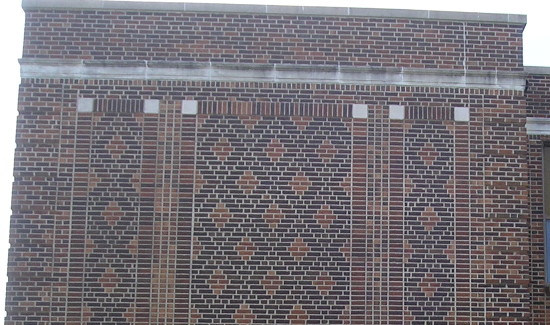
OLYMPUS DIGITAL CAMERA
August 4, 2015: Detailed view of the brickwork at the southeast corner of the St. Ansgar Elementary building, which started out as the town’s main school building. They don’t build them like this anymore.

The St. Ansgar school district has built an elementary addition onto its high school complex along with a new gym, and the fate of the town’s 1928 school building will be determined soon. The Mason City Globe Gazette reports there are two options on the table. In one, the building will be demolished and six residences built on the land. In the other, the building would stay and become a community center.

Posted in Schools | Comments Off on What will happen to St. Ansgar Elementary?
May 03

Jefferson Highway book published

The Jefferson Highway, the much-less-known north-south counterpart to the Lincoln Highway in Iowa, is getting its time in the spotlight. There is now a book about the route, which went from Winnipeg to New Orleans (“Pine to Palm”).

In Iowa, the Jefferson — important enough to be numbered the first IA 1 in 1920 — roughly followed US 69 from the Missouri state line to Ames, US 30 between Ames and Colo, and US 65 to Minnesota. The big curve at Niland’s Cafe is because that’s the way the Jefferson went. US 65 did not run south of Colo through Collins and Bondurant to Altoona until 1940. (The book’s author says the first route of the Jefferson went through Shipley, south of Nevada, but by the time of the first Highway Commission map in 1919 the straight route through Ames had won out.)

The WHO story says the Jefferson Highway will be signed as a historic byway like the Lincoln Highway, so that will be something to check out next year.

Posted in Highway Miscellaneous | Comments Off on Jefferson Highway book published
May 02

Draft Gladbrook-Reinbeck dissolution map released

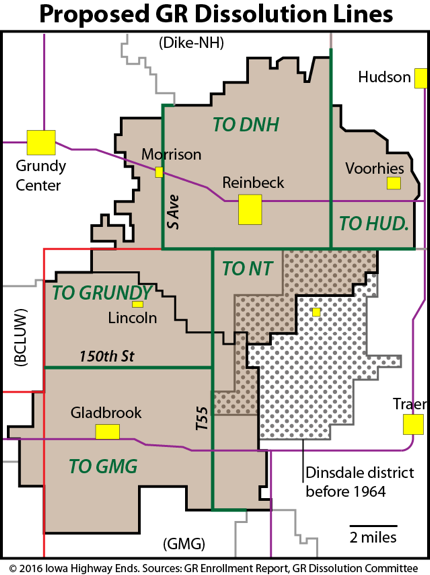
At a meeting last week, the Gladbrook-Reinbeck Dissolution Committee unveiled a first draft of the way the school district would be divided up should a vote pass. The district’s PDF is here (Google Docs) and I have replicated it below.

Surrounding districts have until the end of this week (“within 10 days of receipt of the proposal”) to make an objection. Then there will be another hearing for landowners inside the district to make an objection, and another notification to contiguous districts. The process is spelled out in this PDF (Google Docs).

It doesn’t get any simpler than that. Hudson could get all of the district that’s in Black Hawk County (approx. 16½ square miles). North Tama could get everything in Tama County east of T55 (approx. 33½ square miles but possibly as few as 20 students). The north line for GMG would be 150th Street, a mile north of the township line. Grundy Center would make a major advance into Tama County with 32¾ square miles and the town of Lincoln, and then also the town of Morrison in Grundy County. The remainder, including Reinbeck, would be assigned to Dike-New Hartford. DNH had left open the possibility of keeping the Reinbeck building open — but it could be at the expense of New Hartford, which currently has the junior high.

If the dissolution passes, the boundaries of Grundy Center, Hudson, and North Tama would change for the first time in the modern era of Iowa school districts (post-1965). It would be the first major change in the surrounding area since 1992, when BCLUW and GMG officially consolidated and Dike-New Hartford began sharing. (GR merged later but was sharing earlier.) There would be a buffer of sorts separating Gladbrook from Reinbeck, and I’m not just talking about Grundy Center’s new border with North Tama. With GMG in the Iowa Star Conference and Class A football, and DNH in the North Iowa Cedar League and generally on the 1A/2A football cusp (2A next fall), the two towns would be in separate activity spheres except for large-area fine arts events.

The lines are clean and simple, but have one side effect. Because they are drawn on the section line instead of the half-section, students on the borders would go to different districts depending on which side of the road they live on. (The Iowa Department of Education’s lines for Farragut got caught in this trap when the few houses in Farragut on the west side of M16 were assigned to Sidney instead of Shenandoah.)

Judging solely on the basis of attendance at the meeting at the end of March, this proposed dissolution is not likely to pass, in which case nothing changes. But as with any election, it’s the side opposed to the status quo that is usually the most energized.

Oh, and by the way…next school year David Hill will be the shared superintendent for North Tama and Gladbrook-Reinbeck. I wish him luck, because he’s going to need it.

UPDATE 5/31/21: Corrected Dinsdale lines to 1964.

Posted in Schools, Tama County | Comments Off on Draft Gladbrook-Reinbeck dissolution map released
Apr 29

The ‘Oregon Trail’ Generation

With the news that millennials now outnumber baby boomers, I want to pass along this Huffington Post piece that points out not all millennials (and late X’ers) are created equal. I’ve thought for years that Generation Y should be broken up into two groups depending on what you got first, a driver’s license or a cell phone. Thus, this speaks to me.

We were the first group of high school kids to do research for papers both online and in an old-fashioned card catalogue, which many millennials have never even heard of by the way (I know because I asked my 21-year-old intern and he started stuttering about library cards). …

The importance of going through some of life’s toughest years without the toxic intrusion of social media really can’t be overstated. MySpace was born in 2003 and Facebook became available to all college students in 2004. So if you were born in 1981-1982, for example, you were literally the last graduating class to finish college without social media being part of the experience.

Meanwhile, Generation Z is beginning to enter college, and I have e-mails and ClarisWorks documents older than nearly all of them.

Posted in Uncategorized | Comments Off on The ‘Oregon Trail’ Generation