A whirlwind day of visits to small museums, with more to come!

A whirlwind day of visits to small museums, with more to come!
Legislation lowering the state’s speed limit to 55 miles an hour cleared its final legislative hurdle today and was sent to Gov. Robert D. Ray for his signature. … The bill will remain in effect until July 1, 1975, or until the President determines there is no longer an energy crisis. — UPI in Ames Tribune, 2/6/74
The top half of the Feb. 28, 1974, issue of the Grundy Register had two photos that said it all: a hand-written “Out of Gas” sign from a station in Grundy Center, and Iowa Highway Commission workers putting a panel over a double sign on IA 14 that changed “Speed Limit 70 / Trucks 55” to “Speed Limit 55.”
Seventy. On two-lane roads. With cars the size of boats. Yikes.
Meanwhile, 52 years later, now we have a speed limit of 60 on two-lane roads but 65 on many miles of four-lane roads including controlled-access freeways. Any chance this can get fixed next session?
For July 4, here’s look back at the most patriotic event I attended so far this year: The Clutier Legion’s visits to cemeteries on Memorial Day.

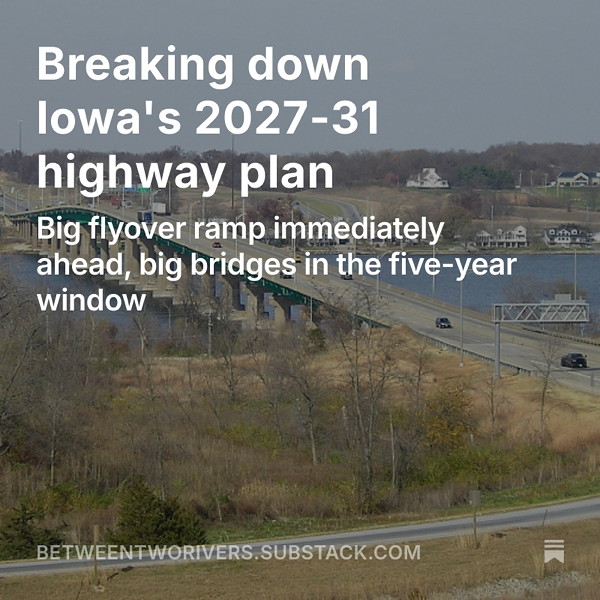
I finally got around to doing a rundown of the big-budget and other interesting items in the 2027-31 Iowa DOT five-year highway plan.
Keep in mind that “underfunded” means the DOT hasn’t allocated all the money the project needs, not that the listed cost of the project will grow.
Now we know what the grade-and-pave listing for two intersections on US 75 north of Sioux City in the five-year construction plan is for.
The intersections of US 75 with county roads C70 and C80, in Plymouth County, just across the Woodbury line and right before/after the Sioux City bypass begins/ends, are going to be restricted.
The Iowa DOT has given less than a week’s notice (Wednesday for a meeting Monday) about installing J-turns at the intersections. The state is referring to them as “reduced conflict intersections” but they’re still that type of intersection that bans left turns from the intersecting road onto the four-lane.
Construction will take place next year. Barring locations that I don’t know about, and depending on the timing of the one coming to US 30 in DeWitt, these will be the third and fourth “reduced conflict intersections” in Iowa.
Despite the failure of a bond referendum last November, the Dubuque Community School District is moving forward with a plan to close one of its two century-old middle school/junior high facilities and move those students to a much newer building. KCRG’s story June 1 shows plans for two additions to Eleanor Roosevelt Middle Schools that would result in Jefferson Middle School’s closure in 2028.
The bond referendum to build a new middle school and close both Washington and Jefferson middle schools got a majority but not a supermajority last November. In the FAQ then, the school district said, “The recommendation to close Jefferson will be needed whether or not the bond issue is approved by voters in November.” The Vote No action group, whose website is still up six months later, had questions on the school board’s transparency and whether a new building was truly needed given declining enrollment.
On May 13, the school board committed $30 million in future state income tax (SAVE) revenue to funding this construction, rather than the $70 million bond (and property tax increase) that would have resulted if the November vote had been a success. Borrowing against future SAVE revenue after a failed bond referendum is also what BCLUW is doing so it can close the school in Union.
For at least the third time, the Iowa DOT’s attempt to turn a major intersection into a “J-turn” has been met with vocal displeasure from local residents.
In March, KCCI reported that the plans to put a J-turn on US 30 on the south side of State Center were on hold. Instead, the DOT would build offset right-turn lanes. These lanes move traffic farther away from the mainline instead of being aligned beside it. I’ve seen other, shorter offset right-turn lanes recently constructed at intersections of rural two-lane roads and wonder if they might become more widespread.
The story says the DOT will monitor how this change, plus the addition of warning lights on the four-lane road when cross traffic approaches, affects the intersection.
A letting scheduled for today shows the turn-lane plan is being put to paper with construction in the second half of this year. Interestingly, all Iowa State football games (not just the home ones!) are listed as “special events” for the contractor to be aware of.
J-turns were earlier rejected at the US 65/330/117 intersection and the US 30/218 intersection, both of which were eventually upgraded to interchanges. The only place one has been installed is on US 20 near Fort Dodge for a truck stop (that I still think was badly located but you get the land that you can get).
Addendum to that link to a blog post from 2022: The J-turn proposed at the south side of the US 61 Wapello bypass has been upgraded to a full interchange.
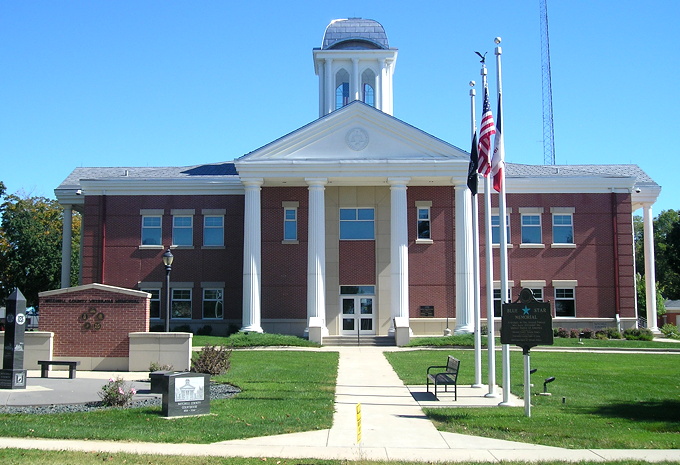 September 28, 2025: The Mitchell County Courthouse in Osage.
A recent story about county courthouses says the newest one is in Pottawattamie County in 1978. This is wrong, twice over.
Dickinson County built a new courthouse in stages in 2006 and 2009. All county offices and the jail are part of the facility in Spirit Lake. It is much larger than the previous one, as the county’s population is much bigger than it was in the 1860s, in addition to holding all services.
The Mitchell County Courthouse in Osage, built in 1858, had major issues in the early 2010s. It was vacated in 2013. The matter of whether to restore or replace got exceptionally heated. Two bond referendums failed, but the county supervisors moved forward with a different bonding method to build a new one anyway. The new courthouse opened in August 2015, and from the exterior, it’s designed to look as much like the old one as possible but with extensions (wings) on either side.
Maybe it takes someone who’s been to every county courthouse to know off the top of their head that Council Bluffs hasn’t had Iowa’s youngest courthouse for two decades.
The Iowa DOT intends to convert the four-way stop of highways 69 and 210 south of Huxley into a roundabout in 2028. The informational meeting is scheduled for Thursday evening at Huxley City Hall.
This intersection is a mile and a half west of the only exit on I-35 between Elkhart and Ames. The IA 210 bridge was replaced while the interstate is being six-laned underneath. It would have been interesting if, in conjunction with either project, 210 between 69 and I-35 was also made four lanes.
Huxley got its first fast-food place, a McDonald’s, last month. The 69/210 intersection is only going to grow in traffic count as Huxley grows. That makes a four-way stop woefully underpowered. I would argue, though, this is close enough to Huxley that a stoplight would be justified and not entirely in a “rural” area.
I wrote 2200 words about five presentations in Ames on May 1. Well, technically, I wrote whatever percentage of those words are not from quoted material. Here’s the second part, and the story links to a full presentation about “streamliner” midcentury train engine design.