Jul 14

Notes on 2024-28 DOT five-year plan: Polk County

Final segment of the 2024-28 construction plan, approved last month:

  • A segment of I-80 east of the northeast mixmaster to US 65, with construction in 2025-27, is mistakenly labeled as I-35 again this year. There is a separate line for the mixmaster, with construction only for 2024. Bridge pillars for the new ramp from WB 80 to SB 235 are already in place. The exit from WB 80 to both NB 35 and SB 235 will be consolidated and then split into a flyover ramp and a much longer ramp, and the exit point moved all the way back to just east of NE 29th Street.
  • The west mixmaster is also now on the plan for rebuilding in 2028. So far, all I’ve seen is one story from KCCI and one from the Register. The latter includes a diagram showing that the northeast loop (SB 35 to EB 235) will be removed and converted to a flyover ramp, but also, SB 35/80 to WB 80 will be retooled into a double-lane exit much closer to the center of the interchange so that it will merge into traffic from WB 235 from the left. This will likely make it harder for traffic on 80 to get to the Jordan Creek exit lane.
  • The Hickman Road (US 6) exit will be turned into a diverging diamond in 2025-27. This project includes adding another lane in each direction (!) on I-35/80 between Douglas and University avenues with slight reconfigurations at both those exits’ ramps. According to a November 2022 handout, “traffic volumes in the corridor are expected to continue to increase by nearly 35% by the year 2042.”
  • Sign replacement on I-35/80 from NW 86th Street to the northeast mixmaster is planned for 2024. Those BGSs are the oldest in the metro. However, I’m confused why a 9-mile segment is billed as 27.4 in the plan.
  • They’re going to try to deal with the congestion on IA 141 in Grimes, a location that did not get enough right-of-way when it was built decades ago and now needs to be a full freeway but can’t, in 2025. Northbound 141 at SE 37th Street (Grimes’ grid) has eight individual stoplights. An attempt to put a SPUI there would probably take out both gas stations.
Posted in Construction | Comments Off on Notes on 2024-28 DOT five-year plan: Polk County
Jul 12

Notes on 2024-28 DOT five-year plan: I-80

Continuing analysis of the 2024-28 five-year plan:

  • Completion of the Council Bluffs Interstate System project is forecast to wrap up in 2024, with construction at both the I-29/I-480 interchange and the I-80 Madison Avenue exit.
  • I-80 east of US 169 will be rebuilt (bridge for six, pave for four) in 2024, and through the US 169 exit in 2028. It will be six-laned in the far west West Des Moines/Waukee area in 2025-26.
  • I-80 will be six-laned from the current end of the six-lane in Iowa City to West Branch in 2024-25.
  • The WB Underwood rest area will be replaced in 2028.
  • Interchanges:
    • The IA 21 exit will be replaced in 2026-28. My guess is this will be like at IA 146, where the roadbed for I-80 will be designed for six lanes. For now, this just means a wider median.
    • Ditto the IA 149 exit, in 2027-28.
    • The same thing will happen at the Middle Road exit in Bettendorf in 2026, which has been the subject of planning dating back to at least mid-2014. In early 2022, the Quad-City Times reported that the exit will change from a folded diamond with ramps in the northeast and southwest corners to a “compressed diamond”. Middle Road is an underfunded project.
  • The Mississippi River bridge will be replaced in 2028, 60 years after its completion in 1967. Recommendations at a meeting in October stick closely to the current alignment. The final report is due later this year. The current price tag is $50 million.
Posted in Construction | Comments Off on Notes on 2024-28 DOT five-year plan: I-80
Jul 10

Notes on 2024-28 DOT five-year plan

Yes, very delayed, for reasons.

The Iowa Transportation Commission approved the latest five-year road construction plan in June. Its press release covers the biggest points, but I want to look deeper into some of them, especially the bigger-dollar projects. Years are fiscal. See previous yearsanalyses for further notes. I-80 and Polk County will be covered in separate posts.

  • The IA 9 bridge at Lansing is scheduled for 2024, meaning work can begin as soon as late this summer. In fact, a special letting dedicated to this bridge is scheduled for August 1. This bridge will be just north of the present one and slip into the current WI 82 pavement on the other side of the river.
    • With the demolition of the I-74 bridges, this will make the US 20 Julien Dubuque Bridge Iowa’s oldest highway-only bridge across the Mississippi. Speaking of, that bridge has rehabilitation scheduled for 2026.
  • US 20 between IA 58 and US 63, with pavement dating back to the mid-1980s, will have its pavement replaced in 2026.
  • The IA 58 Greenhill Road interchange is programmed for 2028, but there is a double-asterisk indicating it is currently underfunded.
  • US 65 south of downtown Mason City will be rebuilt in 2025.
  • Four of the five US 30 bridges between Wheatland and Calamus, all from the 1956 realignment of the road, will be replaced. They won’t be replaced at the same time, likely because even if they could be all done in one construction season, a total closure of US 30 in the area would require a giant detour down to I-80 between IA 38 and US 61.
  • The US 30/59 bridge over the UPRR on the west side of Denison will be replaced in 2028.
  • The US 61 Mediapolis bypass is scheduled for 2025, north of Mediapolis to IA 78 in 2026, and IA 78 to IA 92 in 2026/2028.
  • The underfunded US 30 Missouri Valley bypass is scheduled for 2027.
  • US 52 between the new Mississippi River bridge and Sabula will be repaved in 2026.
  • I-380 will be six-laned from the current end of the six-lane in North Liberty to US 30 in Cedar Rapids in 2024-26 except for the area around the Iowa River and IA 965 crossings and the US 30 interchange itself. This includes conversion of the Cedar Rapids airport exit to a diverging diamond. The north segment is underfunded.
  • The US 151 Springville interchange will be done in 2028, a decade and a half after the clamor for it began.
  • The I-380 Boyson Road exit will be converted to a diverging diamond in 2025.
  • The US 63 Oskaloosa bypass is scheduled for 2027.
  • The southbound lanes of US 75 between Hinton and Merrill will be rebuilt in 2025. The northbound lanes are being rebuilt this year. Work on the road in Hinton, where it’s a four-lane street, will be done in 2028.
  • A large, staggered US 63 project from US 6 to Hudson, discussed here, starts in 2024 in the southernmost part (including conversion to three lanes in Tama-Toledo), covers Toledo to IA 96 in 2026, and Traer to Hudson in 2027. This is separate from the 2020 project to pave half-shoulders on 63 between Traer and Hudson.
  • The old end of IA 225 at IA 146 will be changed in 2024.
  • US 30 will be six-laned between the Duff and Dayton avenue exits as part of a Skunk River bridge replacement project in 2025-27. Project materials were put online in April.
  • A new US 30 exit at R70, just east of I-35, which requires a relocation of the north-south county road while also building a frontage road between R70 and 590th Avenue to the east, wraps up in 2024, five years after the final public meeting. Then another exit will be built on the west side of Nevada in 2027-28, creating a controlled-access freeway from Ames to Nevada save for what appears to be preservation of the old IA 133 intersection.
  • The I-35 SB parking area/scenic overlook south of Story City will be taken out in 2027.
  • I-35 at and north of the Cumming interchange has a NB-only “grade and pave” set for 2027, which at the least is a complete reconstruction that widens the shoulders, but could also be paving three lanes. All the work in Warren County north of IA 92, including bridge replacements and future paving in 2026 and 2028, has been preparing for the possibility of six-laning but for now that stops at the Polk/Warren line.
  • Between ROW acquisition in 2027 and grade/pave in 2028, the Gordon Drive viaduct replacement in Sioux City is already pegged at $66.4 million and still underfunded.
Posted in Construction | Comments Off on Notes on 2024-28 DOT five-year plan
Jul 07

Roundabout coming to Granger

The page for the Iowa DOT meeting announcement just says “proposed safety project” but the result is more insidious: A roundabout is going to be built at the intersection of IA 17 and State Street on the east side of Granger. The public meeting was June 1. Here’s a link to the PIM site with diagrams. Here’s a link to the video of the presentation.

Construction of the $1.691 million roundabout is scheduled for next year.

Posted in Construction | Comments Off on Roundabout coming to Granger
Jul 05

Look back at Traer’s Big Birthday Bash

Here’s coverage from the North Tama Telegraph, along with lots of photos, of Traer’s Big Birthday Bash on June 3.

Naturally, with Tama County being in a moderate drought, the event was plagued by rain showers.

Posted in Tama County | Comments Off on Look back at Traer’s Big Birthday Bash
Jul 03

Will proofread for food

On June 29, I was laid off. I am looking for something in the editing, proofreading, or journalism fields.

Posted in Uncategorized | Comments Off on Will proofread for food
Jun 30

Dysart sesquicentennial celebration next week

The town of Dysart will celebrate its 150th birthday July 2-4. Events begin with a community church service Sunday morning at 10 and end with the Independence Day parade Tuesday morning at 11. Here’s a detailed rundown in the North Tama Telegraph. Sunday’s highlights include a 1916 barn tour and restored prairie tour. Monday afternoon there will be a town photo followed by a time capsule burial. (I hope they print out the town photo and put it in the time capsule!)

When the Burlington, Cedar Rapids, and Minnesota Railway was extended west from Vinton in 1873, the towns of Garrison, Dysart, and Traer all sprang to life. Dysart was named after politician Joseph Dysart, who had been a state senator and was Iowa lieutenant governor for one term. It was not incorporated until 1881, but that’s immaterial on town anniversaries.

According to History of Tama County (1883), the first train made it to Dysart on December 27, 1873, but this has to be a typo for 1872. I say that because the Vinton Eagle was already running a railroad timetable to Dysart on January 22, 1873, and the first train made it to Traer on July 27. This branch line from Vinton was named the “Pacific Division”, because the BCR&M had a grand vision.

But what the railroad didn’t have was a lot of time or clout. A short 2015 review in The Annals of Iowa of The Iowa Route: A History of the Burlington, Cedar Rapids & Northern Railway notes: “Strategic alliances, most notably with the Chicago, Rock Island & Pacific Railroad (CRI&P), and occasional antagonisms, especially with the CB&Q, show how the BCR&N was neither master of its own destiny nor even a particularly important player in the world of railroads.”

The BCR&M became the BCR&N on June 27, 1876, according to a website dedicated to railroad bridges. That syncs with mentions in the Tama County and Cedar Rapids papers. (Related post.)

Posted in Tama County | Comments Off on Dysart sesquicentennial celebration next week
Jun 28

I-74 bridge towers go boom

Do you want to see 3½ minutes of the controlled demolition of the old Illinois-bound I-74 bridge towers? Of course you do.

Do you want to see a news story about the demolition, which interviews a resident who remembers when there was only one bridge and tolls? Of course you do.

Note that only the towers remained; the decking had already been removed. The remaining bridge, closer to the new bridge, still has those connections. They will be taken out next. Because of the positioning of the new bridge, the 1935 span will outlive the 1959 span by however many months it takes to set up a second demolition.

Posted in Construction | Comments Off on I-74 bridge towers go boom
Jun 26

Dike’s role in Nebraska highway history


The 1953 state highway map has a crudely drawn line for what was to become IA 370 and the designation still attached to the town of Dike. That would change.

It turns out a remark I made on one route page is untrue, and there’s a story in the correction.

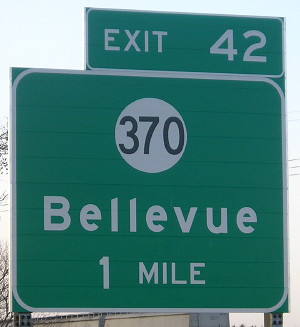
I thought Iowa had numbers to spare when the Missouri River toll bridge at Bellevue opened at the end of 1952. After in-depth examination of the state maps around that period, Iowa did not. All the free numbers were in use in Nebraska.

But sometime in 1952, the Iowa Highway Commission eliminated a five-block-long highway into downtown Dike. Dike’s city limits were along a state-maintained road (US 20, now D19), but the town is one of a dozen such cases that managed to get a spur route into downtown anyway. Its number, assigned in 1939, was 370.

When the Bellevue bridge was being built in 1951 and 1952, there was no connection to US 275 on the Iowa side. According to the Lincoln Evening Journal on December 27, 1952, “[a] newly graded road on the Iowa side of the river had not been surfaced by the opening day, but it was to be graveled.”

Iowa needed to come up with a number, and on September 10, 1952, shortly before the bridge opened, the Highway Commission grabbed the lowest number that wasn’t in use in either state…370.


October 22, 2014

Shortly after the opening of the new US 34 bridge, IA 370 disappeared, but the number is still alive in Nebraska, because of a little highway designated in Dike in 1939.

Posted in Highway Miscellaneous | Comments Off on Dike’s role in Nebraska highway history
Jun 23

Ingersoll ‘road diet’ gives businesses indigestion

A streetscape project on Ingersoll Avenue, just west of downtown Des Moines, has been a long time in the making. Now that part of it has been completed, the results are less than hoped for.

The Des Moines Register reports that business owners along Ingersoll, including former mayor Frank Cownie, are worried about the changes. Dozens of parking spaces have been lost and right-of-way has been handed over to bike lanes between MLK Parkway and 28th Street.

The pro-streetscape group’s executive director told the Register that creating a more “pedestrian-friendly” area “actually enhances retail and restaurant activity.”

A 2014 document from the Des Moines Area Metropolitan Planning Authority (PDF) outlines the changes to Ingersoll. In 2009, the Des Moines City Council approved reducing part of Ingersoll to three lanes (one direction and a center turn lane) despite “considerable opposition” from businesses. Polls on one slide show 60% of those surveyed who live or have a business on Ingersoll were strongly opposed before the change, and afterward, 44% said the city should “definitely change it back to 4-lanes.”

Since then, the council has continued with the “complete streets” vision that includes wider sidewalks, bike lanes on both sides, and bus pullouts. Ingersoll west of MLK Parkway certainly was/is in need of a complete rebuild, but some of the parallel parking spaces that were available in the past decade are now being removed.

In April, Axios reported that the easternmost part of Ingersoll will get the road diet without the rebuild, turning five lanes to three and restriping for bikes.

“Avoid ‘bike lanes vs. businesses,'” the 2014 document warned, but that’s precisely what happened.

Posted in Construction | Comments Off on Ingersoll ‘road diet’ gives businesses indigestion