Jan 27

Another roundabout for Ottumwa

The intersection of Albia Road and Quincy Avenue in Ottumwa is going to be turned into a roundabout this year, KTVO reports.

This intersection is on old US 34, now Business 34. Fifteen years ago, the DOT officially changed the route of Business 34 west from the Albia/Quincy intersection to follow Quincy north to present 34 instead of west. However, signage has never been changed, as seen in this Google Maps image just from November.

Posted in Construction | Comments Off on Another roundabout for Ottumwa
Jan 25

East River Township School, 1956-68

In my 2014 Des Moines Register column about Manilla’s school, I invoked the evolution of a “typical” school complex in small-town Iowa. At the core, you have a two- or three-story symmetrical brick structure from 1913-28. An elementary wing comes in the late 1950s or early 1960s, along with a gymnasium if there’s not one from the ’30s. More ancillary rooms or areas — or a replacement of the original structure — are built in the 1980s and 1990s. To all this I would add one more round of additions and extensions from the 2010s, often built with Physical Plant and Equipment Levy money, that may have come at the cost of the smallest town in the district that still had a school losing it.

In a few places, there wasn’t an elementary wing attached to an existing site, but a whole new structure in the middle of nowhere. I have found at least three from the 1950s: Scott Township, southeast of Winterset; Pymosa, northwest of Atlantic; and East River, southeast of Clarinda.

The 10-room East River Township school opened in 1956 after a bond issue for $65,000. It was built on the site of “Thompson School No. 5,” at the intersection of blacktopped County Road N14 and 240th Street.

East River opposed area reorganization in early 1959, while in August the consolidated South Page school district opened for its first year. Clarinda followed in 1960. It was the Iowa Legislature’s K-12 decree that spelled the end of East River. In 1966, nearly all of the non-high-school district became part of Clarinda. Grades 3-6 of Garfield Elementary School went to East River.

In the winter of the 1967-68 school year, in preparation for opening a new junior high building, Clarinda decided to close East River and engage in a district-wide redistribution of students. About 60% of the student body, 900 kids in all, went to a different building in the fall of 1968 than they had in 1967.

In May 1970, the Clarinda school board voted to demolish the East River school building. Iowa law requires that rural land used for schools revert to the previous owner when the land no longer serves that purpose. The building was stripped and the steel was salvaged.

There was still $12,000 left in debt to be paid on a structure that did not last 15 years. Part of its concrete floor remains on a space now housing four grain bins.

Clarinda Herald-Journal stories used for this blog post:

  • “Propose $65,000 East River Twp school,” 11/3/55
  • “East River school board turns thumbs down on reorganization,” 3/12/59
  • “South Page schools to open first year of merger Aug. 31st,” 8/6/59
  • “East River area divided among three districts,” 7/18/66
  • “Special areas expand in Clarinda’s schools,” 8/15/66
  • “Board considers future for East River building,” 11/16/67
  • “900 in new building on first day of school,” 8/26/68
  • “East River school building to be demolished in summer,” 5/21/70
Posted in Schools | Comments Off on East River Township School, 1956-68
Jan 23

Re-countying Connecticut


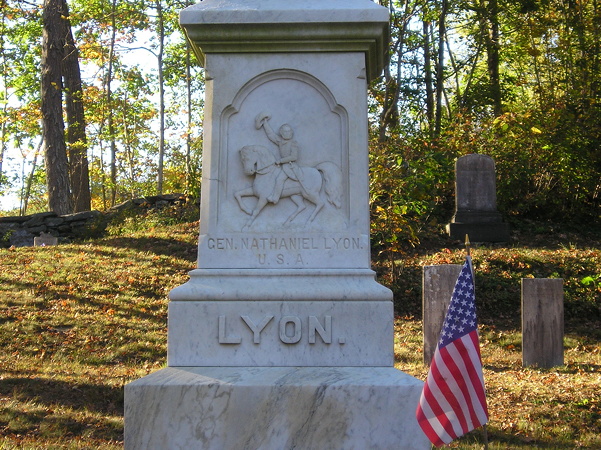
October 12, 2017: The grave of Nathaniel Lyon is in Phoenixville, Connecticut, in the northeastern corner of the state. Lyon was killed at the Battle of Wilson’s Creek in Missouri, southwest of Springfield, in 1861. The following year, the Iowa Legislature renamed Buncombe County for Lyon.

Technically, Connecticut’s eight counties have been dead for six decades. However, for historical and federal government “county equivalent” reasons, they have remained in use to some extent. These boundaries are the ones county counters at mob-rule.com have used. Connecticut became my third clinched state* in two trips: 2002 (traveling on I-95) and 2017 (my second trip to New England).

Now it’s being un-clinched.

Last June, following approval from the Census Bureau and publication in the Federal Register, Connecticut became reorganized into nine “planning regions” that will be recognized as its counties. Very broadly, the north-central two counties are being merged and the western three are being broken into five. The new lines already appear on OpenStreetMap at closer zoom levels. The subdivisions used to create the regions are based on the state’s 169 “towns”, which you can see on this 2020 election results map.

My Bristol-Plymouth-Waterbury travel leg that touched three old counties is now entirely within the new “Naugatuck Valley” county council of government. The new “Northwest Hills,” unfortunately, contains an area I didn’t visit.

M0b-rule is changing its maps Feb. 1. My net number of counties won’t change, but the national total will, and I’ll have a “well, I had been all over, but the map changed” story to tell.

*In addition to every county in Iowa, Illinois, Connecticut, Rhode Island, Wisconsin, and Delaware, I’ve visited every mainland county in Massachusetts and all but the tip of the arrowhead in Minnesota. Some of those states were easier than others.

Posted in Geography, Maps | Comments Off on Re-countying Connecticut
Jan 20

How well does Sprite go with cheese curds?

I did a double-take when I walked in to a Culver’s recently and saw the sticker on the door announcing it was proudly serving Coca-Cola products.

Noooooo!

Culver’s, according to a 2021 fragment of a paywalled story at AdAge, was the only top 10 national burger chains selling Pepsi. Although Culver’s was founded in Sauk City and has historically been a Midwest chain, it recently opened a place in Gainesville, Florida. (Perhaps it’s catering to the Midwestern college students there. Or maybe Florida is joining the Big Ten.)

A Dec. 30 Sioux Center News story about the Culver’s there being remodeled is the first media coverage I’ve seen mentioning it. Eastern Iowa radio station K92.3 had a story Monday, with a Jan. 11 tweet from Culver’s included.

Elsewhere in official brand switches, the Chicago Cubs are dumping Pepsi for Coca-Cola as well. That was first reported by Sports Business Journal in June, but Chicago TV stations reported the change under way last week.

PepsiCo has not been shy about raising prices in the past year. The loss of Culver’s pretty much restricts Pepsi to the Yum Brands family among major restaurants. (I think Taco Bell decreased its food sizes while raising prices.)

Posted in Uncategorized | Comments Off on How well does Sprite go with cheese curds?
Jan 18

In which my podcast machine gets a worse interface

Apple: Welcome to iOS 16! With “all-new personalization features“! “It’s easy to customize the font, color, or placement of elements on your Lock Screen by tapping the element.”

Me: What the [expletive deleted] did you do to the clock font? What did you do to the notifications and who thought this was a good idea? Why are you still hiding notifications in Do Not Disturb time? Why doesn’t Siri cheerfully greet me like a Star Trek computer anymore? Why is Location Services always on? Why is my battery life disappearing faster than an Iowa State lead in the third quarter? Did you notice the location of the podcast player on the lock screen changes based on number of notifications, or if I have a timer going? Why is the podcast view on the lock screen either giant or microscopic (without corresponding changes in button size)? Please for the love of Jobs just tell me how I can put things back the way they were!

Apple: No.

Siri: [sad boop]

—————-

Seriously, do NOT upgrade to iOS 16. It is awful and I immediately regretted the decision in half a dozen different ways.

Posted in Uncategorized | Comments Off on In which my podcast machine gets a worse interface
Jan 16

Unclear on the concept, “What the crap, Ed?” division

This started shortly after the new year.

NOW how am I supposed to watch SoundOff?

(Title reference.)

Posted in Iowa Miscellaneous | Comments Off on Unclear on the concept, “What the crap, Ed?” division
Jan 13

Yag, Yag, Yag


October 9, 2020: Imagine the middle line on this LGS on IA 92 at IA 28 pointing to Yaggy.

Winterset Madisonian, December 8, 1910:

Where is Yaggy? What is Yaggy? Yaggy is a town, and a town right in our midst, and but few of us know anything about it. It is located right near the Madison county line to the east and heretofore has been known as the Osceola crossing, the Burlington junction and officially the M., I. & N. crossing until recently there was a joint convention of the officials of the Rock Island-Burlington officials at which [it] was ordained that this important railroad point should hereafter be called Yaggy. And so it is that Yaggy it is. Three round trip tickets for Yaggy; all aboard for Yaggy; and so here we go.

Des Moines Register, March 21, 1915:

Petitions railroad to establish station
Town of Martensdale, Year Old, Urges Great Western Officials to Act.

The Chicago Great Western railroad has been petitioned by the new town of Martensdale to establish a station there, and representatives of that road have been inspecting the possibilities of the situation during the last few days. Decision as to whether it will be profitable to establish the station will be rendered later by the management of the road. Martensdale came into existence as a town about a year ago under the name of Yaggy, recently changed to its present official name.

According to the Iowa Secretary of State’s Office, Martensdale was incorporated on October 29, 1920.

Posted in Iowa Miscellaneous | Comments Off on Yag, Yag, Yag
Jan 11

2023 Iowa Legislature geography by the numbers

There is the typical coverage of a new legislative session by demographics, so this post is going to focus on geography. Last time, I made a map, but this time, that job has largely been done for me, so thank you Luke Elzinga. Through his maps, with the district boundaries, we can see the Republican dominance, which is reflected in the numbers as well: A supermajority in the Senate (34-16) and a near-supermajority in the House (64-36).

I got information on the size of each district from the Legislative Services Agency. Because state law on setting up districts does not take into account size, only compactness and perimeter, these calculations don’t get made until after the districts are set.

  • Largest House district: 13, in western Iowa from Monona County to Marcus, 2080 square miles
  • Smallest House district: 34, north-central Des Moines, 6.76 square miles
  • Democratic House districts comprise 2.2% of Iowa’s land area. This total is slightly smaller than House District 95 in southeast Iowa.
  • Largest Senate district: 12, 6 whole counties and parts of three others, from southwest Dallas County to the Missouri line, 3450 square miles; Senate President Amy Sinclair’s district
  • Smallest Senate district: 17, north-central and part of northeast Des Moines, 14.5 square miles; the two smallest House districts
  • Democratic Senate districts comprise 2.245% of Iowa’s land area. The largest one by far is 38, which is Traer’s district, but including all of Cedar Falls, at 463.17 square miles.

By my calculations there are 319 public high schools in Iowa in the 2022-23 school year.

  • 8 House districts contain zero high schools, but quite a few have one just outside.
  • 29 House districts have 1 high school within their boundaries.
  • At the other end, 1 district (95, southeast Iowa) has 8, and 2 (13, mentioned at top as the state’s largest; 17, southwestern Iowa from Afton to College Springs) have 9.
  • In the Senate, 6 districts have 1 high school and 2 districts have 9. The most are in District 9, with 16; that district spreads across 6½ counties in southwestern Iowa.
  • 3 Senate districts — 8, 9, and 12, covering southwest Iowa from Pisgah to Patterson to Plano — have nearly one-sixth of the state’s land area and one-eighth of the state’s high schools.
Posted in Geography, Maps | Comments Off on 2023 Iowa Legislature geography by the numbers
Jan 09

IA 146 Searsboro curve to be realigned


May 31, 2005: The former east end of IA 225, at IA 146, looking east.

The Iowa DOT has a request for public input, but not a public meeting, regarding a change to IA 146 at Searsboro. The minimalist PDF available (but, importantly, available) shows elimination of the curve for 146 at the intersection with County Road F62 (formerly IA 225), where the pickup is in the above picture. Southbound 146 would come to a stop at the intersection in the foreground, which would become a T intersection. East-west traffic would have the right of way.

Until the first half of 1933, when the present route was first graveled, IA 146 went through Searsboro. The intersection at the east end of the overpass (which first came in 1939) is where IA 225 ended for about two years.

Also, if you haven’t been to the DOT website recently, it went through a redesign that eliminated the side menu in favor of a GIANT SEARCH BOX at the top and a headline font so wide that capital O’s are square.

Posted in Construction | Comments Off on IA 146 Searsboro curve to be realigned
Jan 06

US 65 beltway is Polk County isthmus

It has annoyed me for a while that Altoona and Des Moines’ annexations in the early 2010s omitted the US 65 bypass between them, meaning that the two cities do not technically touch boundaries. It turns out that, intentionally or not, the past decade has made it impossible to happen.

Multiple Des Moines suburbs had annexation activity in last year’s City Development Board meetings. While the CDB does not provide maps on its website, the Polk County Supervisors’ agendas do. The August 26 meeting had maps for Altoona, Bondurant, Grimes, and Polk City.

It’s not Altoona’s north-side annexation that’s relevant here, although if you compare it to older maps you can see the land-grab north of I-80 that’s mostly the Facebook Meta data center. Instead, pay attention to the “urban service boundary” with Pleasant Hill at the bottom. The map is shown on this KCCI story but the bottom is covered up. In 2012, Pleasant Hill annexed land north of IA 163, between NE 70th and NE 80th streets, that touched Altoona. Then, on June 22 of last year, as seen on Page 8 of this PDF, Pleasant Hill annexed more land north of the intersection of 163 and NE 70th, extending its common boundary with Altoona.

This means there’s a bunch of unincorporated Polk County land “trapped” between Altoona, Pleasant Hill, and Des Moines — and the only connection out is via the Iowa DOT’s right-of-way on the northernmost part of the US 65 beltway. Here’s the Polk County map for reference. Anywhere you see the yellow lines of paved roads, those are outside city limits. The fewer red lines, farther out, are the only gravel that’s left. The beltway acts as an isthmus to a splay of area centered around NE 27th Avenue (the extension of Easton Boulevard) and NE 64th Street (17th Avenue SW in Altoona).

Iowa Code forbids creating “islands” of unincorporated territory. Quite often, though, cities annex land right up to another city’s border in a “letter of the law” but not a “spirit of the law” manner. In this area, we have the Capitol Heights neighborhood connected to the bypass via a very thin strip of land, and a longer section along the extension of Easton Boulevard (NE 23rd/27th avenues). Annexation requires approval by owners of at least 80% of the land, which explains Pleasant Hill’s crazy-quilt city limits. (The village of Rising Sun on 64th Street was there waaaay before suburbia was.)

Farther south is Carlisle’s jumping over the state ROW on IA 5 to get land on the other side of the highway in Warren County. Everything on that map south of the railroad tracks along US 65 to the county line is owned by the state. Not grabbing that ROW prevents Carlisle from touching Des Moines but also keeps County Line Road outside its jurisdiction, and it’s quite possible the only person annoyed by these things wrote this blog post.

Posted in Iowa Miscellaneous, Maps | Comments Off on US 65 beltway is Polk County isthmus