Apr 07

Mocking Iowa’s 2020s congressional districts (2)

The Iowa State Fair does not have a redistricting contest. There are no awards for Most Politically Balanced, Fewest Counties, Best District Made With Bacon, etc. Nevertheless, I have a hankering to be the Robin Tarbell-Thomas of submissions.

In my first set of mock districts using 2019 population estimates, my Mock 2 was the third attempt; my second one had just fiddled on the edges of the first making it more of a Mock 1A.

Mock 3: Failure to launch

It is quite easy, or at least it’s seemed easy, to create a district of around 777,500 people plus or minus a thousand. Unfortunately, we’re looking for 788,768, and that last 11,000 or so is really hard to come by. Inevitably the next county to grab is thousands of people above or below that.

Then there’s the other end of the equation. You can get three districts that come in a few hundred under the ideal, and then No. 4 clocks in at 790,000-plus. I managed to make both of these mistakes, along with a third type: Within 200, but a state-border county was left unclicked.

There are certain county pairs that would juuuust about work on the edges, if only their populations switched. The most common cases I ran into were Cedar/Jones, Worth/Winnebago, Ringgold/Taylor, and to a lesser extent the Hardin/Franklin/Butler/Grundy square.

I did a little work thinking about a five-district map, which as I noted in my previous post has gotten much more difficult as Polk and Dallas counties explode in population while most of the rest of the state doesn’t. Polk’s increase alone since 2000 would account for 18% of a single district in a five-set. I would start with Polk-centered districts, but keep running into a block on the northern edge of the southeast district with Benton, Linn, Jones, and Clinton being just too big.

Mock 3 stands in for my busts.
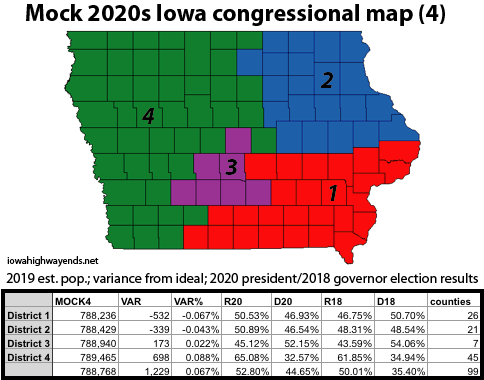
Mock 4: The Marshall County Dangler
District 1: A pretty competitive southeast quadrant resembling with only four counties different than that of the 2010s 2nd (Iowa, Poweshiek, Marion, Ringgold). This would be exceptionally ripe for a rematch of the 2020 2nd District race, and please don’t come after me if it happens.
District 2: Almost a perfect quadrant, and also extremely competitive, filling in a little from the 2010s 1st District and adding Cerro Gordo County.
District 3: I tried really hard to keep Polk and Dallas together, only to not quite get flush on the eastern border. We might be able to come back to this one after the 2020 estimates come out.
District 4: When the LSA creates maps and one county sticks out in some direction, it’s typically connected to the rest of its district by a full county width (see the 1990s map). This has a half-county connection, which doesn’t look great and adds to the perimeter. The most amusing far-down-the-list byproduct of this may be, like in the 2000s, a different congressperson for each of BCLUW’s school buildings.
Posted in Maps | Comments Off on Mocking Iowa’s 2020s congressional districts (2)
Apr 05

‘Against Professionalism’

From the Cedar Rapids Republican, March 15, 1901:

Against Professionalism.

At the close of the football season last fall representatives of ten middle western colleges and universities met in Chicago and adopted a set of rules to the regulation of the intercollegiate athletics. It was called “conference of colleges,” and it was agreed those participating in the conference would live up to the rules and regulations adopted. It was further agreed the colleges would not compete with any outside college which did not observe certain rules and regulations laid down by the conference. The ten* colleges were Chicago, Illinois, Indiana, Iowa, Michigan, Minnesota, Northwestern, Purdue and Wisconsin. Twelve rules were adopted. Of those nine are required for the non-conference colleges. In Iowa Upper Iowa at Fayette and Coe at Cedar Rapids have made the required adoption.

The articles of agreement entered into by these colleges were aimed to exclude those colleges who continue to employ professional men in their teams. No consideration of money or gifts may be accepted by the players, they must be bona fide students and every precaution has been taken to keep the college athlete in the strictly amateur class.

Well, that settles that, then.

* An astute observer will only count nine in that list, and it’s too early for Ohio State to be on it. Either the Republican reporter or the conference was unable to accurately count members, an error the latter exhibits in the present day.
Posted in Sports | Comments Off on ‘Against Professionalism’
Apr 02

Your call cannot be completed as dialed, er, tapped


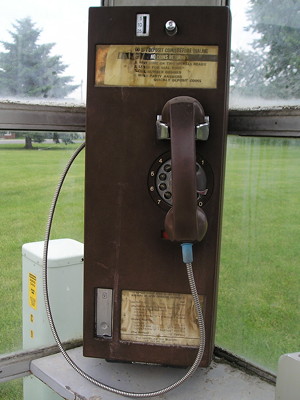
June 14, 2011: A (non-functioning) wonder of the ancient world in Winthrop. Awfully public for a changing room, don’t you think, Clark?

Another part of a simpler technological life is going away in two large swaths of Iowa.

According to the Des Moines Register, everyone in the 319 and 515 area codes will have to engage in 10-digit dialing for every number by October. (Actually, it might be 11, because of pressing 1 to dial out?) The creation of the national Suicide Prevention Hotline is pre-empting the 988 prefix used in two places: Hudson and a block of Des Moines cell numbers.

Of course, no one dials anymore. Few even mash physical buttons anymore. Storing everyone’s name on your phone eliminates the possibility of being one digit off and having a nice five-minute conversation with a wrong number — the number of a person you also happen to know.

This change will affect Traer’s half of Tama County and much of eastern and southeast Iowa for 319, and then Des Moines and many points north for 515. Toledo will still be able to call Gladbrook in seven digits, because they’re 641.

I’m in favor of area code splits instead of overlays, and Iowa has avoided them, but anyone in a place that got one has been doing 10-digit dialing. The 319 and the 515 are just being added involuntarily.

But might it have been easier to give everyone in Hudson a new prefix?

Posted in Iowa Miscellaneous | Comments Off on Your call cannot be completed as dialed, er, tapped
Mar 31

Is America slipping into a fat-jeans phase?

I must voice support for my millennial sisters who have spent much of this year having fashion choices heckled by the youth of Generation Z who wouldn’t know a pair of JNCOs if it walked up and said howdy. We shall not be dictated to by people wearing jeans with giant holes on the thighs. (See also this tweet compilation.)

On the other hand, we have these two stories that aren’t officially related, but might well be …

As consumers venture back into shopping malls and fill online carts, retailers say they’re adjusting accordingly by ramping up orders for spring merchandise and displaying wide-leg jeans and colorful tops more prominently. (Washington Post)

The American Psychological Association’s Stress in America pandemic survey polled 3,013 adults in the U.S. and found that the majority, 61%, said they experienced undesired weight changes. (CBS)

Perhaps the combination of a 15-month-old decade, new president and a desire to put the plague in the past is making things ripe for a change. I wouldn’t be surprised.

Look, if every grocery store in a 30-mile radius never has any of three Healthy Choice dinners I want, I’m totally justified if not obligated to pop in yet another pizza, right?
Posted in Uncategorized | Comments Off on Is America slipping into a fat-jeans phase?
Mar 30

License Plate Letters — KKJ

Let’s just skip a couple notches ahead, ‘k?

Posted in License Plates | Comments Off on License Plate Letters — KKJ
Mar 29

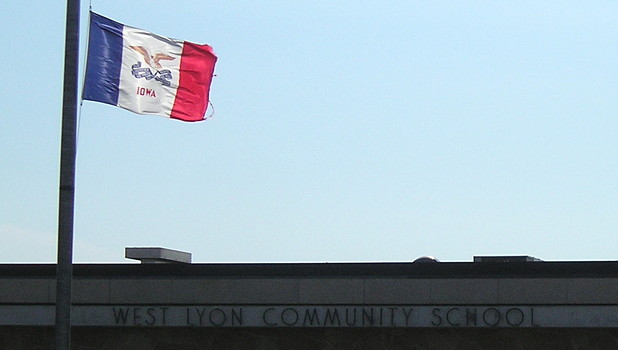
Happy 100th birthday, Iowa state flag!


July 21, 2012: The Iowa flag flies at West Lyon Community School, between Larchwood and Inwood, the northwesternmost school district in the state.

The Iowa Legislature made the Iowa state flag official on March 29, 1921, according to this story from Radio Iowa four years ago that marked when the flag was first designed. The 1917 sketch of the eagle with the state motto, from Dixie Gebhardt of Knoxville, is in the State Historical Society’s Iowa 101 mobile exhibit.

It may surprise you that in some corners, it was not well-received — not design-wise, but its very existence.

The adoption of a state flag by the general assembly was over the protest of Harper Post, No. 79, G.A.R., at Keosauqua, Van Buren County. When the bill was pending, drafted the Daughters of the American Revolution who furnished the design for the state flag, the Post of Keosauqua resolved “That this Post without a dissenting voice is unutterably opposed to the plan or suggestion now pending before the state legislature of Iowa for the adoption of a state flag or emblem of any description. That we believe such a course dangerous in the extreme. That there should be but one flag and that the good old Stars and Stripes, and none other, to which flag allegiance of all citizens of the United State should be required.
Wright County Monitor, March 30, 1921 (also printed in Winterset News, March 30, and Seymour Herald, April 14)

Iowa’s flag calls back to when the land was claimed by the French in the colonial period, although their influence in the area was minimal (but: “Des Moines”). It ended in 1762, when Spain took control, save for a short period at the turn of the 19th century just long enough for France to retake control and Napoleon to sell it.

Detractors aside, we should all be able to agree on one good thing about the Iowa flag: It’s not a blue background with a state seal in the center.

Posted in Iowa Miscellaneous | Comments Off on Happy 100th birthday, Iowa state flag!
Mar 25

Not like that

I try to keep this a clean blog, so I will simply say that last night’s Iowa State women’s NCAA game happened. ESPN said ISU had a 98% win probability with 39 seconds left. Probability, two dozen turnovers notwithstanding, does nothing against swallowed whistles.

This team was so wonderfully Iowa State, in so many senses of that. Why yes, of course our posts shoot 3s, don’t yours?

This team stumbled a few times, but they will be stronger next season. Three starting freshmen will become three starting sophomores. Ashley Joens will be a senior. Maybe, just maybe, there will be thousands of people in the stands again cheering them on.

Posted in Sports | Comments Off on Not like that
Mar 24

Women’s work in the Iowa Highway Commission (2)

Excerpted from “Main roads designed as 24-foot pavement,” by Ellen Landon, Ames Daily Tribune, June 9, 1953, with some cleanup:

The bridge design division makes preliminary layouts and final detail design and drawing and bridges or large culverts on a project.

“We have one department which is composed largely of women,” [R.C.] Boyd[, head of the design department,] explained. “It is the general drafting division. These women are very apt at making special drawings and also design smaller standard culverts.”

The final treatment of plans before they go on to the administration department for bidding comes in the blueprint room presided over by Walter Bappe. He has numerous pieces of interesting equipment including a big blueprint machine which operates by a photographic process. Here all plans are blueprinted in quantity so that bidders may have [text missing].

Not all the blueprints are taken away, however, for it is in this department that a file of every project undertaken is kept. Bappe takes pride in pointing to some drawings on file done by Former Chief Engineer Fred C. White when he was still in college.

==========

This historical excerpt and the previous one have implications for the research I do today. They show that women had a significant role in IHC documentation before computer-aided design (following, admittedly, work done by all-male crews). I am thankful to them for all their work, and of course I’m thankful that the 20th century Highway Commission/DOT is as good/bad at saving everything as I am.

Posted in Iowa Miscellaneous | Comments Off on Women’s work in the Iowa Highway Commission (2)
Mar 22

Women’s work in the Iowa Highway Commission (1)


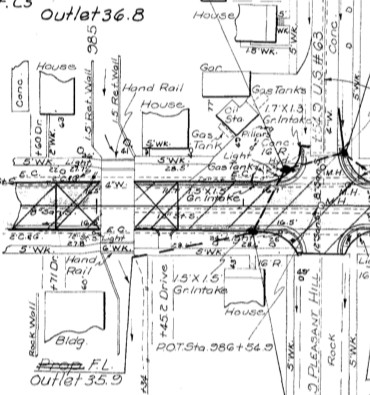
This clip of a blueprint for a project on IA 24 in New Hampton in 1964 is emblematic of the style used in Iowa Highway Commission documents from the mid-1920s to 1970s. Pre-1925 documents have more embellishment of some labels. Notice old US 63 on Pleasant Hill Street; the “oil station” building is there today.

“Women and Girls Help in Commission Drafting Rooms”, Iowa Highway Commission Service Bulletin, July 1918

Nearly twenty young women are in active training to do drafting work in the drafting room of the State Highway Commission. So many of the young men trained to this work have been called to war and so many sent out to do actual field work that it became necessary to take radical means to keep the work of this important department in pace with the needs.

W.T. Ide, of the manual training department of East High school in Des Moines, was secured for the vacation period to train a number of young women to do this work. As soon as an individual shows proficiency, she is given actual drawing work. Many more applications have come in than can be accommodated, showing great interest in this new line of work for women.

The success of the experiment so far has been such that is is freely predicted that much of the work of the drafting room will continue to be done by women.

(Transcribed from the PDF digitized on Google.)

Posted in Iowa Miscellaneous | Comments Off on Women’s work in the Iowa Highway Commission (1)
Mar 19

Photo 38,000

September 26, 2018

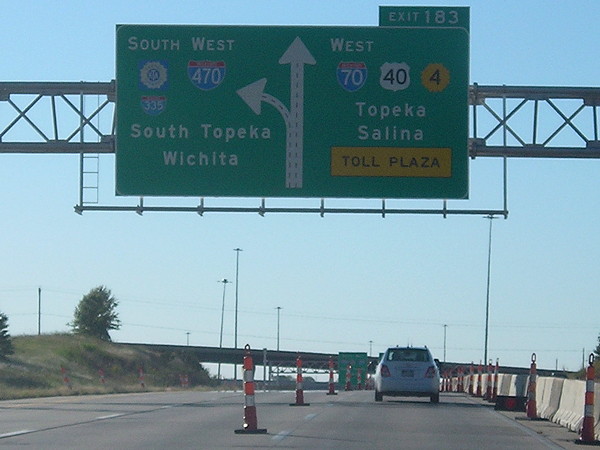
Well, they can’t all be winners. This is on the Kansas Turnpike at the somewhat recently reconstructed I-70/I-470 split on the east side of Topeka, on a weeklong vacation to the Dallas-Fort Worth area that included significant portions of US 81 and US 67, in addition to every remaining interstate in the “DFW Metroplex”.

Posted in Sequences | Comments Off on Photo 38,000