Jul 29

Final Mediapolis bypass meeting tomorrow

What should be the last meeting about the US 61 Mediapolis bypass will be tomorrow night at the elementary school there. PDFs available already here.*

Three years ago, residents voiced their concern or opposition to only having one interchange, on the west side of town at H38, and no access to new 61 on the north or south ends. (All of the four-lane will be shifted at least slightly from the current two-lane.) But the DOT has stuck with the one-interchange plan.

In the most recent five-year plan, the bypass will not be finished until 2024 — more than a quarter-century since the state started to seriously make plans for four-laning US 61 across the state.

* I appreciate that the date of the meeting is in the file name, but a (YY)YYMMDD convention would help out for archive purposes, rather than MMDDYY. Yes, I realize that was a very geeky sentence. The explanation of the difference is equally geeky (and annoys the Brits, so it’s not all bad).

Posted in Construction | Comments Off on Final Mediapolis bypass meeting tomorrow
Jul 26

The Army convoy stops in Denison

The Army cross-country Lincoln Highway convoy got to Denison on Saturday, July 26, 1919, and would spend Sunday there as a rest day. Here’s part of the Denison Review‘s coverage in the next week’s paper (“train” refers to the trucks in the convoy).

“After reaching Denison, camp was quickly established in the park, and people began an inspection of the train. All during the afternoon, there was a continual stream of people go­ing to and from the park. Of course the train carried its own kitchen and during the supper hour, there was a very large crowd of spectators around the kitchen, watching the work of pre­paring the meal for the 250 men. And while the men were waiting the sup­per hour, they were at work inspect­ing the trucks and equipment, and the officers were busy filing reports to headquarters.

Saturday evening the band accompanying the Goodyear truck, rendered a concert on the court house lawn and thousands of people gathered and enjoyed the music. Account of the automobiles around and near the court yard revealed the number to be some­thing over six hundred cars. After the concert, the committee announced a public dance on the pavement and space was cleared on the street be­tween Center Street and Broadway and hundreds of people enjoyed the dancing. Music was furnished by the Hains’ orchestra, and young ladies were chaperoned by delegates from the Woman’s Federated Club, and the soldier boys and officers of the motor train, were given preference in dancing. Throughout the evening, the soldiers were treated to ice cream and cake and canteloupe, served by the ladles of the Federated Clubs of this city. The ladles of the local Relief Corps also added to the pleasure of the boys’ stay in this city by supply­ing them with some 1200 homemade cookies and cake, which were sent to the park Saturday afternoon.”

It wasn’t all fun and games though.

“The only episode which really marred the visit here of the transport train and which has cast some reflection on Denison, was the action of one of our local celebrities, who on more than one occasion has been in the police court.

The young man in question, and who we are sorry to say, was only recently discharged from the army, went down to Washington park Sunday with the evident intention of starting some trouble. He made some remarks to the visiting soldiers which were any­thing but complimentary, but the soldiers bore the insult rather than have trouble. Sunday night down on Broad­way, he met some of the visiting soldiers and again picked a quarrel with them, calling them vile names. The soldiers resented this and for a time it was feared that the local celebrity would pay dearly for the insult, but he managed to make his escape, but not until he had been struck in the eye by one of the soldiers. Officers of the convoy rushed to the scene, and order­ed the soldiers to return to the park, which they did at once.”

Posted in Iowa Miscellaneous | Comments Off on The Army convoy stops in Denison
Jul 25

The Ames bypass of the Lincoln Highway


November 29, 2001: Based on a photo at Hickory Park restaurant, this overhead sign on Lincoln Way at Kellogg Avenue pointing to Main Street in Ames had been around since the early 1960s. It didn’t last much longer after this photo was taken.

The original route of the Lincoln Highway went out of its way, sometimes almost comically so, to pass through as many towns’ business districts as it could. There was one place, though, where it did not take a turn — Ames.

Now, this might seem weird. After all, today’s Lincoln Way is practically one long business district. But what I’m referring to here is what’s now the “Main Street Cultural District” that runs between Duff and Grand avenues on the north side of the railroad. For the Lincoln to run there, the route would have to add two railroad crossings, one of which — at Grand Avenue — involves three tracks and wasn’t grade-separated until 1937-38.

When the 1919 convoy passed through, Ames’ last-minute attempts to divert the trucks onto Main failed. The Army went from Marshalltown to Jefferson that day on Ames’ Lincoln Way, passing by the Iowa State campus and then heading north to Ontario Street and west to Boone.

“Owing to the fact that no one in Ames had arranged a welcome for the train, that no one had been in communication with the commanding officer, no arrangements had been made for the train of 52 trucks and cars and six motorcycles to detour from the Lincoln way long enough to pass down Main street.” — Ames Daily Tribune and Evening Times, July 25, 1919

UPDATE 8/26: According to old notes, the sign at the top of the page was removed in early March 2003.

Posted in Iowa Miscellaneous | Comments Off on The Ames bypass of the Lincoln Highway
Jul 24

Lincoln Highway bridge project has two options

The 1919 Army Lincoln Highway convoy crossed from Cedar Rapids to Marshalltown 100 years ago today. Its route would have included the then-four-year-old bridge on the east side of Tama. Now, work on preserving that bridge is nearing financial and construction goals.

There is a $21,000 difference in two options for repairing the Lincoln Highway bridge in Tama, according to this story from the Chronicle/News-Herald. The more costly one would involve work on the approaches.

The story says there’s about $90,000 saved up, including historic preservation grant donations. More than half of that came a year ago from the Iowa Department of Cultural Affairs.

Posted in Tama County | Comments Off on Lincoln Highway bridge project has two options
Jul 23

The promotional importance of the Lincoln Highway convoy

This week is the 100th anniversary of the Army convoy on the Lincoln Highway across Iowa. The Iowa DOT, quoting the Eisenhower presidential museum, says the primary goal was “an exercise to test the ability of the military to move great distances over roads under wartime conditions.” The experience would color Eisenhower’s experience about highways and (along with the Autobahn in World War II Germany) be among his inspirations for the interstate highway system.

There was a lot of promotion going on in this trip — the military, the Lincoln Highway Association, the Good Roads movement in general, and the military’s suppliers. Here’s what one advertisement in the Clinton Advertiser on July 22, 1919, said:

“The cross country trip of this first motor transport convoy will, in its way, be as historic an event as the first trans-Atlantic flight. The Lincoln Highway Association has for many months been working with the War Department and offices of the Motor Transport Corps in logging the various routes from interior manufacturing centers to the Atlantic coast, and later in providing the necessary data for the first trans-continental trip. The run which started from the Capitol at Washington July 7th is being made by 65 army trucks, staff, observation, and reconnaissance passenger cars, motorcycles, ambulances, tank trucks, mobile field kitchens, mobile repair shops, signal corps searchlight trucks, and personnel-of 290 army officers-and men.”

The Willys-Overland ad made note of its vehicles’ roles — the pilot car, an LHA car, the film/photo crew, and the newspapermen. It was capitalizing on postwar spirit to promote upcoming passenger cars. The company’s 4-cylinder models would become the basis, 20 years later, for a “light-weight, four-wheel-drive, general-purpose (GP) US Army vehicle.”

The GP vehicle … or, the jeep.

Posted in Iowa Miscellaneous | Comments Off on The promotional importance of the Lincoln Highway convoy
Jul 22

When Floyd County voted for good roads

Floyd County joined the good-roads movement on July 22, 1919, when it voted by about a 3-2 margin for hard-surfaced roads. This vote would contribute to the future US 18 being continuous concrete from Algona to Charles City by the end of 1923.

The Rockford Register had this to say the next day about those, um, less-progressive counties.

“As a result of this action on the part of the voters of Floyd County, we will take our place as an organized community with the other alert and progressive counties of the state, which have already endorsed this hard roads movement.  Because of this action we have decided not to herd with the counties that propose to develop callouses on the rump and not on the shoulder. It should be a matter of satisfaction to us to know that in the case of some counties that have voted adversely on this proposition through automobile routes are being changed so as to leave them off to one side. This is simply a working out of the law of cause and effect, and the people of counties thus side-tracked, have themselves to blame.”

That wasn’t an editorial, that was the news story. Spicy!

Posted in Highway Miscellaneous, Iowa Miscellaneous | Comments Off on When Floyd County voted for good roads
Jul 19

Apollo 11 at 50: The end

OLYMPUS DIGITAL CAMERA
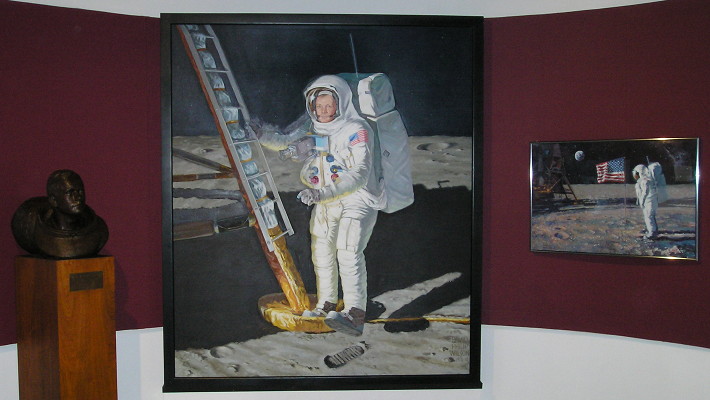
October 3, 2013: An artist’s rendition of Neil Armstrong’s first step on the moon, with his face visible, at the Armstrong Air and Space Museum in Wapakoneta, Ohio. Armstrong died in 2012 and was buried at sea. Only one-third of the men who walked on the moon are still alive.

I do not expect the United States of America to land on the moon in my lifetime.

Americans might return, eventually, but I think it’s likely they would be part of an international crew. But the nation that put so much from so many into making it possible for one man to take one small step doesn’t exist anymore.

It took just under eight years and two months from President John F. Kennedy’s call to Congress and the nation “to achieving the goal, before this decade is out, of landing a man on the moon and returning him safely to earth,” to doing precisely that.

It has been eight years, four months, and 11 days since the United States has been capable of putting a human being into orbit.

About the time I turned 9, I was told there was a plan of getting back to the moon by 2001 and Mars by 2015. So much for that.

For years, pundits and politicians asked, “If we can put a man on the moon, why can’t we do [pet cause]?” No one should be asking that anymore, because the correct question is “If we could put a man on the moon, why can’t we put a man on the moon?”

A moon mission requires a lot of things from a nation. It requires invested leaders who can occasionally think beyond — or not worry about — the next election, and are willing to do some back-scratching with people they strongly disagree with to achieve a higher goal. It requires an ability to withstand, overcome, or suppress a descent into tribalism; a vow to select the best people with as little regard for other factors as possible; the support of the man and woman on the street (or at least, enough to matter); unsurpassed domestic manufacturing capabilities; and the ability to undertake massive civilian and military infrastructure investments that go from plan to shovel in a time frame closer to 10 months than 10 years.

But most importantly, it requires people who believe in both their country and themselves to the extent that pushing the boundaries of the possible is seen as both their duty and their destiny.

When a nation like that is ready to act, the rest of the world will be watching.

Posted in Uncategorized | Comments Off on Apollo 11 at 50: The end
Jul 18

Apollo 11 at 50: The command module

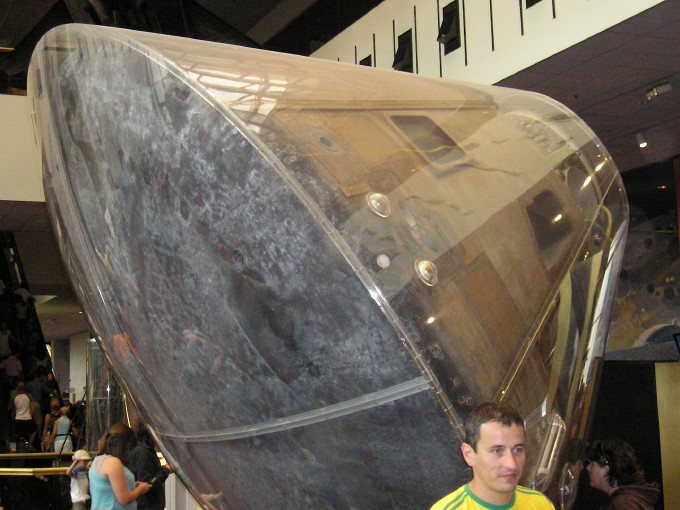
OLYMPUS DIGITAL CAMERAJune 28, 2009: Apollo 11 command module “Eagle” at the National Air and Space Museum, Washington DC. The heat shield after re-entry kind of looks like the surface of the moon, doesn’t it?
The command module is the one piece of the Saturn V rocket, one of America’s greatest engineering triumphs, that remains at the end when the astronauts came home. I have seen at least four of them:

  • Apollo 11 at the Smithsonian on June 28, 2009 (above).
  • Apollo 12 at the Virginia Air and Space Center on July 10, 2008.
  • Apollo 14 at Kennedy Space Center on May 29, 2009.
  • Apollo 16 at the U.S. Space and Rocket Center in Huntsville, Alabama, October 27, 2016.
  • Apollo 17 at Johnson Space Center in Houston on December 30, 2005.

I might have seen Apollo 8 at the Museum of Science and Industry in Chicago when I was much younger.

Major parts of the National Air and Space Museum are closed for long-term renovations, crowding out a chance to mark the 50th anniversary of the first lunar landing. We’re finally getting updates to an exhibition hall that, a decade ago, stopped the space timeline in 1981. (I covered some of this ground in a Des Moines Register column after Neil Armstrong died, but it has vanished into the ether.)

Posted in Uncategorized | Comments Off on Apollo 11 at 50: The command module
Jul 17

Apollo 11 at 50: A different kind of timeline

Consider the following.

July 20, 1869: The Transcontinental Railroad has been complete for 70 days.

July 20, 1919: The U.S. Army convoy taking the Lincoln Highway across the United States, “the largest aggregation of motor vehicles ever started on a trip of such length,” spends a Sunday rest day in Chicago. Over the next week it would pass through Iowa. The journey would take two months.

July 20, 1969:

January 20, 1982: It’s one-eighth of a century since the moon landing. About seven months before this date, MTV debuted using astronaut imagery. About a year after this date, the Apple IIe will be introduced and Time will name the computer “Machine of the Year”.

July 20, 1994: The space shuttle Columbia is on a mission above Earth. The first Power Macs are a few months old. Eleven weeks from now, the beta version of Netscape will be released, but you can already buy the first edition of The Internet Yellow Pages … in a book store, because Amazon.com won’t go live until almost exactly a year later.

January 20, 2007: Apple announced the iPhone 11 days ago.

Posted in Uncategorized | Comments Off on Apollo 11 at 50: A different kind of timeline
Jul 16

Apollo 11 at 50: Mission Control


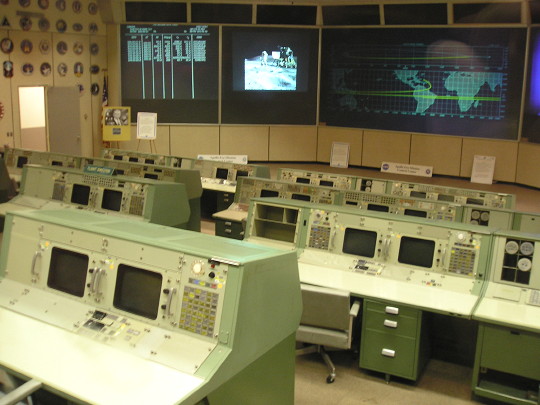
December 30, 2005: Apollo-era Mission Control at Johnson Space Center in Houston, Texas. Reused from this blog post.

Associated Press: Restored Mission Control comes alive 50 years after Apollo

Meticulously recreated down to the tan carpeting, gray-green wallpaper, white ceiling panels, woven-cushioned seats, amber glass ashtrays and retro coffee cups, Project Apollo’s Mission Operations Control Room never looked — or smelled — so good.

Posted in Uncategorized | Comments Off on Apollo 11 at 50: Mission Control