Jun 21

The rise of the 400-square-mile high school, part 2

OLYMPUS DIGITAL CAMERA
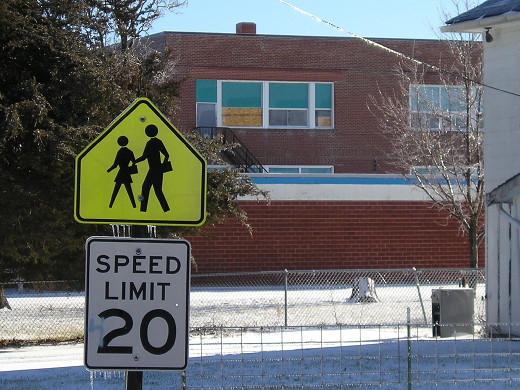
December 28, 2008: Every window in the Russell school building was boarded up shortly after the district was forcibly dissolved. Students in Russell now go to Chariton, which encompasses about 85% of Lucas County.

Lucas County was the home of John L. Lewis, longtime leader of the United Mine Workers of America. It’s perhaps fitting, then, that the Lucas County town of Russell would become the canary in the consolidation coal mine.

On March 11, 2008, the State Board of Education de-accredited the Russell School District because the district had exceeded its spending authority in multiple years and had issues with teacher certification. (A state audit later found $300,000 of local sales tax revenue had been siphoned off to pay salaries, which is expressly forbidden under Iowa Code.) Russell became the second school district in Iowa history to be forcibly dissolved, following Hedrick in 1991. Because 94.5% of the district was in Lucas County, the state simply gave all of that to Chariton (an additional 5% went to Wayne, 0.5% to Albia). In fall 2008, Chariton High School became the ninth in Iowa to cover an area larger than 350 square miles.

In 2009, the wave rolled through northwest Iowa and hasn’t abated since. Battle Creek-Ida Grove and Odebolt-Arthur engaged in whole-grade sharing, a consolidation that has yet to be finalized. Ten. Pocahontas Area and Pomeroy-Palmer did the same. Eleven. When consolidation followed three years later, Pocahontas Area — just barely — became the fifth district in the state to exceed 400 square miles.

In 2010, the last class graduated from Lineville-Clio High School and the Wayne district in Corydon gained that area. When that happened, that little bit of Russell ended up nudging Wayne past the 350 mark, too. Twelve. Also in 2010, South Clay dissolved. It was down to a K-6 district but other students went to multiple surrounding districts. Part of South Clay went to Sioux Central. Since Albert City-Truesdale had been sending grades 7-12 there since 2004, the high school in Sioux Rapids was now covering 372 square miles. Thirteen.

A year later, Titonka and Woden-Crystal Lake went their separate ways, and Titonka’s 91 square miles were attached to Algona’s 283. Fourteen.

Also in the Kossuth County area, where the population decline is especially steep, three districts negotiated the most ambitious whole-grade sharing plan since the formation of North Iowa in 1989. North Kossuth and Sentral of Fenton began whole-grade sharing in 2008 as North Sentral Kossuth, and then in 2012 Armstrong-Ringsted was folded in. Fifteen.

Their resulting three-way sharing agreement, called North Union High School, is a geographic giant, one-seventh larger than the Davis County district, covering 540 square miles. It runs 32 miles along the Minnesota border and extends down to US 18 just north of Whittemore. It brings together seven towns, none of which has a population above 1000.

There were two other large-area whole-grade sharing agreements in 2012: Southern Cal and Rockwell City-Lytton (South Central Calhoun), and East Greene and Jefferson-Scranton (Greene County). Five years earlier, they would have been notable for their size, but were now just thrown on the pile.

In those five years (2008-09 to 2012-13), any informal idea of just how big a school district should be changed. Forget 350 square miles. Rural areas were now looking at 400 — and beyond.

Area figures are based on numbers received from the Iowa Department of Management.
Posted in Iowa Miscellaneous, Schools | Comments Off on The rise of the 400-square-mile high school, part 2
Jun 20

The rise of the 400-square-mile high school, part 1

First in a series on the geography of, and changes to, rural Iowa school districts in the past 55 years, with emphasis on the last 15.

For nearly 50 years the number of places in Iowa where one high school served an area greater than 350 square miles could be counted on two hands. But as rural counties were drained of population and schools continually told to do more with less, whole-grade sharing and consolidation would send this number soaring in the early 21st century.

In this series, here are some things to keep in mind: A township is 36 square miles, a “3-by-4” county like those along the second-southernmost tier in Iowa is ideally 432 square miles, and a square “4-by-4” county is ideally 576 square miles. When the state of Iowa was first settled, a one-room school would typically serve one township. For more background on that era, there’s “Remembering One-Room Schools,” The Goldfinch, Fall 1994.

In one fell swoop in 1960, Davis County went from 62 districts including 48 one-room schools to one covering 474 square miles. Because Western Dubuque is actually a two-high-school district (Cascade is the other), the high school in Bloomfield covered the most geographic space in the state until 2012. Other long-lived large districts are Howard-Winneshiek (1960), Allamakee (1960), and Fairfield.

Maple Valley-Anthon-Oto broke the 350 barrier with a whole-grade sharing agreement in 1993. Mount Ayr followed in 1998 by absorbing part of Grand Valley and Van Buren did the same in 2002 with all of Fox Valley.

In 2005, a rarity in the whole-grade sharing process happened: The tiny CAL and Dows school districts, unable to make whole-grade sharing continue, went their separate ways. Dows searched for a new partner and ended up with Clarion-Goldfield. The new CGD was bigger than Fairfield. In the following decade, breakups of long-term whole-grade-sharing districts would become more common.

On July 1, 2006, 46 years after Davis County formed, the number of high schools covering 350-plus square miles stood at eight.

Then the floodgates opened.

Some information about Davis County’s consolidation comes from an October 1961 Associated Press article. UPDATE 1/21/22: Corrected year of Davis County’s formation.

Posted in Iowa Miscellaneous, Schools | Comments Off on The rise of the 400-square-mile high school, part 1
Jun 18

Apple gets a little tronc’d

*deep, exasperated sigh*

After 15 years as OS X, Apple’s Mac operating system is getting a new name. In the future, it will only answer to macOS, or its latest California-inspired codename, Sierra. The format makes it more consistent with other Apple OSes. [emphasis added]

The WWDC keynote on Monday spent about as much time talking about the iMessage app (BIGGER EMOJIS!) than on upcoming improvements to the Mac OS, which I’m going to keep writing that way because I do not hate my readers and because the English languages has rules that mean things for reasons.

Still have those old eBooks you’ve read? How about email dating back before the Destiny’s Child reunion? Those tens of thousands of iPhone photos can take up a lot of space in your 250 GB drive. macOS Sierra will push old, unused files to the cloud where you can still access them on demand, but your hard drive will thank you for the extra breathing room.

That last sentence is horrifying, and not just because it starts with a lowercase letter. Files on the hard drive, or an external hard drive, mean instant retrieval. Files on “the cloud” mean, at the very least, a lag time for the network, and that’s based on the assumption of an always-accessible, robust high-speed connection. What happens without one?? Apple doesn’t particularly seem to care. (Remember, Apple is showing some hostility to having dedicated USB ports, period.)

WWDC did nothing to dissuade the notion that Apple is firmly a mobile device company that happens to make computers, and those of us who want something more substantive than a Minnie Mouse watch face are the poorer for it.

Posted in Uncategorized | Comments Off on Apple gets a little tronc’d
Jun 17

The first step in six-laning I-35 to Ames

One of the heavily traveled rural Iowa interstate corridors that needs to be upgraded to six lanes takes a baby step in that direction on Monday. There will be a meeting then in Huxley about I-35 between Ankeny and Ames, the Ames Tribune reports. Construction would be about five years out.

Construction on the new Skunk River bridges accounts for three lanes in each direction (hence the new roadbed there), and six-laning I-35 between the Oralabor Road and NE 36th Street exits in Ankeny is part of a different project that would change the 1st Street exit to a diverging diamond.

Posted in Construction | Comments Off on The first step in six-laning I-35 to Ames
Jun 16

Infestation of roundabouts advances in Cedar Falls

Ewwww.

Posted in Construction | Comments Off on Infestation of roundabouts advances in Cedar Falls
Jun 15

An important meeting for Lincoln Highway history


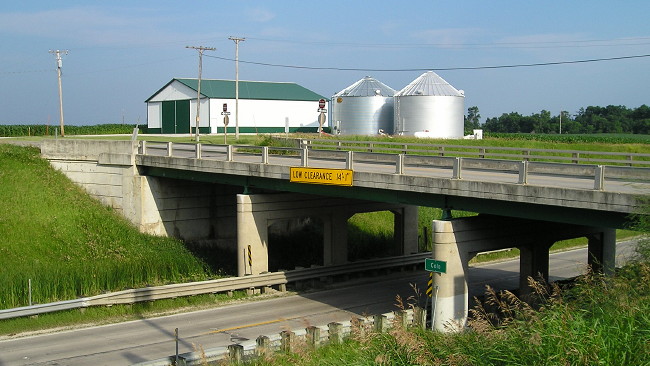
July 5, 2013: The Lincoln Highway (now Story County Road E41) passes over US 65 on the east side of Colo. Note the art deco styling of the bridge abutments.

The Iowa DOT is considering removing an overpass. It happens from time to time, although usually the case is taking out a bridge over a long-gone railroad. But this time, an important piece of Iowa highway history is at stake. This is what’s on the agenda for the meeting at Colo-NESCO High School on June 23:

Discuss the proposed project to either remove the existing bridge and raise the profile of U.S. 65 to meet the profile of County Road E41 or repair the bridge over U.S. 65. If an at-grade intersection is constructed stop signs will be placed on County Road E41. The profile grade raise of U.S. 65 will require approximately 2,500 ft. of reconstruction.

This is the Reed-Niland corner, the oldest and most historically important grade-separated intersection in Iowa. The bridge was built in 1938, nearly 20 years before the interstate highway system started. The Iowa Highway Commission created this grade separation in response to heavy traffic on the Lincoln Highway/US 30 and US 65. It’s not a pure interchange; the bigger curves in the northwest and northeast corners have two-way traffic, because until 1940 US 65 (and the Jefferson Highway before that) turned west to go to Ames and also because the concept of a diamond interchange as we know it today didn’t really exist yet in the United States. The famous and now-restored Niland’s Cafe sits in the spot between the northwest curve and the overpass. Raising the roadbed for US 65 shouldn’t affect it, since existing 65 is the sunk road.

In the meeting documentation (PDF), the first option of keeping the bridge, replacing the abutments seen in the picture at top, and adding a “low vertical clearance detection system” would cost $740,000. The second option, of taking out all the ramps and raising the US 65 roadbed to form an at-grade intersection, would cost $2,488,000. In the short term, at least, status quo is cheaper.

I think this is a spot where saving the bridge is worth the consideration in light of its historic importance. If an at-grade intersection is created, the location as it currently exists should be extensively documented for future generations.

Posted in Construction, Highway Miscellaneous | Comments Off on An important meeting for Lincoln Highway history
Jun 14

Studying which I-80 bridges to remove

Six-laning Interstate 80 across Iowa would necessitate replacement of every bridge along the way outside of the urban areas. As part of the Iowa DOT’s comprehensive statewide study of the interstate, it has studied which locations would have the least hardship if an existing bridge weren’t replaced and the road closed. One example that’s already in planning is 108th Street in Jasper County as part of building new bridges across the Skunk River.

Not surprisingly, Pottawattamie, Cass, and Adair counties have most of the bridges at lowest priority in the evaluation (PDF).

Posted in Construction | Comments Off on Studying which I-80 bridges to remove
Jun 13

License Plate Letters — ELK

“I’m an elk! Shoot me!”


Bugs Bunny – Duck! Rabbit, Duck! by bugs-bunny1

Posted in License Plates | Comments Off on License Plate Letters — ELK
Jun 10

The “worst names in Iowa” list

(alternate title: “I am a scientist. I arrange, design, and sell science.”)

Without a doubt, the “Iowa State University College of Human Sciences” is the most ridiculous name thought up in Iowa in the 21st century. Created in 2005 through the merger of the College of Family and Consumer Sciences (which, if you’re old enough, was Home Economics) and College of Education, it has nothing to do with the hard sciences and very little to do with the soft sciences — that’s what the College of Liberal Arts and Sciences is for. The Department of Human Development and Family Studies is about as close as it gets.

And now, it’s brought us this sentence, courtesy of an e-mail from the Alliance for Iowa State: “Pamela White’s four decades of service at Iowa State have helped the world to define what it means to be a human scientist.” First, if she has, it’s because some focus group came up with it only a decade ago! Second, are we referring to the fact she is a human or that she studies humans? (What about cat scientists? Should we contrast with a plant scientist, i.e. one who studies plants, or may be a human-plant hybrid?)

The College of Human Sciences can serve a springboard for a list of the what I think are the other bad names thought up for Iowa entities in the past 15 years. The list starts with the contingent representing Morrison’s Law of Team Names: The popularity of a sport’s league is inversely proportional to the number of team names that are not plural nouns.

  • Cedar Rapids Rampage, an indoor soccer team, which has now doubled down with an outdoor soccer team called the Rampage United. Like they do in Europe. Because it’s soccer.
  • Iowa Energy, the NBA Development League team in Des Moines. I was going to say, “If you haven’t heard of them, don’t worry, no one else has either,” but the team set the record for D-League attendance in its opening game and broke it in the 2011 finals. Then again, that’s not saying much.
  • Swing of the Quad Cities, which “was supposed to be a nod to the area’s rich jazz heritage” (so, uh, why not the Quad-City Jazz? Not a plural noun but at least a normal construction). Fortunately, the team is back to being the River Bandits.
  • Area Education Agency 267 (Area 2, Area 6, and Area 7). Every other AEA merger resulted in a non-number name, except for this one, and even the non-merged ones have other names now. AEA 267 overlaps with much of the northern part of the Cedar and Iowa river watersheds — “Two Rivers AEA”, there’s a perfectly serviceable name, and an allusion to being in the Land Between Two (other) Rivers.
  • Hy-Vee Heroes Game, along with its garish trophy, given to the winner of the Iowa-Nebraska football game. It’s big, it’s wood, it’s a manufactured rivalry (noble cause notwithstanding), and Hy-Vee dropped the Cy-Hawk series like a hot potato to create and sponsor it.
  • Iowa Department on Aging, the renamed Department of Elder Affairs. Most state departments use “of,” not “on,” and take note of the acronym it makes.
  • Community Choice Credit Union Convention Center, shoehorning “Veterans Memorial” back in on the building only. Not so much bad as it is long/unwieldy and the replacement for “Veterans Memorial Auditorium,” which isn’t an auditorium anymore.

(This blog post was drafted before Tribune Publishing announced its name would be changing to “tronc” — yes, lowercase, even at the beginning of a sentence in the press release — a name that would have shot to the top of this list if it had been Iowa-initiated.)

Posted in Iowa Miscellaneous | Comments Off on The “worst names in Iowa” list
Jun 09

Baxter gives Collins-Maxwell a deadline

The Baxter school district is telling Collins-Maxwell that progress on whole-grade sharing needs to happen by mid-July or Baxter “will begin exploring other sharing options,” reports the Newton Daily News.

Collins-Maxwell is going to be sharing some administrative positions in the fall but with Ballard of Huxley, not Baxter. Among those positions is curriculum director, a position that would better match a district that would engage in future sharing.

The Baxter board’s position is to have the high school in Baxter. Baxter is the largest town of the three, although the district has a smaller enrollment than CM.

On a side note, the construction of an interchange to replace the US 65/IA 330/IA 117 intersection would have a direct effect on daily life in a combined district, more than the athletic sharing already going on. Going between the towns involves crossing the 330/F17 intersection (old IA 223).

Posted in Schools | Comments Off on Baxter gives Collins-Maxwell a deadline