Jul 04

Liberty and law


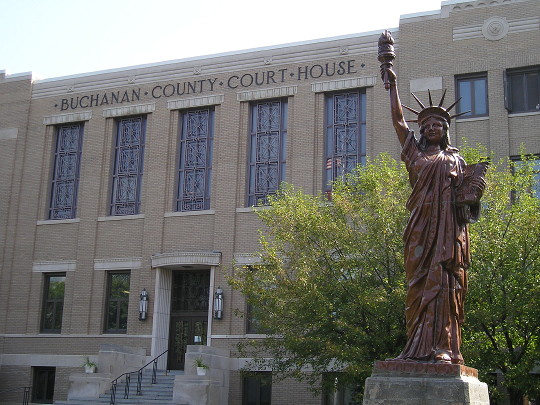
September 2, 2008: Replica Statue of Liberty (1950) outside Buchanan County Courthouse (1939) in Independence, Iowa (1847).

Posted in Iowa Miscellaneous | Comments Off on Liberty and law
Jul 01

Moving IA 17 off Lincoln Highway


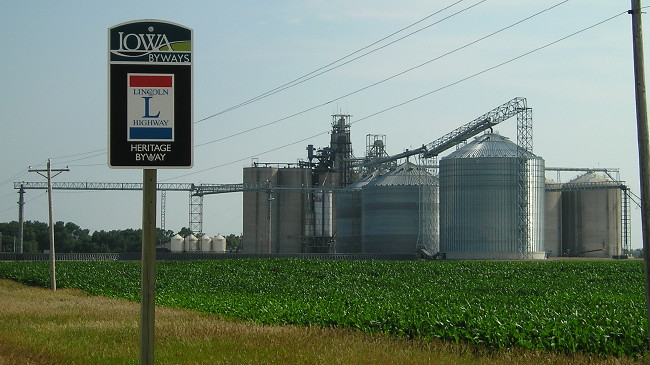
July 5, 2013: The original Lincoln Highway runs on IA 17 between E41 and 205th Street in Boone County. The elevator is part of West Central Cooperative.

There is a mile-long east-west segment of IA 17 that runs along old US 30, north of the four-lane, east of Boone. When IA 17 turns north again, there’s an at-grade railroad crossing right at a West Central Cooperative elevator. (The elevator is the last legacy of the town of Jordan.)

At a meeting earlier this week, the DOT presented options to reroute IA 17 in the area. All the options (PDF) have a railroad overpass with new connector to E41/old 30. One option has a gradual curve to line up the segments; the others keep right angles but the east-west segment would be north of the elevator.

The reroute is a good idea. Making IA 17 traffic turn at right angles is fine, and would be an improvement since the existing turn at the elevator is sharper than 90 degrees.

The signed Lincoln Highway Heritage Byway uses the 1913 alignment, crossing the railroad tracks back at R Avenue, going east on 205th Street, then south on IA 17, then east at Jordan, then crossing the railroad tracks again on U Avenue before heading east to Ames on 220th Street. That means it’s a north-south half-mile of 17 that is co-signed with the Lincoln, while it’s the east-west mile that used to be part of US 30. If the new 17 were to use 205th Street as its east-west mile (the “orange concept”), it would be the first time the Lincoln Highway in Iowa gained pavement in a very long time.

Posted in Construction, Highway Miscellaneous | Comments Off on Moving IA 17 off Lincoln Highway
Jun 30

Map of Iowa school enrollment changes, 2001-2015

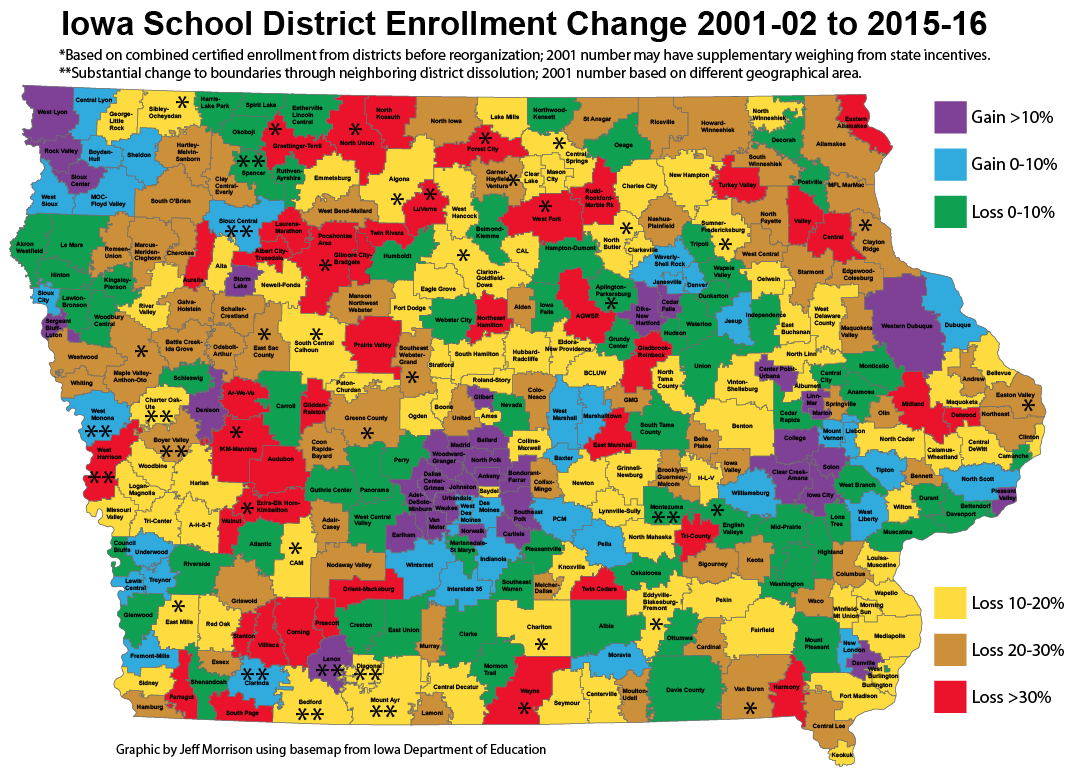
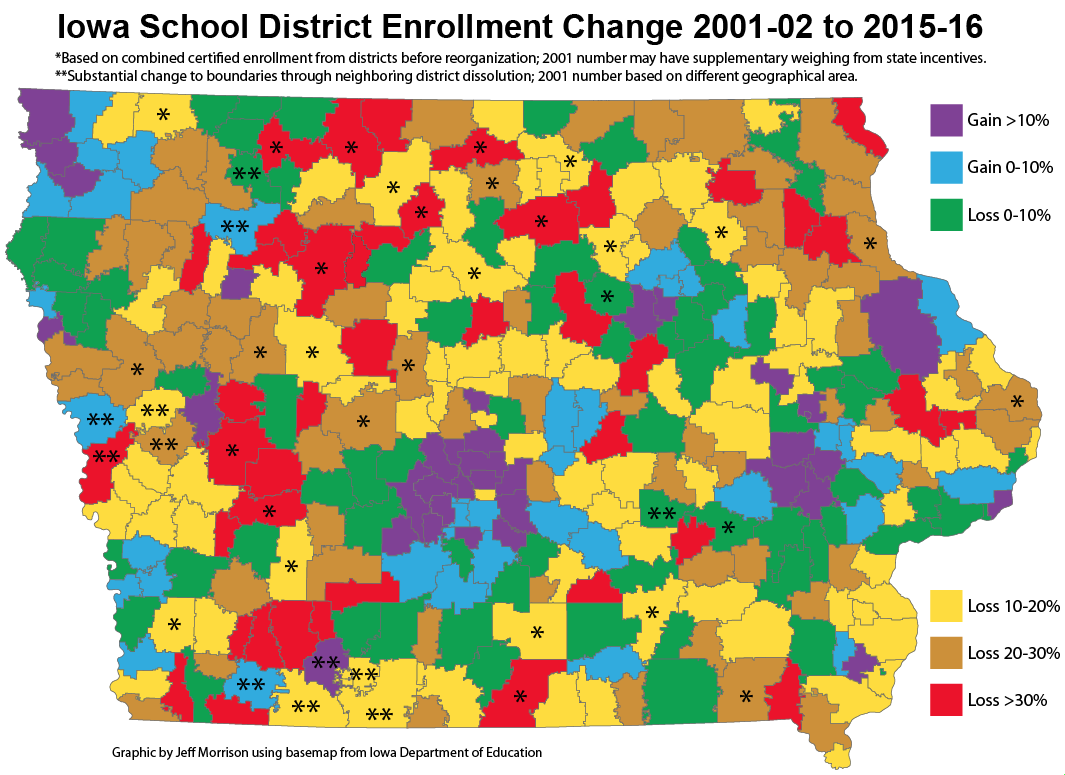
I have created a color-coded map of Iowa that shows changes in certified enrollment between 2001-02 and 2015-16. Certified enrollment is not a direct correlation with head count, because of certain formulas, but it’s the number used for all state purposes. (The best analogy is “official attendance” vs. butts-in-seats at sporting events.) The map shows a vivid representation of rural decline: With red, brown, and yellow showing the worst drops, it looks like a tree in October.

Map of Iowa school district enrollment changes, 2001-15 (names)

Map of Iowa school district enrollment changes, 2001-15 (outlines only)

Nearly all the districts that gained enrollment fell into three categories: Suburbs, exurbs (within about 30 miles of a city), and meat-packing plants (Denison, Marshalltown, Storm Lake, and West Liberty). A cluster of eight in far northwest Iowa is the largest exception. The few others that showed growth: Clarinda, Fremont-Mills, Lenox, Moravia, Sioux Central, and West Monona.

For districts that merged in this time frame, I added together old districts’ certified enrollments from 2001-02. This is not a perfect metric, since state incentives can “add students”, but the differences are so stark I don’t think the overall results are significantly affected. For example, Exira and Elk Horn-Kimballton independently had certified enrollments over 330 in 2001, but today’s consolidated EEHK is hovering around 400. Dissolutions are factored into the remaining districts’ numbers. (Russell and Corwith-Wesley are treated as mergers with Chariton and Lu Verne, respectively, given the overwhelming move of land to those districts.)

Of Iowa’s 336 school districts in 2015, compared with certified enrollments in 2001:

  • 35 gained 10% or more, with Ankeny, Bondurant-Farrar, and Waukee blowing the doors off everyone else.
  • 37 gained up to 10%. The most neutral-enrollment district is also the state’s largest: Des Moines’ certified enrollment changed by a net of 1.5, which is kind of remarkable.
  • 72 lost beween 0% and 10%
  • 85 lost between 10% and 20%
  • 65 lost between 20% and 30%
  • 42 lost 30% or more, including 33 whose boundaries never changed during this time.

While making this map I stumbled on a couple issues relevant to graphic design I thought I’d share:

  • I have six categories, so my plan was for a simple rainbow palette (the U.S. map on my “College conferences and House apportionment” page is like this except ROYPBG instead of ROYGBP). The orange felt too close to the red for a map like this where there are a lot of lines, so I switched to a brownish hue instead.
  • Because I have two positive categories and four negative categories, green is denoting a negative statistic. It’s the least worst (it’s the new “up”!) but since green connotes positive/go/growth, I had to think about it. I didn’t want to use a USA Today-style “shades of blue” set, and even the rainbow runs into issues of red-green colorblindness (as the NFL inadvertently discovered).
  • When maps and graphics were drawn before the desktop publishing era, hatch/line/dot patterns were used to convey different categories of information. See, for example, this map of population growth created in 1921. On such a busy map with detailed, crooked lines, patterns seemed to confuse more than illuminate, and “color-hatching” wasn’t an option. Solids were definitely the way to go.
Posted in Iowa Miscellaneous, Schools | Comments Off on Map of Iowa school enrollment changes, 2001-2015
Jun 29

Iowa’s largest enrollment gainers, 2001-2015

Statewide student enrollment over the past decade and a half tells a different story than a district-by-district breakdown: Rural areas continue to be drained of students while the gains are concentrated in the suburbs.

By the raw certified enrollment total, the state is about 5,000 down from 2001-02 to 2015-16 (489,522.8 vs. 484,378). That is actually a recovery from a valley in 2010. But here’s the change: The top 20 districts by enrollment now educate 42% of Iowa’s students, up from 38% in 2001.

From 2001 to 2015, six districts — Waukee, Ankeny, Iowa City/Clear Creek Amana, Johnston, and Southeast Polk — added nearly 20,000 students while the rest of the state lost 25,000. (I am grouping Iowa City and CCA together because, while Iowa City is much bigger, North Liberty and Coralville are split between them, and it’s the most effective way to get the total growth in the area.)

I was going to give year-by-year enrollment equivalents of these fast-growing districts for the last 15 years, but the lists got quite lengthy. To illustrate what I was going for, Waukee added the entire enrollment of North Tama to its 2003-04 student body, and then added the entire enrollment of North Tama again in 2014-15. Instead, here is the aggregate growth of 15 years and their equivalents. Between 2001 and 2015:

  • Waukee added the entire 2015 enrollment of Johnston, which is on this list in its own right below.
  • Ankeny added the entire 2015 enrollment of Ottumwa.
  • Iowa City/Clear Creek Amana added the entire enrollment of Indianola between them.
  • Johnston added Oskaloosa and threw in Orient-Macksburg for good measure. It’s building a new high school and the existing one will be turned into one for eighth and ninth grades.
  • Southeast Polk added the entire 2015 enrollment of Storm Lake.
  • The next two fastest-growing districts, Linn-Mar and Pleasant Valley, weren’t too shabby either, adding roughly the enrollments of Harlan and Boone, respectively.

As the rural districts drop in enrollment, per-pupil funding shrinks accordingly, and that’s not the only squeeze on the financial end. For a decade the Legislature has put education funding on meager rations — annual allowable growth below 3 percent means expenses outpace the budget. Keeping expenses down means, in turn, keeping salaries down, and the effect of that is that instead of hiring “lifers” small districts become the equivalent of triple-A ball or small network affiliates, a stopover place to pay one’s dues before moving on to a bigger gig. Rapid turnover has its own effects on education.

Posted in Iowa Miscellaneous, Schools | Comments Off on Iowa’s largest enrollment gainers, 2001-2015
Jun 28

Smallest districts of 1996 by enrollment — where are they now?

I have a map of the state of Iowa’s school districts as they were in the 1996-97 school year. As with any district map, it doesn’t reflect what sharing arrangements were at the time, but counting up the numbers then and now is another way to gauge developments in rural districts.

There were 24 districts in 1996 with a certified enrollment under 250. This fall, only four of that group — Diagonal, Luverne, Paton-Churdan, and Stratford — will be left standing. Only two, Diagonal and PC, have a high school. Thirteen were involved in mergers — including Prescott, which officially ceases to exist July 1 — and seven were dissolved.

There were 47 districts in 1996 with a certified enrollment between 250 and 400. Slightly more than half, 26, will still be around next fall, and 11 of those don’t have a high school.

Twenty years later, districts that formerly had much higher numbers have fallen down to take the place of the vanished. In fact, in 2015, there were 24 districts with a certified enrollment under 250, and 47 with a certified enrollment between 250 and 401. (Edgewood-Colesburg and Coon Rapids-Bayard flex the line a smidgeon.)

Posted in Schools | Comments Off on Smallest districts of 1996 by enrollment — where are they now?
Jun 27

Largest one-high school areas in Iowa

This is a list of the top 10 places in Iowa, by size, served by one high school, in five-year increments. In most cases, it involves whole-grade sharing followed some time later by consolidation, but in some cases there is only one-way sharing, where a district sends grades 7-12 or 9-12 to the larger school. Those cases are indicated by “plus” in the text.

NOTE 6/27/16: Western Dubuque, 554 square miles, has two high schools, Western Dubuque and Cascade. It has been the largest school district in Iowa since 1960. Areas are based on a list from the Iowa Department of Management, rounded to the nearest square mile (or tenth if necessary).

Fall 2001: Davis County, 463; Howard-Winneshiek, 426; Allamakee, 423; Mount Ayr, 383; Maple Valley-Anthon-Oto, 374; Fairfield, 359, Albia, 338; Benton Community, 332; South O’Brien, 305; North Iowa, 296.

2006: Davis County, 463; Howard-Winneshiek, 425; Allamakee, 423; Mount Ayr, 383; Maple Valley-Anthon-Oto, 374; Clarion-Goldfield plus Dows, 362; Fairfield, 359; Van Buren, 352; Albia, 338; Benton Community, 332.

2011: Davis County, 463; Howard-Winneshiek, 425; Allamakee, 423; Pocahontas Area/Pomeroy-Palmer, 402; Mount Ayr, 383; Maple Valley-Anthon-Oto, 374; Chariton, 374; Sioux Central plus Albert City-Truesdale (adding part of South Clay), 373; Clarion-Goldfield plus Dows, 362; Fairfield, 359.

2016: Algona plus LuVerne, 550; North Union (Armstrong-Ringsted merged with Sentral, sharing with North Kossuth), 540; Van Buren plus Harmony, 520; Southeast Valley (Prairie Valley plus Southeast Webster-Grand), 498; Davis County, 463; Mount Ayr, 425.4; Howard-Winneshiek, 424.6; South Central Calhoun, 424.3; Allamakee, 423; Webster City plus Stratford plus Northeast Hamilton, 422.

2021: MVAOCOU (Maple Valley-Anthon-Oto plus Charter Oak-Ute), 553; Algona plus LuVerne, 550; Pocahontas Area plus Laurens-Marathon, 549; North Union plus North Kossuth, 540; Van Buren County, 532; Southeast Valley, 498; Davis County, 463; Mount Ayr, 425.4; Howard-Winneshiek, 424.6; South Central Calhoun, 424.3. (Four more are in the 410-424 range.)

UPDATE 3/5/22: Now with fall 2021 numbers. Sometime between 2016 and 2019, Davis County and Van Buren swapped 11½ square miles, but I don’t know more. Also, Howard-Winneshiek and Mount Ayr got tweaked juuuust enough to switch places.

UPDATE 7/7/22: After some correspondence, I have updated the size of Davis County throughout. The Department of Education’s 2016 map and Department of Management’s 2016 database appear to have been in error.

Posted in Iowa Miscellaneous, Schools | Comments Off on Largest one-high school areas in Iowa
Jun 25

A note for summer parade organizers

PUT THE HORSES LAST.

Posted in Tama County | Comments Off on A note for summer parade organizers
Jun 24

Updates to the index page on the blog’s fifth anniversary


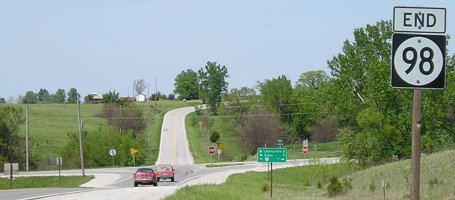
May 10, 2005: IA 98 is expected to be turned over to Van Buren County July 1.

There’s a front door to this place, although it has less action than the blog page. I haven’t done major work on the index since the first few months of this website, and there have been enough changes to the Iowa highway system than an update is necessary. So why not do it on (approximately) the fifth anniversary of my first blog post?

I started Iowa Highway Ends on Angelfire in 2001 and kept it there for years, then moved it to a mac.com site, and then moved it here when Apple shut that down. (Dale Sanderson told me my Angelfire site stopped working, but that appears to be the case only on certain browsers. How that happens, I have no idea. All of the images hosted by Apple are 404’d, but there are still a good many existing ones, showing how many have stuck around since the beginning of the previous decade. However, all of the pages that used to be in the /ia3/roadgeek directory DO appear dead.)

One part of this website update is that SOMEONE neglected to create any page for Business US 30 in Tama-Toledo. Those responsible have been sacked and the page created in an entirely similar style at minimal expense. What else has happened since mid-2011?

  • IA 370 is gone.
  • The state turned over IA 926 (Business US 169) to Fort Dodge.
  • IA 196 is dying and IA 471 is arriving. According to the state’s “Major Construction Projects” website, the reconstructed 196 opened at noon June 14 signed as US 71.
  • On July 1, IA 98 and 192 will be dead, and the rest of IA 934 will be dropped on Waterloo’s doorstep.
  • I’ve added in the secret numbers 404 (Business 75 in Le Mars, north of IA 3) and 461 (Business 61 in Davenport) to the main list.
  • Finally, to cover all 98* active numbers, I’ve thrown in the best-kept open secret in the state highway system. Which one? You’ll have to look at the index for yourself.

*In addition, there is a 99th active number to be named, covering those portions of US 6 and IA 192 that are not turned over to Council Bluffs. It could be “192” — certainly sensible for record-keeping purposes — or something else entirely.

Posted in Highway Miscellaneous | Comments Off on Updates to the index page on the blog’s fifth anniversary
Jun 23

The rise of the 400-square-mile high school, part 4


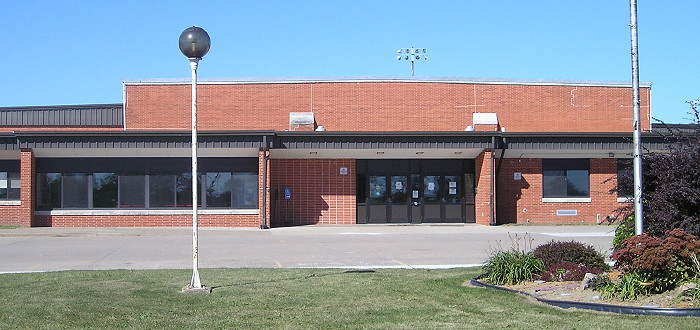
October 3, 2015: Harmony High School, a one-story building at the intersection of J46 and W46, will become the sole building for Harmony this fall, with all elementary students relocating here from Bonaparte. Junior high and high school students will go to Van Buren High School in Keosauqua, leaving one high school in the county from three in 2001.

In the early 2000s, Benton Community High School in Van Horne covered the eighth-largest area of any school district in Iowa. A student generation later, it won’t even rank in the top 25.

This fall there will be 13 places in Iowa where one high school serves an area larger than 400 square miles. Combined, they cover one-tenth of the land in the state. The 32 high schools overall that cover areas greater than 300 square miles will account for 22.2% of Iowa’s area.

The newest additions to the jumbo list come from southern and northwestern Iowa. This fall, the Harmony district will send grades 7-12 to Van Buren in Keosauqua, and Marcus-Meriden-Cleghorn and Remsen-Union will start whole-grade sharing.

Laurens-Marathon, whose inability to field a girls’ basketball team a year and a half ago kicked off a New York Times story about the power shift to urban areas in Iowa, still has a high school but as of last year is in partial sharing with Pocahontas Area. LM freshmen and sophomores spend a quarter of their day 15 miles away at “Poky”; juniors and seniors spend half. In those periods, Pocahontas Area is supporting nearly 550 square miles’ worth of high school kids, just like Algona. This fall Ar-We-Va, which brought together all its students in the Westside building four years ago, is going to start partial-day sharing with Carroll. (These are similar to what Paton-Churdan has done with Greene County, formerly Jefferson-Scranton, since 2004.)

This series has been all about numbers, but of course the numbers are only part of it. A story about a rural town losing its high school often is also a story about a town’s largest or second-largest employer shedding up to half its workforce. Then, when the junior high or an elementary is closed and students are condensed into one location, that town loses one of its largest employers. Students who once could walk to school now either drive or have to wait for the bus. There are longer drive times for sports teams (and the athletes’ parents). The growing distances can mean that maybe someone in the community who doesn’t have children/grandchildren directly involved decides it’s not worth driving to see an event when it’s 10 degrees outside. It’s created a paradox: Larger areas are bound together, yet tight-knit communities face a Great Unraveling.

The rapid increase in large-area high schools and, in course, large-area school districts should be sounding alarms about both depopulation and school funding. (Hmm… what are the rules on artificial noisemakers by groups at the state Capitol? Would an army of clanging cowbells serve to make a point? Because you always need more cowbell.) It also has effects on the growing urban-rural split in Iowa, because the voices for rural schools will continue to dwindle. One can envision some time in the future that a metro-area legislator will float a bill to force consolidations, and there won’t be enough people on the other side to stop it.

Next week: A look at enrollment.

Posted in Iowa Miscellaneous, Schools | Comments Off on The rise of the 400-square-mile high school, part 4
Jun 22

The rise of the 400-square-mile high school, part 3

OLYMPUS DIGITAL CAMERA
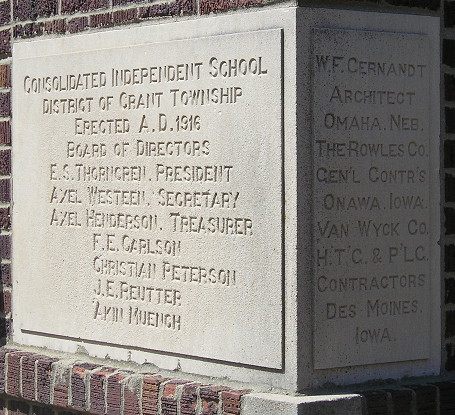
July 25, 2012: The cornerstone of the Boxholm school, last serving as Southeast Webster-Grand Junior High. The Boxholm school is not currently in use.

By the summer of 2013, residents of the Corwith-Wesley district knew their high school was a goner. Corwith-Wesley and LuVerne had voted in April to begin whole-grade sharing discussions with Algona. But when CW was asked how it could be a school district without students, the dissolution process began.

In 2014-15 the Des Moines Register embarked on its “Lost Schools” project, focusing on Corwith-Wesley’s dissolution and the first year of whole-grade sharing between Prairie Valley and Southeast Webster-Grand. Both of these cases dwarfed nearly everything that had come before.

In the September 2014 vote to dissolve Corwith-Wesley, 87.1% of the district was attached to LuVerne, and another 7.1% directly attached to Algona. (Algona Upper Des Moines, 9/4/14) The remainder, split off to West Hancock and Clarion-Goldfield-Dows, turned out to make a difference in the state record.

Algona, which had just finished digesting Titonka (and Burt a while before that), would now get CWL’s junior high and high school students. Algona High School now covers 550 square miles, from County Road A42 to the Kossuth/Humboldt county line and from Whittemore to southwestern Hancock County. It took the title of “largest area in Iowa for one high school” away from neighboring North Union, which had only had it for three years. However, a future consolidation with LuVerne, should one occur, would not result in Algona surpassing Western Dubuque as “largest school district in the state” because of the fraction of CW that went elsewhere.

Prairie Valley and Southeast Webster-Grand, as Southeast Valley, spreads across the southern half of Webster County, west to Rinard, and south to Fraser. It’s a hairbreadth away from being 500 square miles (498) and brings together a dozen towns.

The 2013 sharing arrangement for North Fayette Valley, at 355 square miles in northeast Iowa, was dwarfed that same summer in the opposite corner by Corning and Villisca combining to form 420-square-mile Southwest Valley. The following year Mount Ayr, which had made it into the 350 club by gaining land from Grand Valley’s dissolution, would enter the 400 club the same way, gaining land on its western edge through a crazy-quilt carve-up of Clearfield. The year after that, Northeast Hamilton gave up its high school, and Webster City, through that arrangement and a longtime one with Stratford, crossed the 400 barrier too.

If you threw the three new “Valley”s together — Southeast Valley, Southwest Valley, and North Fayette Valley, six existing districts, three high schools — you would have 1,273 square miles and a K-12 certified enrollment of around 3,000. In comparison, West Des Moines Valley High School has 2,200 students in three grades in 37 square miles.

To be concluded…

Posted in Iowa Miscellaneous, Schools | Comments Off on The rise of the 400-square-mile high school, part 3