
Posted without further comment.

Posted without further comment.
In the “Hmm, that’s funny” category, this weekend I was making sure that my long list of Iowa State football games vs. ranked teams synced with the university’s media guide. It did not. Two read-throughs later, there’s a good reason: The numbers were changed. Below is a screen grab of the 2012 (left) and 2010 (right) media guides for the 2006 and 2007 seasons.
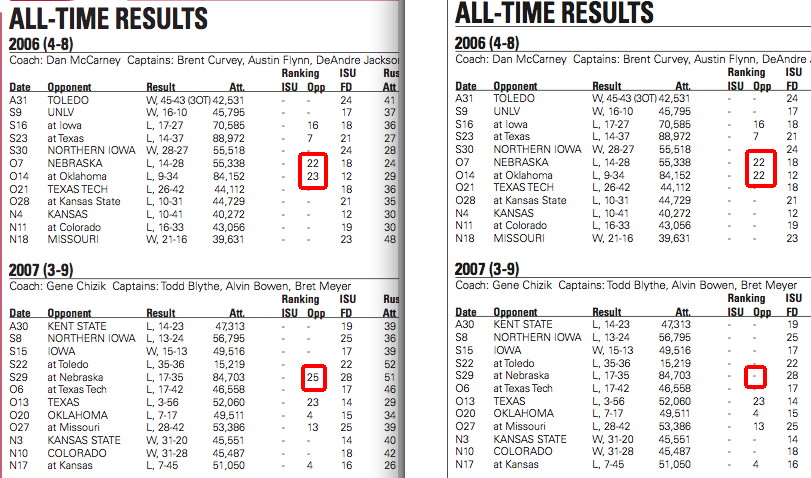
As you can see, 2006 Oklahoma has been bumped from 22 to 23, while 2007 Nebraska has had a #25 ranking added. The latter matches up with this chart. ESPN also archives polls going back a decade; here’s the poll for 10/8/06, before the Oklahoma game.
The kicker is that the final page of the media guide may not have been updated to reflect changes. My list has one too few #13s and one too many #14s compared to the record vs. each number, but 1972 Colorado has been revised to #14 instead of #13. According to the same historic poll tracker used earlier, that revision is wrong. (ISU is #18 in both places.)
Overall, very little changes. It’s not like anything was deliberately hidden. 2011 Oklahoma State remains the only victory against a top-six team. It’s just a little odd that such discrepancies would exist to be addressed.
It’s a short segment (Ellen Young is interviewed) of a story focused on a festival in Kansas. Traer is part of the larger picture of how some town festivals may not be completely in sync with their namesakes. In the grand scheme of things, it’s a pretty minor example since the festival moved a block over and had events beside the staircase for years.
Correction to WSJ article: It is the Winding Stairs Festival, not Stair.
In fact, as part of the initiation into being a Cyclone fan, you are required to be kicked in the groin at least once.
This is just outside of Iowa, but important to the southwest. (It also means I have to go back there and travel across it to re-clinch US 159.)
This Lincoln Journal-Star article errs in saying the bridge connects Richardson County NE to I-29 in Iowa. US 159 goes into Missouri and meets I-29 about 35 miles south of the state line, but then travelers obviously can travel north into Iowa from there.
The US 159 bridge is near the southeasternmost point of Nebraska and one of two bridges connecting Nebraska and Missouri.
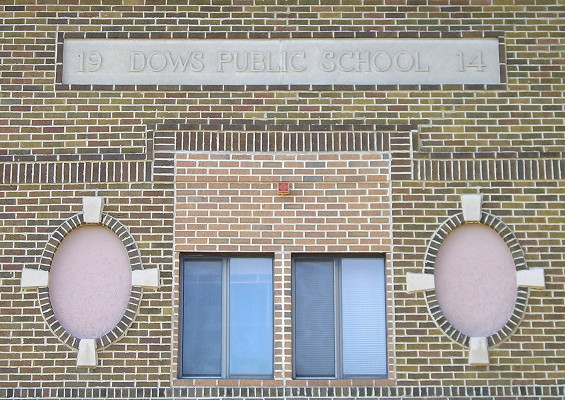
July 7, 2011: Brickwork detail on Dows’ original school building. It may not live to see its 103rd birthday.
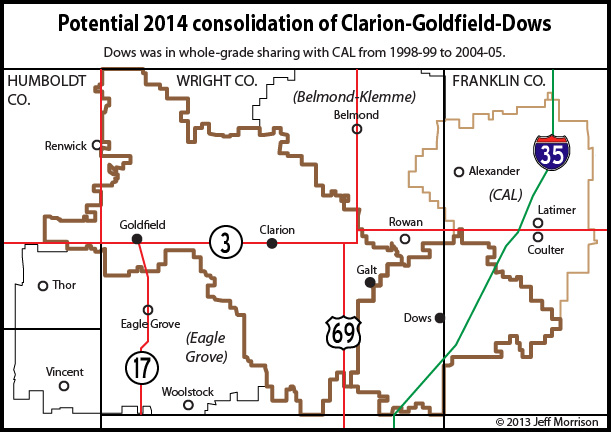
Dows hasn’t had its own high school since the late 1990s, when it entered into a grade-sharing agreement with northeastern neighbor CAL. It wasn’t long before continued declining enrollment had both districts studying options. They together looked toward Hampton-Dumont, to the east, but then Dows alone also looked north, to Belmond-Klemme. Southeast of Dows is Alden, but it was already in a whole-grade sharing agreement with Iowa Falls, ruling out talks there. Finally, Dows settled on a one-way deal with Clarion-Goldfield.
In 2004, Dows school board president Shelly Howard told the Mason City Globe-Gazette, “We’re the small fish in the pond and if we merge, we’re the first ones to shut our doors.”
A decade later, the small fish has run out of places to swim. A consolidation vote between Dows and Clarion-Goldfield is scheduled for next week. Approval would create the 12th-largest consolidated district in the state by area, half a square mile bigger than Van Buren.
Clarion-Goldfield doesn’t mince words when it outlines the plan (PDF). All students will attend class in Clarion, a change from not that long ago when Goldfield was still used as an elementary. Dows already only has grades K-3 in the 99-year-old building photographed above. If the new school district can’t find any use for the Dows building in two years, it will be destroyed save for the gym and multi-purpose room.
The plan would be to incorporate Dows into the name, a fact the newsletter points out likely would not happen in the case of a dissolution. Many in the area are familiar with what happened to Boone Valley of Renwick, one of only two voluntary dissolutions in Iowa between 1965 and 2004. That story made it all the way to the Los Angeles Times in the greater context of the farm crisis.
Wright County is southeast of Kossuth County, whose population and enrollment declines I have gone over in detail. The circumstances and effects apply here as well. Wright County lost more than 3,000 people between 1980 and 2010, around a fifth of the total population.
This bounced around the Internet last week: A map of college football fandom by county with the caveats that it’s only the top 25, and based on Facebook. This link is to the largest image I could find. The problem with such maps is that trying to differentiate 25 colors on something like this is very tricky to do and understand at the micro level. Some cross-hatching or dot patterns for some would have made for better legibility. As might be expected, the areas without top-25 teams have a varied quilt of team fandom. Here’s where fans in Iowa allegedly are looking when their own team isn’t falling flat on its face.
Indiana, central Illinois, and eastern Pennsylvania are hotbeds for the Figthing Irish.
(Warning: Long. Or long-winded. Your pick.)
1912 was an important year in the evolution of the game of football. The field was standardized to the length and width it is today, and the value of a touchdown was fixed at six points. It is also the last year Iowa State won a conference championship in football — and half of one, at that.
The Cyclones won their only two “conference” games, if you could call the loose confederation typical of the time a conference; Missouri played five. Nebraska also won its two conference games and shared the title with Iowa State. The two had shared the 1911 crown as well after a tie game.
When Iowa State closed out its last championship season against Drake, Nov. 23, 1912, Nebraska and Oklahoma played each other for the first time that very day. William Howard Taft was president. The U.S. flag had received its 47th and 48th stars five months earlier. Clyde Williams was in his last season as ISU’s coach. Some things and people in college football that didn’t exist the last time Iowa State won a conference championship:
