Jun 18

The longer effects of Iowa’s rural population decline

First in a series.

The Census Bureau released its 2017 county-level population estimates in April. It’s not a full decade, but it is seven data points, and the trend for rural counties may be even worse than it was.

The following statistics come from the Census Bureau’s final yearly intradecade percentage growth estimates for the 1990s and 2000s, and the 2017 data used for the 2010s. (Fortunately, the last was easy to obtain from the Census Bureau; the Iowa State Data Center has been next to useless for raw data since the decade began.) All years are fiscal (starting July 1 of the preceding calendar year).

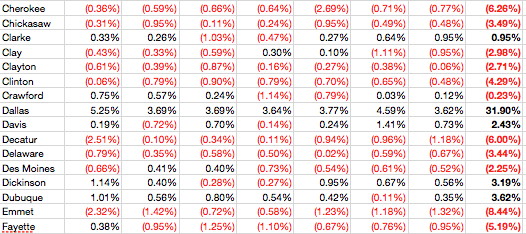
While Dallas County keeps winning (more on that in another blog post), much of the rest of the state loses…and loses…and loses. Here’s a sample of what it looks like for 2011-17 (with decade bolded at end), with Dallas County’s absurdities in the center row.
AlphaPopEstNearDallas

Most of those losses are below 1 percent, but that isn’t a salve. If you are, say, a county of 14,000 people in 1990 and lose an average of three-quarters of 1 percent a year for 20 years, then you become a county of 12,000 people. And if you’re still losing, 11,000 is getting closer than you’d like. You are, in fact, Cherokee County. Cherokee County has been on a once-interrupted losing streak for more than a quarter-century, losing 2700 people, or nearly 20 percent, since 1990. (That interruption was the April 2010 hard count vs. the July 2009 estimate, a nine-month period that in a sense reset the projections.)

In the 1990s, only three counties never had an estimated increase, while six more only had one. In the 2000s, that jumped: 12 never grew, and 13 only grew once. In the 2010s so far, a whopping 21 counties have never had an increase, and 25 more have only one positive year. There’s still time for those last two numbers to shrink, but not much.

The 1980s dip in real population, not just a lower percentage growth, has had repercussions to this day. To think about it compound interest-wise: If, starting with the 1980 census, the state as a whole grew by 1% a year, Iowa would have had 4,210,675 people in 2017 —likely good for six U.S. House members. At HALF a percent a year, it would be 3.5 million. Even if we moved that baseline forward, from the 2000 census, 1% growth would have led to about 3.47 million in 2017, and half a percent, a bit under 3.19 million.

But none of that came true. Instead, Iowa in 2017 had an estimate of around 3.146 million — an average 0.28% increase per year over a 27-year period, or 0.46% per year in a seven-year period starting in 2010.

In the first half of the 2010s, North Carolina grew a total of 4.3%, South Carolina grew 4.5%. Utah and its comparatively smaller 1.72% average growth rate this decade will be enough to pass Iowa even sooner than I thought should its gangbusters 2016 and 2017 numbers hold up.
Posted in Iowa Miscellaneous | Comments Off on The longer effects of Iowa’s rural population decline
Jun 15

Tama County Farm Bureau 100th anniversary

Tonight, the Tama County Farm Bureau celebrates its centennial with a dinner at the Traer Memorial Building. The Iowa Farm Bureau also turns 100 years old this year. Iowa Farm Bureau president Craig Hill will speak tonight.

The Farm Bureau organization and county Extension offices were co-organized until a “divorce” in 1951.

Posted in Tama County | Comments Off on Tama County Farm Bureau 100th anniversary
Jun 14

A Wisconsin town loses its school, and the New York Times is on it

Sound familiar?

But the reality of rural life in the Midwest, school officials say, is that younger people are fleeing. They want Starbucks and Thai restaurants, plentiful jobs and high-speed internet, and when they start families, they want schools with amenities and big, thriving athletic programs.

“In any small community, anywhere in this country, our kids grow up and move away,” said Mark Strozinsky, a River Valley school board member. “They go to college and get a job, but it’s not here, because the opportunity is not here. So who’s left here? Grandma and Grandpa.”

(Don’t read the comments. Never read the comments.)

Posted in Schools | Comments Off on A Wisconsin town loses its school, and the New York Times is on it
Jun 13

Is Fazoli’s sizzling or fizzling?

If you believe articles from an industry publication, the fast-casual Italian food franchise Fazoli’s is in good shape and plans to release “a completely clean food menu” this summer. (Because chemicals are bad, you see, and unpopular with the youths.) But with that is a restaurant revamp, and I’m wondering if some franchisees aren’t able to shoulder the cost.

I say that because the Fazoli’s on Edgewood Road in Cedar Rapids — the only one in a 70-mile radius — closed earlier this month. That means the nearest ones to the Corridor are singles in Dubuque, Moline, Ames, and Ankeny. A Fazoli’s in Fort Dodge closed earlier this year. One in Waterloo, open less than a decade, closed five years ago (as I said at the time, the location had great visibility but bad access).

Perhaps it’s my fault for not patronizing it, but on the other hand, eating them out of breadsticks has its own costs.

Posted in Iowa Miscellaneous | Comments Off on Is Fazoli’s sizzling or fizzling?
Jun 12

Sabula ferry service offered

Starting today, the Iowa DOT is offering “complimentary vehicular/passenger ferry service” across the Mississippi River from Sabula to Savanna. This would last at least through the summer because of the delays in construction of the overflow bridge. There’s also a transit service.

There is one other car ferry service in Iowa: A seasonal $15 ride from Cassville WI to Millville across a narrow part of the Mississippi, south of where the Turkey River flows into it. That’s about halfway between Dubuque and Marquette. It doesn’t get much publicity though, aside from its inclusion on the map.

UPDATE: Story and video from WQAD.

Posted in Construction | Comments Off on Sabula ferry service offered
Jun 11

Still lost in Younkers

IF
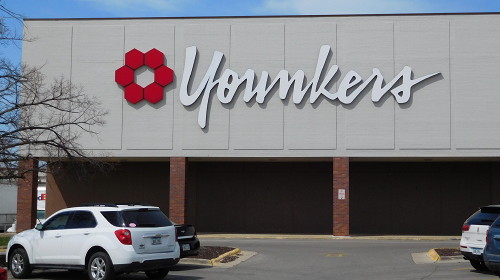
April 23, 2018: If you want to assemble a clothing collection, now’s the time; Lindale Mall in Cedar Rapids is having dueling down-to-the-walls sell-offs at Younkers and Sears. The upbeat tone of the “closing forever” radio ads is a little off-putting, though.

It’s interesting how the Iowa governor’s race and the “retail apocalypse” cross paths this year.

Gov. Kim Reynolds (advantages: incumbency, hair, heir to the ‘Stache) worked as a waitress at Des Moines’ downtown Younkers, back when there was a notion that a big-city department store could have a dining area. (Even the Waterloo Sears did, at first.)

Fred Hubbell (advantages: money, height, hair) was chairman of Younkers when it was a part of Equitable of Iowa, and both were based in Des Moines. While the Hubbell name is big in history and real estate — the diagonal road leading northeast from Des Moines is named Hubbell Avenue after the candidate’s great-great grandfather — it’s Des Moines-centric enough that he may get more mileage from his labor and activist group connections.

The common thread between them, then, is Younkers — one as labor, the other as management, with a party-swap twist. But while they’re touting their old connections, the chain itself, long divested from its Iowa roots, is having its name blotted from mall directories everywhere in bankruptcy. That itself could have an effect on the governor’s race as jobs and options are lost in Iowa’s midsize cities — by August, Ottumwa will be down to a Wal-Mart and a Kohl’s. (Although, realistically, the bigger issues will be things the Legislature did, like passing a tax cut while giving schools a 1% increase.)

Iowans are very, very reluctant to evict incumbents from the governor’s office, a guest columnist points out in the Register. (That goes for House members as well… except in wave elections, as I pointed out in 2012.) But this is a new race for Iowa in other aspects as well. Reynolds is the incumbent, but has never been at the top of the ballot; Iowa has practically zero experience with interim replacements. A female governor seeking to stay at the top is new, of course. There have only been two other women to be a major party nominee, Roxanne Conlin in 1982 and Bonnie Campbell in 1994.

Iowa is going to have a governor’s race (an expensive governor’s race) like never before. The 1st Congressional District has, by at least one metric, the most vulnerable Republican in the country. Voter sentiment in northeast Iowa’s Democratic-until-Trump counties will be the key for not just those races but as a national bellwether for 2020. It’s going to be impossible to watch “Jeopardy” live after Labor Day, and probably earlier, without drowning in mud.

UPDATE: For once I had a post slightly ahead of the news cycle.

Posted in Iowa Miscellaneous | Comments Off on Still lost in Younkers
Jun 07

What’s Russian for ‘nuance’?

I don’t/didn’t watch FX’s “The Americans” — or any “prestige TV” for that matter — but I happened to find the contrast in these points funny. (If, that is, the phrasing wasn’t supposed to be a tell.)

From the New Yorker:

I tried to make the Russian dialogue free of such anachronisms. Beautifully and strangely, the creators of “The Americans” indulged and even encouraged this quest for quality in a near-vacuum: only a tiny fraction of viewers could understand Russian at all, and a disappearingly small portion of this fraction would notice the Soviet-era purity of the Russian-language dialogue.

From Twitter:

Posted in Uncategorized | Comments Off on What’s Russian for ‘nuance’?
Jun 06

Current bypass philosophy, 61 corridor interests at odds

As late guests to the state’s bypass party, Mediapolis and Wapello are the beneficiaries of about 25 years of such work — or, depending on your point of view, the victims.

The “preferred alternative” for a four-lane US 61 from IA 78 to south of IA 92 was released earlier this year. The Louisa County Board of Supervisors, along with other government and public safety groups, are not happy with having one interchange to serve Wapello and all other access roads blocked off, reports the Muscatine Journal. The same thing happened two years ago in Mediapolis.

If US 61 had been four-laned in the late 1990s, there likely would have been at-grade intersections at either end of each bypass with an interchange in the middle like New London, or interchanges at either end skipping the middle like Blue Grass. A preliminary proposal for Mediapolis had two half-interchanges at either end of its much smaller bypass. But according to that 2016 AP story, “Multiple access points from freeways don’t fit with new construction guidelines IDOT follows.”

I can see Wapello’s point. There is no intersection between the proposed interchange and H16 four miles to the south, which is a big gap. The junction with old 61 could be turned into an intersection rather easily; an at-grade intersection with 65th Street nearby would eliminate the need for overpasses.

But I can’t blame the DOT for the cutoffs. As traffic in four-lane corridors increased, and drivers laugh off the speed limit (the Iowa State Patrol has had its budget whacked), accidents at at-grade intersections are numerous. Less than two weeks ago, the state was sued by the family of a motorcyclist killed at the US 18/218 intersection in Floyd, demanding “immediate” construction of an interchange. An EIS was done in 2016 (large PDF), and construction is planned for 2022; I’m not sure it’s physically possible to make it happen faster.

Posted in Construction | Comments Off on Current bypass philosophy, 61 corridor interests at odds
Jun 05

Kim Reynolds’ first ascension

The public notice page of the July 15, 1993, Osceola Sentinel Tribune started off with the minutes of the Clarke County Board of Supervisors’ June 30 meeting. Between a seasonal-employee hire and rejecting bids on care of the courthouse lawn was this resolution:

Kim Reynolds, Deputy in the Auto Department has been appointed 1st Deputy Treasurer at 80 percent of the Treasurer’s salary, to replace Sharon Dunfee who is resigning from the position, effective June 30, 1993.

The rise to top deputy put Reynolds in good position to run for Clarke County treasurer when that officeholder retired after the 1994 midterm elections. She won. And now, after a winding path, she’s the first female governor of Iowa.

Reynolds enters the 2018 technically-not-a-re-election campaign without ever having done a statewide debate, thanks to Ron Corbett concentrating more on sending copies of his book to small-county Farm Bureau officeholders than gathering petition signatures.

That puts nearly all the state/federal action today on the Democrats’ side. The governor’s race got scrambled with a warning against bumping, grinding, and early voting. Now that Republicans have broken the glass ceiling for Iowa at governor, senator, and speaker of the House, there are some who really want a female Democrat to take the 1st or 3rd District. (The EMILY’s List PAC endorsed Abby Finkenauer a year ago.)

(I found the Reynolds item when reading the Murray school board minutes on the same page. The board set up a meeting with Grand Valley on whole-grade sharing. Nothing came of it.)

Now it occurs to me that the Advantage Preservation archives for so many papers could be a gold mine for state-level oppo research. Is the proper response “Hmm” or “Oops”?
Posted in Iowa Miscellaneous | Comments Off on Kim Reynolds’ first ascension
Jun 04

US 400 is a deeply, deeply stupid highway


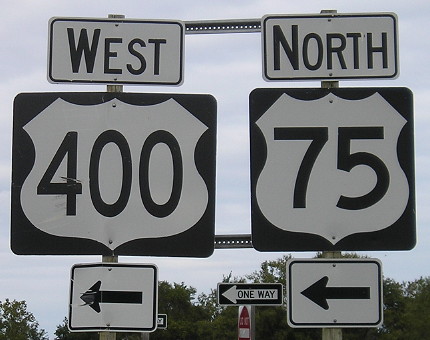
October 7, 2008: There’s a random 14-mile stretch of controlled-access two-lane US 400 in southeastern Kansas. This photo is in the middle of it, between Neodesha and Independence. Once 400 hooks up with US 54 77 miles west of here, it only has one segment of standalone route.

Dale Sanderson of US Ends ranted about one of most illogical, illegitimate numbers in today’s US highway system and I agree with all of it. A photo from me, taken New Year’s Day 2006, leads off his blog post.

US 400 is a top example in why control of US and interstate highway numbering should not be in the hands of bureaucrats (or congresscritters) and should instead go through a council of roadgeeks. It seems we care more about the integrity of the system than AASHTO does.

Posted in Highway Miscellaneous | Comments Off on US 400 is a deeply, deeply stupid highway