
Wanted in Rock Valley. (Sioux City Journal)
I’m sorry. After Friday’s news about Steve Ballmer, I couldn’t resist.
Wanted in Rock Valley. (Sioux City Journal)
I’m sorry. After Friday’s news about Steve Ballmer, I couldn’t resist.
Last month, on my first day of vacation, I listened to the hosts of “The Big Show” on WHO-AM talking about a uniquely Iowan part of their youth. “Watch out for the 77 cars,” their parents warned, “because those are the city drivers.” In those days, Iowa license plates included the county number on the left side; Polk is 77th alphabetically in the list from Adair to Wright.
Today, I become one of those “77” drivers. And that means time is up for something that has stuck with me for more than half of my driving career.
The numbers don’t have to be memorized anymore. In 1979, Iowa switched to a three-letter/three-number combination that had the full county name stamped on the bottom. The 1986 series of plates did the same. Starting with the design released Jan. 2, 1997, the county name changed to a sticker and then part of the print when the plates stopped being stamped. The alphabet sequences have now been randomized to the point that few long streaks belong to a single county or series of counties.
Last year, instead of creating a new background, the DOT announced it was keeping that same design and reversing the alphanumeric order. It also changed blue type to black and started putting slashes through zeroes. The first six years’ worth of 1997 series plates would be replaced in 2012 and 2013 and then on a rolling 10-year cycle afterward.
My license plate is three cars old, starting with the replacement for the one I drove in high school and college that was stolen in Omaha in mid-2003. No matter where I went, in all 99 Iowa counties, from the Rocky Mountains to the Atlantic Ocean, from the south end of I-35 at the Rio Grande to the north end of US 41 on Lake Superior, there was a tiny message that said THIS DRIVER IS FROM TAMA COUNTY, IOWA. (Even if, strictly speaking, that wasn’t true anymore.)
In its own way, that’s a pretty big thing. There aren’t many states that differentiate. There’s nothing official to tell apart a car first registered in Cairo, Ill., from one in Chicago, or St. Joseph and Ste. Genevieve in Missouri. (Nebraska puts names on the three largest counties’ plates and uses numbers for the rest; as you may imagine, Hooker County is reluctant to support switching styles.)
Wherever you are, wherever you go, that name at the bottom of the license plate is a reinforcement of the sense of place Iowans cherish.
According to the 2012 Iowa vehicle registration database, the 10 largest counties account for half the state’s registered cars and pickups. For every Tama, there are two Websters, 10 Scotts, and 26 Polks — three out of every 20 passenger cars/trucks in Iowa are registered in Polk County. At the same time, there are two Tamas for every Lucas and four for every Ringgold.
Today, I become a little more anonymous, a little more of a stranger in the place I grew up, a little more of a “city driver” to the outside world. All because of four little letters.
From today’s noon news. *buries head in hands*

So of course some of them were game for this football camp of sorts at Dike-New Hartford.
The first game of the season for some teams is this Friday.
There is nothing extravagant about this state.
Iowa rates in the middle tier of population and average income. It’s not a destination setting for outsiders, and there’s no big-city draw. Iowa’s weather is often frustrating, and other than a few rolling hills, it’s a ho-hum drive from one end to the other. Iowa is known for producing corn and soybeans, which fulfills a vital role in this country, but completely lacks flair. …
All this marries central Iowa to Paul Rhoads.
I’m not quite sure what to make of that allusion.
The Quad-City Times has an article on David Darby, who has led the effort to get old US 6 signed through parts of Iowa. It may be a little much to say he “found the old route through all these towns in Iowa,” since a 1979 map would show the pre-I-80 route except for between Atlantic and Adair. However, that would depend on how “original” he wants to get. (As I think I said earlier, “Historic US 32” would have been neat as well, but calling it old 6 ties it more into the cross-country road.)
Thanks to the U of I Library’s online publication of Huebinger guides, the 1912 River-to-River Route can be traced today, and I did part of that this summer. The River-to-River became US 6 east of Des Moines.
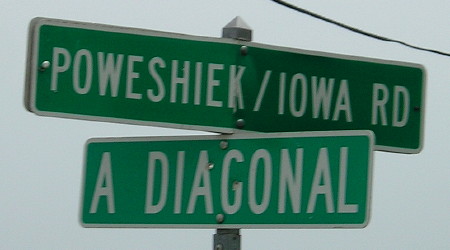
June 21, 2013: South of Victor on the original River to River Road. (The name is for the lettered street system.)
In no particular order:


July 5, 2013: Alphabetically, Ankeny and Arcadia are only separated by two towns. The demographic gulf between them, though, couldn’t be wider. Ar-We-Va closed its elementary schools in Arcadia and Vail in 2012 in favor of an addition at Westside.
Iowa politics blogger John Deeth did a “District of Day” series periodically between the 2011 redistricting and the 2012 election, where he evaluated the geography, political leanings, candidates, and horse-race status of each state House and Senate district. Because Ankeny had grown too large to be wholly contained in one House district, he dubbed House 37 “This is where your district went,” in reference to all the redone rural districts that paired up legislators because of declining population.
Ankeny Centennial High School opens today. It is the first new high school to open in Iowa since Davenport North in 1985-86. (Or, to be technical, the first that did not replace an already existing high school building.) West Des Moines should have split Valley 15 years ago, but didn’t, and is now building an 1100-seat auditorium, but that’s a subject for another time.
What do Deeth’s series and Centennial have in common? Much like Ankeny’s new House district came at the expense of rural Iowa, so too does Ankeny’s new high school. Iowa’s student population has been declining for years, and just as in state or national legislative allocation, that puts schools in a zero-sum game.
Today, there are precisely 90 fewer school districts than in 1985, a 20% decrease, running a reorganization gamut from AGWSR to West Fork. More than that, though, there are far fewer school buildings. Even among districts that have remained unchanged over the past three decades, small towns within those districts have lost what in many cases was the town’s biggest employer.
Here, then, is a list of those towns that I know have lost their only school building since 2000:
Arcadia, Callender, Chelsea, Crystal Lake, Cumberland, Denmark, Dumont, Elk Run Heights, Farrar, Goldfield, Hawkeye, Lineville, Lohrville, Lost Nation, Lytton, Menlo, Millersburg, Milton, Minburn, Montour, Moorhead, New Market, New Virginia, Onslow, Ridgeway, Ringsted, Rolfe, Rowley, Russell, Sabula, St. Charles, Shelby, Thornton, Titonka, Vail, Wesley, Woden.
For all the fancy, shiny things suburban districts have gained in the past decade, what’s happening elsewhere should not be overlooked.