Oct 25

Notes on second redistricting plan

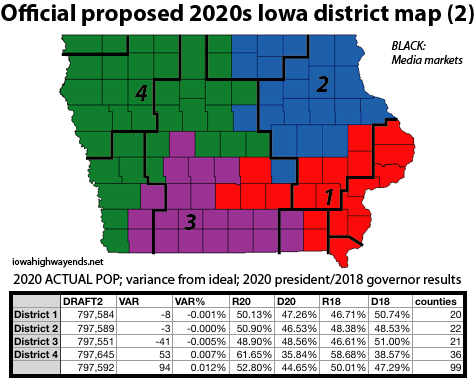
The second redistricting plan is out and has some surprises.

  • The LSA did not do what it did in the 2000s and use a different color for the district outlines in its second plan, because like in the 2010s it differentiated districts with background colors instead. I’m sure that precisely one person cares about this, and they’re writing this blog post.
  • Like the first draft, and unlike the 2000s and 2010s, the 1st District starts at Lee County and works out from there. That’s the way it historically worked.
  • The map has three Hubbell-Trump congressional districts, although it’s very close in the 3rd.
  • Will Mariannette Miller-Meeks go house shopping in Batavia or will there be an incumbent-on-incumbent mud-filled gold mine for central Iowa TV? (In which case, maybe watch WOI, because Tegna is now fighting Dish in addition to Mediacom.)
  • For the second time since adoption of nonpartisan redistricting, Tama County would be split between state House districts. Traer and Clutier wouldn’t have the same representative or senator. (That means that North Tama kind of gets two of each!)
  • This would be the first time any part of Tama County — in this case about the northeast fifth, including Traer and Dysart — gets grouped with Cedar Falls in both state House and state Senate districts.
  • The bulk of Tama County, including Clutier and Dinsdale, is assigned to House 53, which includes two present representatives: Dean Fisher and Dave Maxwell. (Maxwell’s farm is on IA 21 halfway between Thornburg and Deep River.)
  • The rural-towns part of House 76 is Traer, Dysart, La Porte City, and Mount Auburn. The suburban (or suburban-ish) part is Hudson, Evansdale, Elk Run Heights, Gilbertville, and Washburn. It’s those cities and the urban part — Cedar Falls south of effectively a University Avenue-Main Street-Greenhill Road line, plus Waterloo southwest of the intersection of Ridgeway and Ansborough avenues — that comprise the bulk of the population.
  • The current representative for the south Cedar Falls/Hudson district is Democrat Dave Williams. The companion House district is the rest of Cedar Falls, meaning Senate 38 will be the Cedar Falls/UNI district. Democrat Eric Giddens of Cedar Falls would be Traer and Dysart’s state senator.
  • Senate 38 is one of a very tiny handful of mid-sized districts, neither sprawling that much nor entirely concentrated in a metro area. It’s also one of the extremely few politically competitive districts, according to this trio of tweets.
  • The rest of Tama County is in a Senate district with Poweshiek, Grundy, Hardin, and the westernmost edge of Black Hawk counties. Republican Annette Sweeney of Alden would be their senator. This district is L-shaped because it forms the southwest portion of the 2nd Congressional District.
  • The two Senate districts that jump congressional districts are 24 (Boone, Greene, Guthrie, northwest Dallas counties) and 33 (Jones and Jackson counties, and most of Dubuque County outside the city of Dubuque).
  • 15 counties of the 4th Congressional District along the north and west borders make a self-contained unit of 10 House and 5 Senate districts.
  • In the 1970s, the bulk of the Des Moines metro fit into 10 state House districts. In the 2020s, it will take 15.
  • That Urbandale district (plus a fraction of unincorporated Webster Township to the east) remains unchanged.
  • Waukee and the Dallas County part of Clive form their own House district.
  • Robins’ city limits are outrageously absurd.
  • Coralville is almost its own House district.
  • Ankeny is its own Senate district (and Jack Whitver’s district).
  • 18% of the population in the 1st District is in the 4 counties of the official Des Moines media market.
Posted in Maps | Comments Off on Notes on second redistricting plan
Oct 22

North Tama football’s longest road trip

North Tama football lost by a combined 42-0 in its last two games, so the Redhawks are on the road for the “first round” of the playoffs. (I will not get used to calling round-of-32 the first round, let alone consider it “going to state”.) Tonight’s opponent, Wapello, will make for the farthest road game in North Tama history. Here’s a list of the longest road trips.

  • Wapello, 128 miles (postseason 2021)
  • WACO in Wayland and Winfield-Mount Union, 121 miles
  • Mason City Newman, 104 miles (postseason 2011)
  • St. Ansgar, 103 miles (first-time opponent 2021)
  • Riceville and Postville, 100 miles

Farther-flung state playoff opponents, including Central Decatur (158 miles) and Woodbury Central (206 miles) last year, came to either Traer or the UNI-Dome, an easy half-hour away.

It could be worse — GTRA, in northwest Iowa, plays tonight in Gladbrook, 180 miles away.

Kickoff temperature in Wapello (54) will be 9 degrees higher than in Traer (45), according to the National Weather Service.

Posted in Sports, Tama County | Comments Off on North Tama football’s longest road trip
Oct 21

More familial bragging

My brother is getting a Distinguished Alumni Award from the Department of Genetics, Development, and Cell Biology at Iowa State University.

My brother’s job does not involve anything in genetics, development, or cell biology, but he majored in it, so they’re claiming him.

The recognition ceremony will be livestreamed tonight and presumably available thereafter at this YouTube address.

UPDATE 10/25: Longer and more glowing press release.

Posted in Uncategorized | Comments Off on More familial bragging
Oct 20

Taking a run through every town

For all the hubbub about the two Nebraska guys going to every BUT NOT EVERY town in Iowa, there’s another cross-state trekker out there, and he’s doing it the hard way.

For the last six years, Tyler Sullivan of North Liberty has been running to reach not just every county, not just every incorporated place, but every dot on the state map.

When the Mason City Globe Gazette profiled Sullivan in April (link via Marshalltown Times-Republican), he had run in 84 counties. That included doing 21 miles in Tama County (but how do you even reach a mile in Dinsdale?). He did Marshall County in May.

According to the Estherville News on July 1, he’d gotten up to 90 counties and 913 towns (not specified as to type). At the end of August, the Le Mars Sentinel said “he even does the unincorporated communities like Seney.”

I tried to find Sullivan’s current status and came across a Facebook post from a page mentioned in one of the stories. He posted on Oct. 1 that he had approximately 150 places on the state map remaining, in eight counties, and would do them over the next two years.

When he completes that, he will to my knowledge be the fifth person to visit every incorporated community in Iowa, and the first to visit every map dot. Not even I got that granular, and though I might have a good percentage of the unincorporated villages, there’s no way I’m going to be driving from Sewal to Meyer any time soon.

Posted in Iowa Miscellaneous | Comments Off on Taking a run through every town
Oct 18

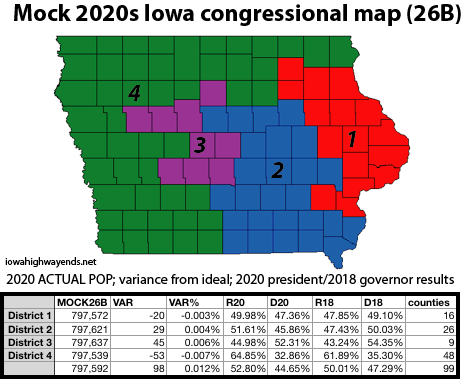
Mocking Iowa’s 2020s congressional districts (10)

Mock 26: The X-rated gerrymander

Is it possible to gerrymander Polk and Johnson counties together? There is, in fact, a workable (if no way compact) population-match district with that five-county span, plus Boone and Warren. Envision (or draw) it on a map and you’ll understand both the title and why I bailed on it immediately.

Obscene in a totally different way is the proposal for Illinois’ congressional districts.

Mock 26B: Perimeter parameter problems, possibly passable
District 1/2:
[raises eyebrow] Fascinating. Two Hubbell-Trump districts in mostly reasonable outlines, with Linn and Johnson.
District 3: Although Polk, Dallas, and Story are unified, it’s not a great shape at all, and it eats deeply into…
District 4: If the Legislature thought a Cresco-to-Hamburg district spanning “almost” half the state was bad, this one bumps it up a notch. Perimeter and compactness rules will probably sink this one, but the population variance is better than the official first plan — by 1.

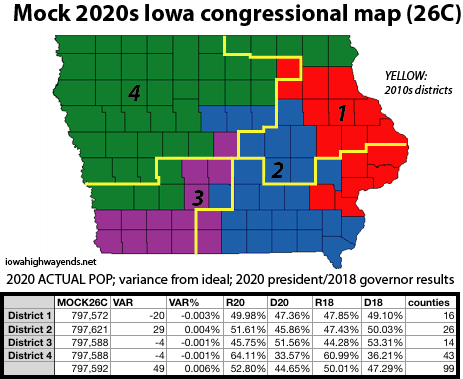
Mock 26C: The Story County snake
Districts 1/2: Same as the other.
District 3: I decided not to show 26A because while its variance was great in a vacuum (138), it’s more than the LSA’s first map. This one springs from that one, swapping Guthrie and Adair for Mills and Adams, but the outline of the 3rd makes Story County stick out like a sore thumb. At least Polk and Dallas are together. Pottawattamie has 5,000 fewer people than Story, preventing a slightly better-looking district. This district is a fever dream, but I’m not sure whose fever.
District 4: Woooow, look at those variances. The perimeter has minimal jut-ins from other districts. But the shape of District 3 harms this map overall.

The LSA intends to put out its second draft this week. Remember, in the state senate districts, there are a few complications required to ensure 50 senators do not face incumbent-on-incumbent matches.

Posted in Maps | Comments Off on Mocking Iowa’s 2020s congressional districts (10)
Oct 15

School timeline mega-update: Multi-high-school rural districts

For forward-moving history, it’s “and then the Sixties happened.” For this timeline, it’s “but first, the Sixties happened.”

These notes mostly, but not exclusively, relate to the middle of the 1960s as Iowa’s era of one-room schools ended and consolidated districts, many of which had formed over the previous decade, dealt with uniting under one roof — metaphorically and literally.

  • Despite an official deadline that required all non-high-school areas to be attached to a K-12 district by April 1, 1966, some stragglers hung around. These aren’t part of the Iowa Department of Education’s post-1965 reorganization timeline, but I think I’ve stumbled upon nearly all of them.
    • There was also the Amish school issue, and for that I’ll refer you to this Des Moines Register article from 2015.
    • Atkins wasn’t officially part of Benton Community until 1968 because there was an intense tug-of-war over whether to join Benton or Cedar Rapids (Cedar Rapids Gazette, 6/30/67, 3/7/68, 5/11/68).
    • On March 20, 1966, the Gazette had a compilation of area merger actions, which I have used to populate the 1966 section. On the same page was an interview with the UI Writer’s Workshop’s newest lecturer, Kurt Vonnegut Jr.
    • Future consolidations didn’t always take the whole district with them. A mile-wide strip of the Garrison district was moved to Dysart-Geneseo when the latter merged with Vinton in 1970 (Cedar Valley Daily Times, 2/5/69). Pocahontas Area lost 8.6% of Havelock-Plover (Pocahontas Record Democrat, 6/14/89).
    • It only takes a hint of imagination and extrapolation of actual events to come up with some alternate histories. Imagine, for example, 2021 with a combined North Tama/Dysart-Geneseo (with or without Garrison), a Shellsburg/Center Point/Urbana system (with or without Palo), and Allison-Bristow/Clarksville as the ABC School District (though it likely would’ve merged with Greene by now, like A-B actually did).
  • This period includes the rush of new high schools in Iowa’s largest cities — as many as the next five decades combined.
  • North Linn (Coggon, Troy Mills, and Walker) started in 1965 as, technically, a three-high-school district! All high school students were moved to Coggon in 1967 (Cedar Valley Daily Times, 3/8/67 and 8/14/67) before the present site just east of Troy Mills opened January 8, 1969 (CRG, 5/5/69). Construction got held up over whether the Linn County building code applied to schools outside incorporated places (CRG, 8/3/67).
    • North Linn’s superintendent and a rural Walker resident gently asked the Gazette sports section not to call the teams “Coggon” in articles (7/17/66).
    • Not to be outdone, South Hamilton had FOUR high schools for three years until centralizing at Jewell (Webster City Daily Freeman-Journal, 8/14/62), even maintaining separate basketball teams (DFJ, 1/20/62).
    • So did Benton Community for one year, 1964-65 (Blairstown Press, 11/19/64). Ironically, a full-page advertisement strongly opposing the reorganization (Cedar Valley Daily Times, 3/5/64) favored a larger area that is pretty much the present district.
  • Districts that are still around today were beginning to build centralized facilities. See North Linn, above. West Lyon closed all its town schools in 1967 for the place along IA 182 (Lyon County Reporter, 7/27/67). Tri-County in Thornburg opened its present building while using the old one as a junior high (CRG 8/28/66), but Gibson’s school was still around for some time.
  • While working on my April schools post, I learned that in 1987, the director of the Department of Education proposed mandating a minimum district size of 1000 students. It turns out the same man, Robert Benton, as Superintendent of Public Instruction, also made the same suggestion a decade earlier (DFJ, 2/3/77). Let’s just say that torches and pitchforks weren’t allowed in the Statehouse back then, either.
    • A syndicated Iowa Press Association press release in late May 1968 (Red Oak Express, 5/30/68) reported on a four-state project called the Great Plains project. Iowa’s representative proposed requiring a district minimum of 3500 students (!!!) with boundaries to be drawn by a commission by 1971. The Iowa Association of School Boards “soundly rejected” the idea (Cedar Valley Daily Times, 11/15/1968) and it died with a whimper in the first half of 1969.
      • The closest enrollment to 3500 today is Mason City, which is down 1000 from two decades ago.
    • In the 2020-21 school year, 111 districts had a certified enrollment above 1000, and 100 had a certified enrollment below 500.
Posted in Schools | Comments Off on School timeline mega-update: Multi-high-school rural districts
Oct 13

Auburn intersection becoming all-way stop

The intersection of US 71 and IA 175 on the north side of Auburn will be turned into an all-way stop later this month, the DOT says.

At this intersection, northbound 71 turns from northbound to westbound while IA 175 runs straight through. When I’ve driven in this area before, I was kind of surprised that the intersection wasn’t a four-way stop already.

CORRECTION: Daniel Drackley points out there is no road going north, so it is more accurately a three-way or all-way stop.

Posted in Construction | Comments Off on Auburn intersection becoming all-way stop
Oct 11

DOT taking ramps out of Sioux City interchange


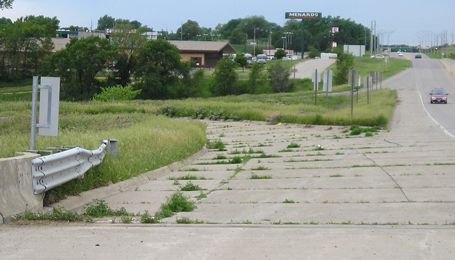
June 12, 2005: This “ghost ramp,” built in 1979 and never used, would have been for (future) southbound US 75 to eastbound US 20. Instead, this area will have its existing ramp removed for a stoplight around where the car is.

For half a century, construction plans and road openings have been geared toward making US 20 across Iowa a faster ride. But there’s a construction plan in the future that will disrupt that, just a bit.

The DOT plans on turning the US 20/US 75 six-ramp not-cloverleaf on the east side of Sioux City into a simple diamond interchange. (PDF from DOT; story on KCAUstory from Sioux City Journal) The interchange was built in 1979 with the objective of eventually becoming a full cloverleaf. However, when the US 75 bypass finally came about in 2001, the stubs were left alone and one of the loops was modified such that traffic had to stop at US 20.

But instead of upgrading the exit, the DOT wants what in my opinion is a downgrade. The plan is to take out the two inner loops and turn the ramp that flows into eastbound 20 into a ramp that serves both eastbound 20 and westbound Business 20 and comes to a stoplight. This will mean that travelers following eastbound 20 will have a stoplight, and westbound 20 will have two stoplights and a left turn.

In addition to changing the interchange, there are plans to smooth out the elevation between eastbound and westbound lanes east of the interchange. The lanes are uneven, though not nearly as much as US 75 in the Hinton area, because the segment is part of 20 built as two lanes in 1954 and “twinned” in 1964.

Dakin Schultz, District 3 transportation planner, told the SCJ, “It’s looking long-term, looking at the future and the growth of Sioux City towards the east.” Part of that is consolidation of area DOT facilities to a new spot at the northeast corner of the interchange. If eastward expansion of Sioux City is in the cards, downgrading the interchange and thus slowing down traffic does make some sense.

In other Sioux City news, KSCJ radio reports the DOT is “moving forward to develop a plan” to replace the Gordon Drive Viaduct. The core of the viaduct dates back to 1937, and we’ll just have to see if it reaches its centennial before its replacement is ready.

Posted in Construction | Comments Off on DOT taking ramps out of Sioux City interchange
Oct 08

School timeline mega-update: 1966-67


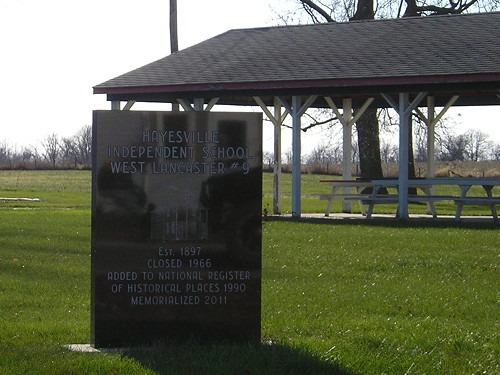
November 15, 2013: “Hayesville Independent School, West Lancaster #9, Est. 1897, Closed 1966, Added to National Register of Historic Places 1990; Memorialized 2011.”

The modern school district era in Iowa began on July 1, 1966. Starting with the 1966-67 school year, the entire state was supposed to have been reorganized into K-12 districts — 455 officially, including the newest, Dysart-Geneseo in Tama County.

It didn’t quite work out as planned. There was a big dash to the finish, but sometimes voluntary reorganization didn’t work, and county boards of education had to make the final decisions. If the disputed area was involved in court proceedings, everything was frozen in place.

I am not chasing after the last one-room or two-room school in every county, although that’s an interesting idea. However, any active in 1966-67 or 1967-68 are somewhat noteworthy, because they were the last remnants of the old system.

  • A smattering of unattached districts between St. Ansgar and the Minnesota border got assigned to St. Ansgar in 1966 (Mitchell County Press-News, 4/21/66). This resulted in the closure of the Otranto building.
  • Holland was attached to Grundy Center in 1966 (Grundy Register, 4/7/66). The school building was sold to the town before the school year ended and the district leased it back until the end.
  • Hayesville’s school closed in 1966, based on the monument placed at the site after its demolition in 2011 (see above).
  • In the Howard-Winneshiek district, Chester’s school closed during the 1966-67 school year, per the Lime Springs Herald‘s extremely helpful breakdown of what grades were going where (8/18/66; 10/5/66). A new school in Lime Springs, which closed in 2015, opened to replace one that partially burned in 1960 (Cresco Times Plain Dealer, 4/6/60). A replacement school in Ridgeway opened in the second half of the 1966-67 school year, resulting in seventh-graders shifting towns three times, Chester to Lime Springs to Cresco (CTPD, 12/28/66).
  • The school in Shipley, about 3 miles southwest of Nevada, was closed in spring 1967 before the year ended (Nevada Journal, 4/15/67). The building, old enough to have been a sight on the original alignment of the Jefferson Highway, and its later gymnasium remain intact and maintained.
  • Owasa, in Hardin County, fought until the bitter end, when the Iowa Supreme Court unanimously ruled that the state had the power to delegate final consolidations to county school boards (Cedar Rapids Gazette, 3/8/67). The district was divided 54.64% to Eldora, 31.55% to Iowa Falls and 13.81% to Hubbard (Waterloo Courier, 11/6/67).
  • East Union, which formed in 1959, acted as a two-high-school district until closing Lorimor’s high school in 1965 (Winterset Madisonian, 3/24/65). It closed the Shannon City school in 1967 (Madisonian, 12/14/66).
  • The school in Numa, which in the 1940s was one of the state’s girls’ basketball powerhouses, closed in 1967 (Centerville Iowegian, 1/25/67). So did the “Thirty” school, the last one-room school in Appanoose County.
  • Despite plans to reorganize in 1965, the Carroll Community School District didn’t solidify until 1967 because of a court case, and parts of Carroll County were not figured out until weeks before the 1968-69 school year began (Carroll Daily Times Herald, 9/8/65, 8/31/66, 7/3/67, 5/4/68, 8/6/68). Among the consequences, Templeton’s area was split between Carroll and Manning, and Dedham’s area was split between Carroll and Coon Rapids. However, both were only maintaining kindergartens. Parochial schools, plentiful in the area, skew both enrollment statistics and my ability to track closures, so I’m going to pass. Sorry, towns in Carroll County.
    • But I do know that Dedham’s school was torn down in the summer of 1972 (DTH, 5/2/72).
  • The Carroll issue tied up a chunk of the 19 districts reported as being in non-high-school areas as late as spring 1968 (Cherokee Courier, 5/29/68). Another batch in Kossuth County, including the town of Bancroft, was assigned to Swea City (Swea City Herald, 3/21/68). Of the rest, Marion No. 4 in Marshall County was involved in litigation over being mostly assigned to Marshalltown instead of Green Mountain (Garwin Sun, 1/6/67).
    • North Kossuth moved its middle school to Bancroft in 1993 following St. John’s elimination of grades 6-8 (Bancroft Register, 3/3/93; Algona Upper Des Moines, 8/26/93).
Posted in Schools | Comments Off on School timeline mega-update: 1966-67
Oct 06

Back to the drawing board

The Iowa Senate dropped more work on the LSA yesterday by rejecting the first proposed redistricting maps. The above map wouldn’t qualify for what the agency has been ordered to come up with — a total variance of less than 99, since each map must be better than the previous. But it’s very hard to get one district less than 99 off the ideal, let alone four of them.

Whether the first set was rejected for putting Linn and Johnson counties in the same congressional district or for creating too many incumbent-on-incumbent matchups in the Legislature, well, you’ll have to ask the state senators.

(In Mock 24 I could come up with two districts with variances of 60 and -2, but kept busting on the other two, usually around Kossuth County.)

Posted in Maps | Comments Off on Back to the drawing board