Aug 25

School timeline mega-update: 1985-89

I am breaking things up into five-year spans, which tells you how much information I’ve found, and how many schools were closing in the 1980s.

  • Doon’s school closed in 1985 (Lyon County Reporter, 6/26/85)
    • The closure was a two-year-long issue that included a threat by Doon residents to petition for dissolving the Central Lyon school district. It became THE factor in the school board election that September. A 67½-cent levy was collateral damage; it would’ve reached simple-but-not-supermajority status had Doon not voted 350-12 against (LCR, 9/11/85).
    • Doon’s threat did not make it to a vote, which to my knowledge still makes Gladbrook the only town to go that far.
  • St. Marys’ school closed in 1985 after an addition at Martensdale (Winterset Madisonian, 2/29/84)
  • Ocheyedan’s high school was demolished in summer 1985 (Osceola County Gazette-Tribune, 5/23/85 and 8/29/85)
  • Havelock-Plover shut down its high school in 1986 (Pocahontas Record Democrat, 12/11/85), three years before merging with Pocahontas. Its legacy is the black in Pocahontas Area’s school colors (PRD, 12/23/87). The Havelock school was closed upon reorganization and demolished before the 1989-90 school year began (PRD, 7/12/89).
  • Newkirk’s school closed in 1986 (Sioux County Capital, 8/7/86)
  • Nichols’ school escaped closure in 1986 (Cedar Rapids Gazette, 1/21/86) but got axed a year later (Columbus Gazette, 1/21/88).
  • Sumner’s original school, a junior high at the end, closed in 1988 (Sumner Gazette, 9/1/88)
  • Pulaski’s school closed in 1989 (Ottumwa Courier, 2/14/89)
  • The Panora town square school building was torn down in spring 1989 (Guthrie Center Times, 4/12/89), but there’s more to the story:
    • It was built in 1897 as a “county” high school, but that system ended in 1930.
    • It replaced and was distinct from the older school in the town square, which was originally built as the Guthrie County Courthouse before Panora lost a fight with Guthrie Center. Iowa: A Guide to the Hawkeye State (1938, reprinted as The WPA Guide to 1930s Iowa, p.506) conflates the two, but this postcard featured on a school alumni page shows both.
    • It remained Panora’s high school until a new one was built in 1974 (Guthrie Center Times, 4/6/88).
    • The school year it was torn down was the first for the Panorama district, a combination of Panora-Linden and Yale-Jamaica-Bagley, each of which had formed in the early 1960s (Guthrian, 2/21/61 and 10/1/61).
  • I could not find a year for Bradgate, only that it was still operating in 1973-74 (Pocahontas Record-Democrat, 1/3/74), but that led to other discoveries:
    • Talks between Gilmore City-Bradgate and Rolfe over sharing fell apart when GCB didn’t want to lose the high school (PRD, 12/21/88, 2/15/89). They shared athletics for one year but then Rolfe went with Pocahontas.
    • Newell-Providence and Fonda began sharing in 1989 (PRD, 1/18/89)
    • Rockwell City and Lytton began sharing in 1989 (PRD, 12/28/88)
    • Manson and Northwest Webster began sharing in 1990 (PRD, 3/28/90)
  • Olds’ school closed over Christmas break in 1989 (Mt. Pleasant News, 12/13/89)
Posted in Schools | Comments Off on School timeline mega-update: 1985-89
Aug 23

School timeline mega-update: 1990s


June 22, 2014: The Wayne school district’s midyear closure of the school in unincorporated Cambria in December 1995 is a crucial link in a discovery I explained weeks ago: It contributed to a streak of closures that predated the modern era and did not end until the 2020-21 school year.

Between the newspaper searches and the IDOE databases, I believe I have upwards of 95% of all small-town closures in the past 30 years.

  • Clay Central-Everly sharing has been corrected to 1990 (Hartley Sentinel, 12/7/89)
  • Milford Township school, 2.5 miles east of the I-35/E29 exit in Story County, was used by Nevada until 1991 (Nevada Journal, 5/30/91; Ames Tribune, 6/22/13)
  • Pella closed Leighton and Otley in 1992 (Pella Chronicle, 4/17/92; IDOE database)
  • Grandview’s school closed in 1993 (Wapello Republican, 4/15/95, via IAGenWeb), and I already had the building in Letts listed for this year. Big kudos to both the paper and IAGenWeb for doing and transcribing the series on Louisa County schools.
  • Ryan’s school closed in 1993 (Manchester Press, 10/13/92)
    • The building was less than 20 years old at the time. It was a replacement for one that was destroyed in a tornado on August 12, 1974.
  • The town of Bancroft gained public school students when St. John’s closed its middle school in 1993 (Bancroft Register, 3/3/93). The town only had kindergartners since its attachment to Swea City in 1968 (Swea City Herald, 3/21/68). North Kossuth would use the school for another quarter-century.
  • I have received confirmation that Cambria’s school in Wayne County closed in December 1995.
  • Elementaries in Elvira and Goose Lake closed in 1997 after an addition to Northeast High School in Goose Lake (De Witt Observer, 12/21/96)
  • Keswick’s school closed in 1997 (Cedar Rapids Gazette, 6/26/96)
  • Marcus’ original high school, by then only a third-grade building, closed in 1997 (Cherokee Daily Times, 4/24/97) and was demolished in February 1998 (Cherokee Chronicle, 2/26/98).
  • Paton’s school closed in 1998 (Scranton Journal, 4/15/98)
  • Hanlontown and Plymouth both lost their schools after an addition to North Central at Manly (Mason City Globe Gazette, 4/12/99 and 6/6/99)
Posted in Schools | Comments Off on School timeline mega-update: 1990s
Aug 20

School timeline mega-update: 21st century


June 24, 2017: The rear addition of the Arthur school building is close to the original’s style except for the color of the bricks.

Starting off with a bullet from earlier so the next one makes sense, and admitting a double-entry.

  • Closure of Auburn’s school has been corrected to 1992 (Carroll Times Herald, 12/18/91). Previous entry was incorrect due to an error in a 2014 Times Herald article (lost to link rot).
  • In light of the Auburn date issue, I went double-checking on Danbury. Its closure by the Maple Valley district in 2001 was confirmed through a school board member’s letter to the editor in the 5/24/01 Mapleton Press, as he promoted a bond issue that would result in Danbury getting a new K-5 building. The referendum got positive reaction in Danbury and nowhere else — crushed 3-to-1, with precisely one “yes” vote cast in neighboring Castana (Mapleton Press, 6/14/01)…
    • …which then lost its school in 2004, after a bond issue for a new high school building in Mapleton squeaked by with a nine-vote margin (Mapleton Press, 12/20/01).
  • Earlville’s school was demolished in June 2000 to make way for a new Maquoketa Valley elementary, “but it did put up a fight, as during the demolition process, a hole was accidentally opened up in the gym of the new elementary, after a section of the building fell the wrong way.” (Manchester Press, 6/27/00)
  • Luana’s school closed in 2001 (North Iowa Times, 1/2/02)
  • Grand Mound’s school closed in 2002 (De Witt Observer, 4/24/02), three years after its oldest building was demolished (DWO, 5/12/99)
  • Meriden’s school closed in 2002 (Cherokee Daily Times, 1/23/02) and was demolished in May 2003 (Cherokee Chronicle Times)
  • Harris’ school closed in 2004 (Osceola County Gazette-Tribune, 1/21/04)
  • Volga’s school closed in 2004 (Clayton County Register, 3/31/04)
  • Arthur’s school closed in 2005 (Ida County Courier, 9/17/03)
  • Welton’s school closed in 2005 (De Witt Observer, 6/11/05)
  • West Monona’s Central Elementary, the original Onawa High School, closed in 2013 (Onawa Sentinel, 12/27/12)
  • Mingo’s school closed in 2013 (Newton Daily News, 5/24/13). I believe this was the only one-site town I was missing from the past decade.
Posted in Schools | Comments Off on School timeline mega-update: 21st century
Aug 18

School timeline mega-update preview

Someone took the last shot in an official basketball game in the gymnasium.

Someone was the last student out the door on the last day.

Someone was the last school district employee to lock the doors.

When I started my school closure timeline a decade ago, I settled on 1980-81 for a start date, as a nice round number, as the year Corwith-Wesley-LuVerne started sharing, and because I figured it would be hard to go back farther. Since then, lots of Iowa newspapers have been digitized through Advantage Preservation. Months of research can be condensed into seconds. There are briefs and tiny headlines I never would have seen in microfilm but rapidly appear with a text search.

A few months ago, I decided to start seeing how much I could find. Now, I have what I believe is the most comprehensive compilation of school district evolution in Iowa.

Most of this work, sadly and expectedly, is related to closures — the year a tiny community lost its only school building. (I freely admit I am less interested in closures of sites in large cities, and only note them when I happen across them.) Demolitions figure into it too; consider that someone who graduated from East Greene High School a decade ago now has only the Rippey gym to revisit, and the district name itself has faded into history. Forty years of schools in Iowa can be summed up, although wildly oversimplified, in three lines.

  • 1953-73: The Boomers are coming! The Boomers are coming!
  • 1973-83: The Boomers are going! The Boomers are going!
  • 1983-93: The Boomers are gone! The Boomers are gone!

After looking at construction stories and the school timeline, one can see the pattern easily. A surplus of young children, plus the sweeping closures of one-room schools, bring about new one-story additions to hold them. By the mid-’60s and early ’70s, the wave flows into new high schools in Iowa’s largest cities and centralized sites for smaller districts. At nearly the same time, elementary schools noticed the first signs of a different complication: Generation X.

Decorah Supt. Wayne Burns said, “There’s no question but what the birth rate is down.” Central Community Supt. R.D. Buckner of Elkader, pointing to the pre-school census for Central, said, “Please note there is a distinct drop in 3-year-olds.”
— “Crowded classroom outlook varies in Iowa,” Cedar Rapids Gazette, October 15, 1967

Into the Carter-Reagan years, it was the farm crisis. Elementary-only sites in the 1980s closed by the truckload. The cascade of sharing and reorganizations in the last span was aided by state incentives, but mostly, so many schools just didn’t have the numbers anymore.

I’m going to share my findings in a series of blog posts, and then upload a new timeline page with all the new listings.

On a completely related note, Waukee Northwest High School opens next week. Waukee becomes the tenth city in Iowa to have two high schools, and the district will build at least four new schools in the next four years. If 700 new students show up there, as its superintendent speculates in the KCCI story, the new crop alone would be larger than more than half of Iowa’s 327 districts, rivaling Hudson or Panorama.

Posted in Schools | Comments Off on School timeline mega-update preview
Aug 16

Many state-level ‘poor’ bridges on replacement list

A few weeks ago, we got another round of stories about Iowa’s high number of “structurally deficient” bridges. This occurs regularly; I made a post five years ago about the bridge list then and their replacement timetables. As a reminder, “structurally deficient” does not mean “unsafe.”

A substantial percentage of Iowa’s less-good bridges are on gravel or even dirt roads, and many of those have an average annual daily traffic count at or under a few hundred. (Not in the latter group: Tama’s Lincoln Highway bridge, which is both poor and structurally deficient and is going to get $200,000 worth of work.)

I also wonder how many of the bridges called out in the National Bridge Inventory aren’t being used as bridges anymore. In Tama County, for example, the 360th Street bridge over the Iowa River west of Chelsea was closed in 2017. It shows up on the Iowa DOT’s “story map” of bridges as being in poor condition, structurally deficient, and closed. Also closed are every bridge on E Avenue northeast of Montour (which, for a short time in the 1950s, was IA 135 [II]) and two bridges in the city of Montour — one of which, on Elm Street, has clearly been abandoned for a long time. Those closures should eliminate six “structurally deficient” bridges from the inventory — right?

On the Iowa DOT’s “story map”, I have found 26 of the 34 state-maintained bridges listed in “poor” condition, and five of the six mentioned as being on the interstate system in the WHO story. The others either are in an area with a lot of bridges that I couldn’t spot without super-close zoom, or have just been replaced. I then cross-checked that list against the five-year plans.

  • Of the 26 bridges I was able to locate, I could not find replacement plans for eight. They include the Centennial Bridge (not going anywhere), two inside state parks, and E41 over US 65 in Colo, which was considered for removal a few years ago but saved due to its historic importance. Two bridges over I-80 in Scott County are also in this set, and I don’t know if those are counted as “on” the system or not.
  • Four are being replaced right now, and the I-280 bridge over the Mississippi River is being rehabbed.
  • Four will be replaced in FY 2022, including both I-80 bridges over IA 146. A fifth, on US 30 in Benton County, will be taken out in the four-lane project. A sixth, US 65 near Clio, has a “culvert repair” note but I’m mostly sure this is what’s being referred to.
  • Four will be replaced in FY 2023, including US 18/52 at Froelich that is original to the 1967 straightening of the road in this area.
  • Three will be replaced in FY 2024-26, including the Black Hawk Bridge in Lansing, which I just talked about, and IA 141 over I-29, which just had its (first?) public meeting in April.

Progress is being made to whittle down the list of bridges in need of assistance, so to speak, but the overall numbers in Iowa are going to remain high unless and until there’s an infusion of road fund money on the county level.

Posted in Construction, Highway Miscellaneous | Comments Off on Many state-level ‘poor’ bridges on replacement list
Aug 14

Mocking Iowa’s 2020s congressional districts (6)

Bonus Saturday post!

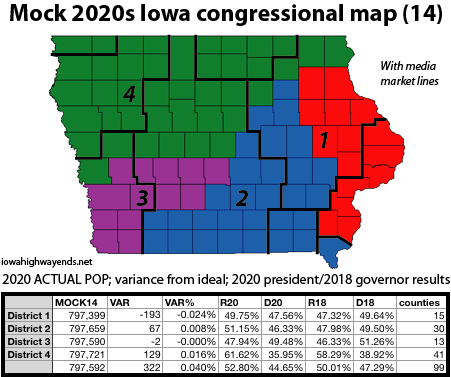
Had the census numbers been released Monday or Tuesday, when I had a full evening to play with them, I would’ve come up with this map earlier. It might have even superseded Mock 13 entirely.

Once I had fresh eyes, I looked at the previous product. There is no way I’m going to get better than that 3rd. The 4th is sprawling, but it has to sprawl, and it has extensions but no mid-state danglers. That reduced my work to: Can I take the remaining counties and make those two districts better? Yes!

This map has a congressional district variance of less than 300, and .037%. For comparison, in 1981 the equivalent numbers were 217/.045%; in 1991 they were 265/.05%; in 2001 they were 134/.023%; in 2011 29/.00384%. Shrinking from five to four could have contributed to the exactness of last decade’s plan, but my plan here is at least competitive with previous decades’ variances.

The 2011 plan aimed for 761,589 per district; the 2021 plan aims for 797,592, or about 36,000 more in each.

Components of this map have precedent in previous maps. Polk County as the tip of a southwest district is the 1990s 4th. Allamakee and Winneshiek counties as the extension of a northern district is the 2000s 4th. A tower including Tama and surrounding counties is kind of like the 1980s 3rd, except this time it’s the top instead of bottom. A district taking a big swath of southern Iowa and going up like a triangle is the 1990s 3rd, except this one goes farther north.

What this map loses vs. Mock 13 is the 1st’s compactness. I believe that is made up for with a decline in the 2nd’s perimeter. The 2nd gets better on compactness as well, actually, as the length-width measurements are simply comparing the widest part (Taylor to Lee counties) with the tallest (Missouri line to Bremer). The 4th is probably twice as wide as it is tall.

Politically, all I can say is, let’s get ready to rumble. The first three districts sit squarely in the middle, with statewide candidates in the 46%-52% range in these configurations. The “Channel 9 Election” — Ashley Hinson vs. Liz Mathis, both Linn County residents and former TV anchors — is going to be fought in their home market and also the Quad Cities. Johnson County gets paired up with even more of southern Iowa. Story County resigns itself to another decade of Randy Feenstra, who now gets to attend Nordic Fest in Decorah.

The Legislative Services Agency is on the clock.

On a related note, has anyone seen an actual LIST of city populations, or am I going to have to copy and paste those numbers 900-plus times too?

UPDATE 9/22: Fixed slight Scott County population error.

Posted in Maps | Comments Off on Mocking Iowa’s 2020s congressional districts (6)
Aug 13

Mocking Iowa’s 2020s congressional districts (5)

The actual 2020 census numbers came out yesterday, in extremely large and complex files meant to be interpreted by extremely expensive and complex software. I am but a simply country blogger of limited means. So, in order to get fast numbers, I had to take the brute force approach: Stumble upon this interactive map, go to Iowa, select county-level data, and manually enter 100 lines.

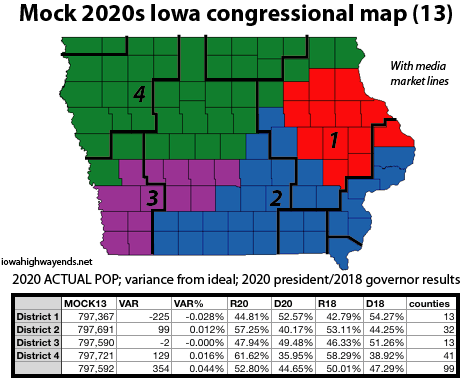
Behold, Mock 13, on Friday the 13th, which like my first mock redistricting presents Ashley Hinson with her worst nightmare: Johnson County. (I did some other maps in the interim. Mock 12 was a self-check of this proposal at Bleeding Heartland, which appears to have used 2018[?] estimates and substantially undercounted Dallas County.)

LOOK AT THAT THIRD DISTRICT. IT’S SO PRETTY. Number-wise, I mean, and map-wise, kinda too. But remember when I said that working on Polk County-centric districts often led to a busted map because east-central Iowa kept throwing things off? A similar thing happened here. I played with different reconfigurations of the counties on/north of I-80 — only to realize, in separate maps, I’d forgotten to include Lee and Wayne counties — and landed on this when I said good enough. There’s a variation that swaps out the northern ones for Johnson, and it fits within my self-imposed 1000-person deviation, but it’s not as close to the ideal.

Looking at the partisan breakdowns, I don’t know if the Legislature would bite on this one. Any map that puts Johnson and Linn together could meet resistance … unless the state legislators are very happy with how their districts turn out.

UPDATE: Better map placed shortly after post time.

UPDATE 9/22: Fixed slight Scott County population error.

Posted in Maps | Comments Off on Mocking Iowa’s 2020s congressional districts (5)
Aug 12

Iowa State Fair 2021: Metal detectors, NO TRAM

I once said a year without the Iowa State Fair would be unfathomable.

Well, we’ve seen and heard a lot of unfathomable things lately.

Now the Iowa State Fair is BACK, but with a couple of changes that show things aren’t what they used to be.

First, there are metal detectors at the entrances now.

Second, from the fair’s website: “For crowd and pedestrian safety, the inner grounds trams or tractor drawn trailers will not be running.” This is not good, and I say that as someone with their knees intact. I really hope this is a one-time thing. I may end up on the Sky Glider(s) for the first time in years, and those rides aren’t inexpensive.

Third, the fair shuttles from downtown Des Moines and Southeast Polk High School, a service I have endorsed without reservation, will require masks because they are public transportation.

It could be worse. It could be Illinois.

For an overview of fair changes and challenges, including relocation of the Avenue of Breeds to near the 4-H Building, here’s a video from Iowa Agribusiness Radio Network.

Posted in Iowa Miscellaneous | Comments Off on Iowa State Fair 2021: Metal detectors, NO TRAM
Aug 11

When is Channel 14 not Channel 14?

KMEG, Sioux City’s CBS affiliate, is by a good margin the youngest of the “Big Three” network stations serving Iowa. It is more than a decade younger than any except WQAD, which preceded it by four years. Its youth is also signaled in being Channel 14, the only one on the UHF dial, back when that mattered.

On Feb. 4, KMEG’s programming was moved from Channel 14, or more specifically Channel 14.1 in the digital era, to Channel 44.3. Both KSCJ radio and North Pine Broadcasting covered the switch. However, this only matters if you get TV the old-fashioned way, or the slightly newer old-fashioned way, via a digital antenna. On cable and satellite, it’s still reached by pressing “1-4” on the descendant of your Zenith Space Command.

A similar switch happened at about the same time in eastern Iowa. On New Year’s Day, Fox station KFXA became Channel 2.2 over the air while remaining Channel 28 by other means.

Both cases are connected to Sinclair Broadcasting. Sinclair owns KPTH, Sioux City’s Fox station, but only operates KMEG, the latter’s ownership being Waitt Broadcasting. Sinclair owns KGAN, eastern Iowa’s CBS station, but only operates KFXA, the latter’s ownership being Second Generation of Iowa. (The distinction matters not a whit in retransmission disputes.)

For both KMEG and KFXA, if you try to go to Channel 14 and Channel 28 through over-the-air means, you get Dabl, one of the many networks available on subchannels elsewhere. This probably means, under strict definitions, that neither station’s call letters should be attached to their networks anymore. Hence, “CBS 14” and “Fox 28”, branding that isn’t necessarily wrong but doesn’t quite tell the story.

Posted in Iowa Miscellaneous | Comments Off on When is Channel 14 not Channel 14?
Aug 10

Derecho day


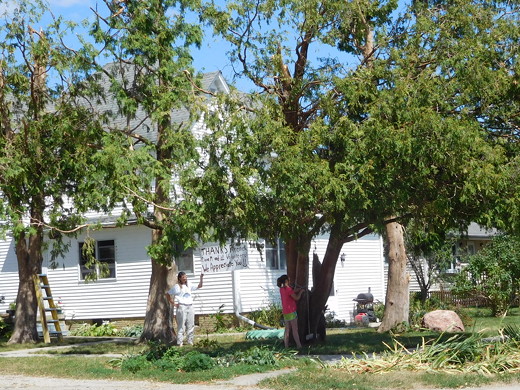
August 18, 2020: Derecho-damaged trees in Keystone. Sign says “Thanks firemen, Dave M and all volunteers. We appreciate you!!” See this blog post for more pictures.

“You have 20 minutes!” I said to the front desk as I left the fitness center Aug. 10, 2020, having watched the progress of a large thunderstorm on the TVs. Just another line of severe weather.

Around 12:36, the power went out. I’ve had the power go out before. Two weeks earlier, in fact, I had an issue after a thunderstorm where my kitchen had electricity but my computer room didn’t. It was annoying.

Little did I know.

The derecho left my place without electricity for eight days and ten hours, and without Internet for nearly two weeks. I spent more than a week commuting an hour each way. I was very, very fortunate.

For at least one night, Traer was the only community in Tama County with electricity (or so it appeared from space), and the day after, it was the closest place to Marshalltown with functioning gas stations. The angle of the corn got worse the closer you got to US 30 until it was flat. The area was flooded with utility trucks for weeks; I saw some with Michigan plates in Vining.

Here’s a link to a lot of KWWL drone videos of damage.

In October 2020, the derecho was deemed the most costly thunderstorm event in U.S. history. In June 2021, the cost was revised upward to $11 billion … and counting.

Posted in Iowa Miscellaneous | Comments Off on Derecho day