Feb 01

What’s next for Wall Lake school?


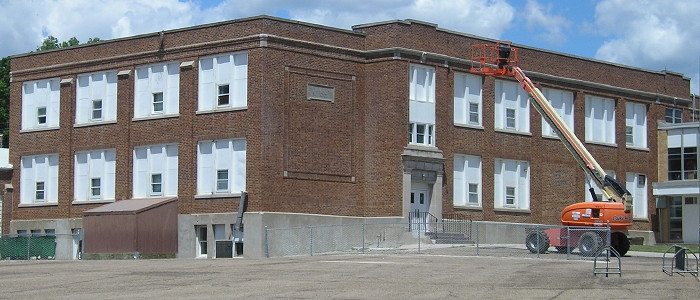
June 24, 2017: The oldest part of Wall Lake school.

I found out about the closure of Wall Lake Elementary School in late February of last year. It turned out to be one of the last things I blogged about on a normal timeline.

I wondered if the East Sac school district had proceeded with its plans, given then-immediate-future developments. A news story on KCIM-AM has answered that. The property is being transferred to the town of Wall Lake. The “oldest parts of the building” will be demolished, presumably referring at least to what’s in this picture.

Posted in Schools | Comments Off on What’s next for Wall Lake school?
Jan 29

Corning-Villisca merger on hold

Corning and Villisca, which started whole-grade sharing in 2013 as Southwest Valley, last year started to make gestures toward full consolidation. But like pretty much everything else, the plague got in the way.

KMA reports that the merger is on hold for now. Moving forward will depend on what the Iowa Legislature does regarding operational sharing. That program offers incentives to separate districts to have certain school officials do part-time work for both of them. For example, one-time North Tama teacher Ken Crawford has been superintendent for both Highland and Lone Tree, and starting next school year will be full-time for Highland (story: KCII).

Speaking of school things, Enrollmas*, which usually happens this week, came early this school year. More on that after evaluations.

* The word I made up for the Iowa Department of Education’s release of certified enrollment statistics, which means a new set of numbers for me to play with.
Posted in Schools | Comments Off on Corning-Villisca merger on hold
Jan 27

Grassley makes Traer early stop on 99-county tour

It hasn’t been a full year since Sen. Chuck Grassley last visited Tama County, but in four months he checked it off both his 2020 and 2021 lists. The senator visited Clearline Industries on Traer’s south side on Jan. 13 and had a round-table discussion there, reports the North Tama Telegraph.

Also according to the story, he visited Marshall, Benton, and Iowa counties the same day. That gives him at least 4 out of 99 with 11 1/2 months to go.

Posted in Tama County | Comments Off on Grassley makes Traer early stop on 99-county tour
Jan 26

115th anniversary of ‘Leander Clark College’

In southern Linn County, just north of Shueyville, is a map dot called Western. The town came into existence in 1856 and was named because it had the westernmost college of the United Brethren Church. A Western College Road still runs a fraction of a mile north of the county line today.

The college made it 25 years before relocating to Toledo. The primary reasoning was that it was not on a railroad or telegraph line, but the Toledo Chronicle on July 22, 1880, said Rev. M.S. Drury told a meeting “the country round Western is almost entirely settled by foreigners — Bohemians, principally — and therefore the local patronage is very light.” The college was relocated to Toledo and classes started in 1881.

In 1903, the president of Western’s board of trustees, Leander Clark, made the college an offer: If it could raise $100,000 in three years, and name the college after him, he would donate $50,000. The Toledo Chronicle reported June 18 that the proposition “was received with profound satisfaction by the board.” The endowment committee adopted it “with great enthusiasm, and following which action the members of the board and visitors present while standing, sang ‘Praise God from whom all blessings flow.'”

On January 23, 1906, the articles of incorporation officially changed the name to Leander Clark College. The Chronicle reported two days later:

The large auditorium of the U.B. church was crowded with the numbers of the faculty, board of trustees, students, citizens, and all the loyal friends of Western, who had assembled to participate in this joyful jubilee.

The front of the church was decorated with Leander Clark pennants, but the chief decoration was a beautiful Leander Clark banner, which was suspended over the platform. This banner of cardinal satin embroidered in gold, is the work and the gift of Miss Cronise to the students. Above the banner hung a large artistically framed picture of Major Leander Clark, which is the gift of Major Clark to the college.

A decade later, as seen in the Chronicle, the college had an enrollment of 125 “with over a hundred in the conservatory.”

Leander Clark College, under that name, lasted less than 15 years. It was “suspended for the duration of the war” in June 1918 as a commission looked into a merger with Coe College in Cedar Rapids. The merger was approved in April 1919, with Coe taking control of Leander’s history, and the once-Western College making its way back “home” to Linn County. The college grounds were offered to the state of Iowa “for use in the establishment in Toledo of an orphans’ home” and became the Iowa Juvenile Home.

Coe College’s website has a brief history of Leander Clark College. Coe’s football records split by name, with all-time records of 3-3-1 against Western and 6-2 against Leander Clark between 1894 and 1916. (That includes the ultra-rare score of 4-4 in 1894, when touchdowns were four points apiece.) Many of Leander Clark’s athletics opponents remain today as Division III colleges scattered across Iowa. As far as I can tell, the teams never got a nickname.

Western’s township in southern Linn County is named College, and I assume the township was named for the college though I can’t be sure. The township is the root of the College Community School District, formed in 1954, which is better known as Cedar Rapids Prairie.

Was supposed to run Friday, forgot to make live. — Ed.

UPDATE 1/28: Added final paragraph.

Posted in Tama County | Comments Off on 115th anniversary of ‘Leander Clark College’
Jan 25

Rodney Dangerfield, call your office

I know ESPN’s been having trouble, but…

tx_isu_wbb_big

(The announcing crew at the Baylor game said “Iowa Cyclones” at least once.)

Posted in Sports | Comments Off on Rodney Dangerfield, call your office
Jan 20

IA 88: The road that torqued off a Legislature

In 1920, IA 88 was a harmless little highway, between the tiny town of Altoona and the tinier town of Bondurant, slightly lengthened a year later.

In 1935, it was nothing less than the first piece of a giant conspiracy, “a plan of Des Moines to make Iowa a ‘one town state'” (Cedar Rapids Gazette, April 3). IA 88, you see, was the number given to the Marshalltown diagonal.

Farmers whose land would be taken had an valid argument. Triangular plots of land are not optimal from a logistical standpoint, especially if one had triangles on both sides. But that aspect took a back seat to the trade implications, or at least the perceived implications. In fact, the most vocal opponent of the diagonal between Des Moines and Marshalltown in the Legislature was Don McLean — the representative from Marshall County.

McLean’s bill, which the House approved 101-3 on April 2, 1935, forbade further consideration of diagonal highways. An amendment from a Buena Vista County legislator to halt all construction and abandon the road entirely failed 33-68.

The Webster City Freeman (April 11) editorialized:

The plan to build a diagonal road from Des Moines to Marshalltown and on to Waterloo was conceived in Des Moines, from purely selfish business motives, and is opposed by Marshalltown and Waterloo and other towns along the route. It is a scheme to draw trade to the capital city at the expense of other towns.
If it were seriously proposed to build a diagonal road from Burlington to Marshalltown, and on into Kossuth county, or from Council Bluffs to Boone and Waterloo and on into northeastern Iowa, it is easy to divine what Des Moines would say … There would be the most vigorous and strenuous opposition.

The Freeman was demonstrably wrong on that latter part, given that during 1933 and 1934 a diagonal IA 33 had been fashioned from Le Mars to Sibley. However, that hugged the railroad the whole way, and the Marshalltown diagonal was a whole new path.

The Centerville Daily Iowegian and Citizen (April 4) saw a big-government plot:

There were warnings when states began to look to Washington for road and health and other help that the entering wedge was being driven which would reduce the states to mere vassals of the federal government. The day is here when we see the prediction being fulfilled. And blows continue to be struck to centralize government. Des Moines is trying to wipe out the county seats and get diagonal roads to make that the one big city. Washington reaches out to make the state subservient. And who is there who can point to any gains in the manner in which we are governed because of this centralization?

Even good-roads advocate E.E. Taylor, editor of the Traer Star-Clipper, didn’t like it much, as he wrote when the whole thing was winding down (May 31):

The highway commission has heard from the taxpayers. The body has announced that the diagonal road planned and partially constructed, from Des Moines to Waterloo, will end at Marshalltown, at least for the present. Too bad the people did not speak earlier and louder and thus headed off this expensive project for which there is no need.

The bill did not get out of the Senate, and the Highway Commission didn’t attempt any more diagonals for four decades. The 88 number was replaced with IA 64 in 1939 and IA 330 in 1969.

Another writeup about this episode in Iowa highway history is at the top of the IA 117/330 (2002) page. Self-plagiarism is an art if done right.

Posted in 1920 Highway Sytem | Comments Off on IA 88: The road that torqued off a Legislature
Jan 18

Four verts, basketball style

In case you missed the biggest sports story of the weekend.

Beat Baylor in Waco for the first time since 1997 with three freshman starters? After having made a combined 35 3-pointers in the previous two games? Sure, why not?

Also: 41 seconds of Ashley Joens doing Ashley Joens things (ESPN)

Posted in Sports | Comments Off on Four verts, basketball style
Jan 15

Little Brown Church being renovated


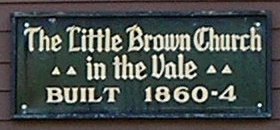
July 31, 2005: Closeup of LBC’s nameplate.

The Waterloo Courier has a story, and some pretty courtesy photos, about the Little Brown Church getting its first major renovations in decades. The story mentions that a letter was left for the next crew to replace the fabric on the lectern — 65 years ago.

The Little Brown Church is just east of Nashua on IA 346.

Posted in Iowa Miscellaneous | Comments Off on Little Brown Church being renovated
Jan 13

Can I backdate a passport?

This sounds interesting:

Through the new Scenic Byways Passport, travelers can check in at 12 scenic byways and more than 100 unique attractions and local businesses. Each check-in to a location on the passport earns travelers one entry into a monthly drawing for a prize package valued at about $200. Prize packages include an overnight stay, gift certificates, and more.

The website requires a smart phone. I signed up via my desktop only to get an e-mail telling me to click a link to “put link on home screen”. The instructions say “there is no app to download” but it creates something very app-like, probably directing to a specific browser page. (There is a separate “Iowa Culture” app from the Department of Cultural Affairs.)

The catch for me is, I’ve already been to so many of those places! The Lincoln Highway sites, especially, as shown in this story from WQAD. The second catch is promoting something travel-related when so many people are reluctant to travel. However, many of the “check-ins” would have to be outside anyway.

The passport is all about the Scenic Byways, so large swaths of north-central and south-central/southwest Iowa don’t have any special locations, nor about a 40-mile radius of Muscatine. If the recently minted Jefferson Highway Heritage Byway gets some stops, that will change a bit.

Posted in Iowa Miscellaneous | Comments Off on Can I backdate a passport?
Jan 11

‘Rehab’ on IA 28, Sioux City pages

“Pavement Rehab” is a line often used in DOT five-year plans regarding construction projects. That phrase makes sense for what I’ve done on the IA 12, Business US 20 (Sioux City), the combined IA 12 South/Business 20 East, and IA 28 pages.

As Jason Hancock reported, the transfer of jurisdiction on Virginia Street in Sioux City between Gordon Drive and the new I-29 exit resulted in the hidden designation of IA 12 being relocated and part of Gordon Drive being renumbered secret IA 812. I do not agree with this designation at all. If the “12” connection had to be kept, IA 912 didn’t live longer than two years and its road is now gone, so confusion would be nonexistent. On the IA 12 page, I try to walk through both that change and the routing history of the segment east of the Riverside Boulevard exit, including some tweaking of the endpoint table.

The Virginia Street exit and 812 issue also affect Business 20. Business 20 remains signed on Gordon Drive, so it and IA 12 now technically run separately for a while. The issues of eastbound and westbound Business 20 becoming separated and eastbound Business 20 not being signed from I-29 remain, though.

As for IA 28, I don’t know how recent the project was but its south end in Martensdale now has LGSs and IA 92 has new concrete. I also added clarification regarding the Beaver Creek bridge and its effect on the north endpoint.

On the US 77 page, I integrated photo dates and hope I’ve arranged the photos such that comparisons can be made in the past and present configurations of the I-29 exit.

Posted in Highway Miscellaneous | Comments Off on ‘Rehab’ on IA 28, Sioux City pages