
-
Recent Posts
Informational PDFs
- 2010 Iowa City Population Descending Order
- 2010 Iowa County Population Descending Order
- 2020 Iowa City Population Descending Order
- 2020 Iowa County Population Descending Order
- Iowa HS FB playoff brackets 2014
- Iowa HS FB playoff brackets 2015
- Iowa HS FB playoff brackets 2018
- School Directions Booklet FINAL
Key Posts
- College conferences and House apportionment
- How Iowa State has lost football games in the 21st century
- Iowa 2010 population breakdown
- Iowa daily newspaper publication, 2022
- Iowa school enrollment changes, 2001-15 (maps)
- Iowa's largest school enrollment gainers, 2001-15
- Kossuth County Area Schools and Rural Iowa's Population Collapse
- Post offices targeted for closure (1)
- Post offices targeted for closure (2)
Roadgeeking
Categories
Nov
07
IA 333: The hot-potato highway
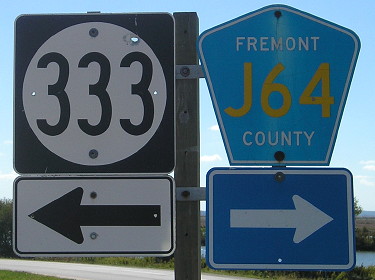
October 2, 2015: The beginning of IA 333 as seen from an I-29 offramp. The entire route, along with the town of Hamburg, was underwater in the spring of 2019.
The Great Decommissioning of 1980 was the end result of a process for “functional classification” of all roads in Iowa. Primary roads that didn’t reach a certain level were eligible for being turned over, and a handful that were higher in rank went to the state.
And then there is IA 333, whose history got weird one more time, because it managed to fall under both categories.
An agreement in 1976 resulted in 333 being paved in Page County the second half of 1980 and decommissioned when that project was completed. At the same time that was going on, the part of 333 that had been dropped upon paving in Fremont County in 1964 was on its way back up.
On June 16, 1980, an appeals board in Ames ruled that the DOT had to keep IA 184 and IA 145 but could drop IA 42. The board deadlocked on County Road J64 running from I-29 to US 59, meaning that a lower appeals board ruling stood and the DOT had to take the road.
So it sounds cut-and-dried, right? BZZT. The state had been OK with taking a new road from I-29 to US 275, but east of Hamburg, not so much.
At the October 29 Fremont County Board of Supervisors meeting, whose minutes were printed in the Hamburg Reporter in November, a resolution was passed. Paraphrased summary: “Whereas, the DOT is supposed to take J64 once the county fixed two things on it, and whereas, the county finished those by October 9, the road is [was!] the DOT’s responsibility on October 10, 1980.” I’m not quite sure how a retroactive commissioning from a county works, but that’s what the resolution said.
So in the fall of 1980, we had 333 in Page County that the state was going to drop, and a disconnected 333 in Fremont County that the state didn’t want to add. (Technically, I suppose there’s no reason it had to be 333, but there was no need to add more confusion.) Unfortunately, without contemporary photographs there’s no way to tell the status of signage at the beginning of 1981, and the map… uh…
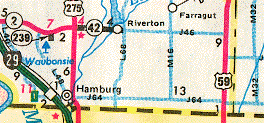
Donde está trescientos treinta y tres?
However what went where, the route across the base of Fremont County was 333 until the Second Great Decommissioning of 2003, when through legislative action the DOT was able to unload its remaining spur routes and a handful of significant portions of low-traveled routes.
Today, IA 333, running between I-29 and US 275 in Hamburg, is the shortest Iowa highway east of the Missouri River.
Posted in Highway Miscellaneous, Iowa Miscellaneous
Comments Off on IA 333: The hot-potato highway
Nov
06
IA 999: The untold story (5)
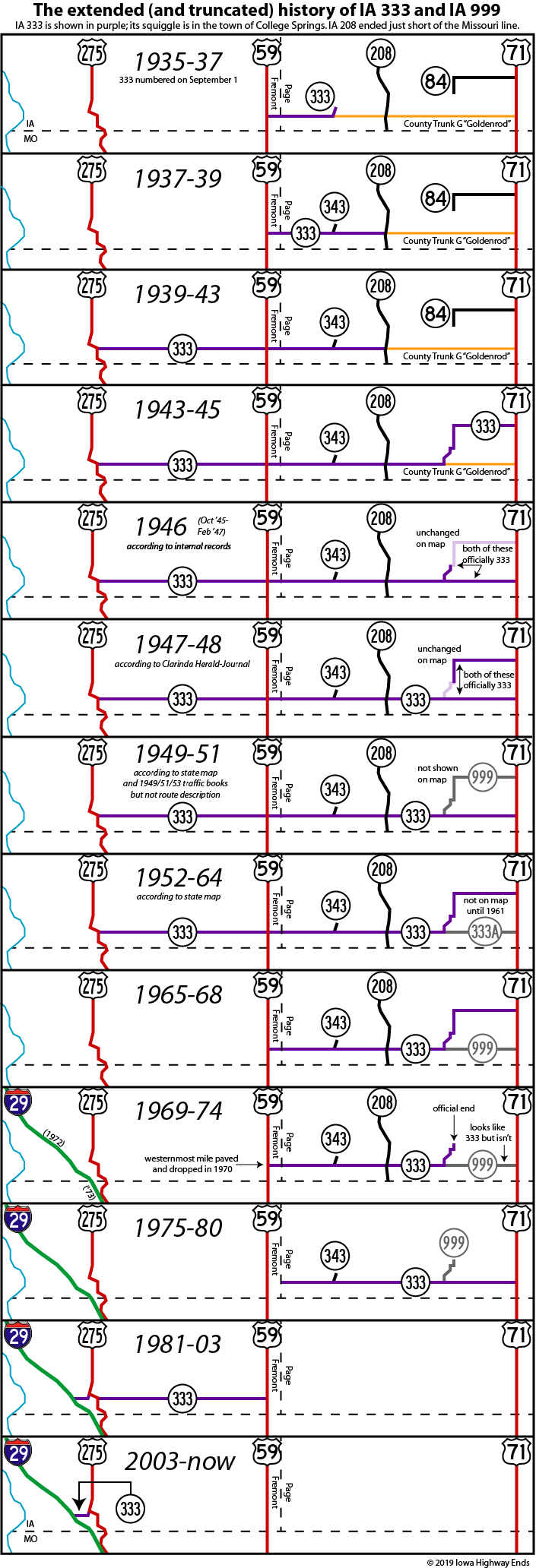
Looking at state maps in the early 1970s, it seems clear-cut. IA 333 runs from the Fremont/Page county line to 71, there’s a secret designation for the route to College Springs, and the absence of a 333 marker east of there on state maps is a design choice.
And then along come the 1972 county map, and early 1970s state traffic count books, to announce, “Every word of what you just said was wrong.”* Well, not every word, but surprisingly, a lot of them!
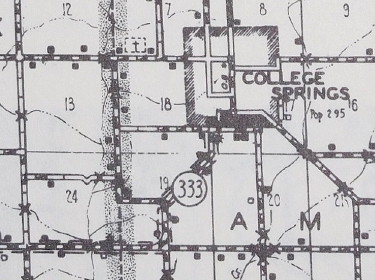
1972 Page County map showing 333 turning north, instead of running straight east-west to US 71. IA 999 is unmarked.
As it turns out, the line running from the “stub road” to College Springs east to US 71 was in fact not IA 333, but IA 999 — 333 is acting as a long spur to College Springs. This is what all the Highway Commission files say, anyway, although the Clarinda Herald-Journal certainly seemed to think it was the other way around. Without a photo from the time of the signs at the intersection, I doubt the actual situation is knowable today.


1972 traffic book (both)
On May 15, 1974, the route descriptions were revised again, and 999 officially, again, became the spur into College Springs. IA 333 was extended straight across on the former 999 east to 71, and indeed a marker appears there on the 1975 state map. This change was necessary because of the decommissioning of IA 208, the north-south road running from IA 2 to Blanchard via Coin, weeks later. Because the mile from US 59 to the county line was not part of the state system, a 333 that ended in College Springs would have become an orphan route disconnected from the rest.
By the mid-1970s, Page County was desperate to get something, anything, done. It volunteered to the newly christened Iowa Department of Transportation to take over 333, 343, and 999 as long as the state paved 333. The same type of deal had been done for 208. At the end of March 1976, according to the Des Moines Register, the DOT finally agreed to unload a road that had been neglected for years (citing, repeatedly, low traffic counts) for a $5.2 million construction project … more than four years later.
On August 29, 1980, the first concrete was poured on IA 333 in Page County. In the final days of that year, 333 was both paved and decommissioned. Also decommissioned was IA 999, three decades after it first appeared, turned over separately to the town and county.
The story of Iowa’s highest-numbered highway was over. The story of its parent wasn’t.
*Use of this line does not constitute endorsement, real or implied, of Star Wars: Rian Johnson Sets Fire to a Franchise.
Posted in Highway Miscellaneous, Iowa Miscellaneous
Comments Off on IA 999: The untold story (5)
Nov
05
IA 999: The untold story (4)
Southern Page County did its damnedest to put itself on a paved path to prosperity.
The Highway 333 Association formed in the summer of 1959 with the goal of getting the road from US 275 near Hamburg to US 71 at Braddyville hard-surfaced. A delegation of 61 people went the 180 miles to Ames to have their concerns heard, and reading about that meeting will take you to a time far different from our own.
AMES, Ia. — A farm wife said Wednesday she doesn’t dare wear white gloves while riding on dusty Highway 333.
“The gloves would get dirty immediately,” Mrs. Dale Athen of Hamburg told the Iowa Highway Commission. “I have to carry my gloves in my purse if I want to keep them clean.”
— “White-Glove Objection to Highway 333,” Des Moines Register, September 10, 1959
It had been 19½ years since a delegation from Shenandoah had asked for IA 208 and 333 to be blacktopped and got nothing. The result this time was scarcely different…with a fractional exception. In the Iowa DOT online construction archives are plans for right-of-way and culverts in 1959 and 1960 along the Goldenrod from the College Springs junction eastward, with no route number. The road was still gravel, but starting in 1961, IA 999 was on the map, hiding in plain sight.
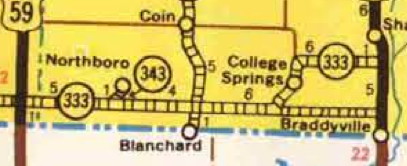
See the gravel marking right above the word “Braddyville”? That’s 999. By the end of 1964 the intersection of IA 208 and 333 was the only location in Iowa where two gravel routes met.
Southern Iowa is full of gently rolling hills. Under those hills — especially in the Des Moines River valley — is an abundance of “soft coal” deposits that contributed to a mining industry that was extinct by World War II. What isn’t abundant is the aggregate needed for highway concrete.
It was found that the gravel that is so plentiful in north-central and northern Iowa is almost entirely lacking in the southern part of the state. Furthermore, ledge rock was found to be almost entirely absent from the southwestern part, and though it is more abundant in the south-central and southeastern parts, even there it is in some places of poor quality or is available only in limited, quantity.
— The Road and Concrete Materials of Southern Iowa (1935)
You can’t get much farther south than a mile from Missouri.
Fremont County got 333 paved west of US 59 in 1964, and as a consequence the state dropped it. The mile east of there would be paved in 1970, giving the highway a “hanging end” for a decade. Page County would not fare nearly as well.
- In 1957, two years before the aforementioned “white-glove” meeting, 333 from US 275 to US 71 was “the longest single stretch [of primary road] still surfaced with gravel and crushed rock.” (Register, September 4)
- In 1961, the Highway 333 Association was told it would be paved in 1965. (The very same night, voters in the two-year-old South Page school district shot down a bond issue for building a new gym at College Springs.) (Clarinda Herald-Journal, September 14)
- In 1971, the state put 333, 343, and 999 down for paving “after 1977”. (Herald-Journal, December 23)
But for the Goldenrod itself, the only sop was bridge replacements, for a situation so dire that the Herald-Journal reported March 14, 1968, that Shenandoah school bus riders had to get out and walk across one of the bridges because of the load limit.
In 1967, the state approved paving the road from College Springs north and east to US 71. It happened a year later, and the segment once known as IA 84 in the original 1920 system was off the state books for good. The remaining 2½ miles from College Springs to the Goldenrod was left as a secret designation.
Or was it?
Posted in Highway Miscellaneous, Iowa Miscellaneous
Comments Off on IA 999: The untold story (4)
Nov
04
IA 999: The untold story (3)
On the official state transportation map, the highway on the corner of Iowa’s floor was stable for 20 years. There was only one change to IA 333 marked between 1943 and 1964: It was straightened to miss College Springs and go east to US 71 near Braddyville in 1949-51, a three-year flip that looks innocent enough. But what the maps don’t show is a fierce persistence from Page and Fremont counties pressuring the Iowa Highway Commission to get “three-dirty-three” out of the mud, and how geology, funding variabilities, and sleight-of-hand in the records collided into a mess that would not be sorted out for decades more.
In April 1946, Page County found out that in October 1945, the Highway Commission had straightened 333 away from College Springs, to use the “Goldenrod” road a mile from the state line. Notice this is before any change was shown on the map.
The authorized change would make No. 333 directly across the southern part of Page county, over what is known as the Goldenrod, officially marked on county maps as county road G. (Clarinda Herald-Journal, April 8, 1946)
But here’s the problem: According to the online route description, 333 was routed straight east to US 71 and also into College Springs. In effect, the route had been forked, at least on paper. After a year of pressure, the commission reverted its change…mostly.
In other words, the gravel from College Springs to Highway 71 south of Shambaugh will again be a state highway and the road from the town south to the Goldenrod will become a county road, the Goldenrod remaining under state maintenance. (Clarinda Herald-Journal, February 24, 1947, emphasis added)
So … what was the number of the road running north and east from College Springs? It couldn’t become IA 84 again; that number had been immediately recycled to run from Cedar Rapids to the city airport on what now is Sixth Street SW and County Road E70. (The Gazette reported on November 18, 1943, that traffic on Sixth Street SW at the intersection “of No. 84 and 381” would get stop signs instead of the east-west road to the airport.) But neither did it become IA 393, the next number up.
Yet the Herald-Journal December 13, 1948, under the banner headline “College Springs Road in Primary System,” said:
State highway 84 into College Springs will be repaired and the road south of College Springs to highway 333 will be included in the primary road system.
This closed the gap between College Springs and the Goldenrod. The 1949-50-51 state maps show only IA 333 running due east-west across the county. But what about the road through College Springs to Shambaugh that residents just lobbied so hard to get? It doesn’t exist on the map, but it exists in internal Highway Commission files. At the end of the 1949 traffic book (large PDF) — the first evidence available online — we meet IA 999.
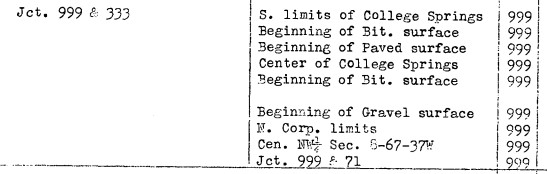
I told you it was weird.
Posted in Highway Miscellaneous, Iowa Miscellaneous
Comments Off on IA 999: The untold story (3)
Nov
01
IA 999: The untold story (2)
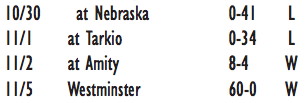
This excerpt of Missouri football’s 1897 schedule from the 2017 football records book shows one of two games played at Amity College. The meeting appears to be part of a barnstorming tour; the Tigers’ game in College Springs comes three days after taking on the Nebraska Bugeaters, and a day after a game in Tarkio, only 26 miles away.
It may be hard to believe, but there was a college in College Springs. Amity College, “founded as a Wesleyan Methodist school and afterward chartered as an undenominational college,” started in the mid-1850s, at the same time Page County was being settled. The town of Amity was renamed College Springs in 1879.
The college closed in 1913, and bricks from the building were used in construction of the consolidated school at College Springs in 1917. As far as I know, it’s the only school building in Iowa with a clock tower.
College Springs was included in the original Iowa highway system in 1920. IA 84 was a spur route running north and east to IA 18 (future US 71). Fifteen years later, as part of the Second Great Commissioning, IA 333 was created in the southwestern corner of Page County, running from US 59 to Northboro. Over the next decade, 333 would be extended eastward to IA 208 (now M48) just north of Blanchard, westward to US 275 in Fremont County, and finally, through College Springs to US 71, superseding IA 84.
And then things start to get weird.
Sources:
- Batesel, Paul. “Lost Colleges: Amity College” [Online], 2013.
- Kershaw, W.L. History of Page County, Iowa. Chicago, IL: The S.J. Clarke Publishing Co., 1909.
- Van Nostrand, John. “100 years and many more memories,” Clarinda Herald-Journal, Feb. 23, 2017.
Posted in Highway Miscellaneous, Maps
Comments Off on IA 999: The untold story (2)
Oct
31
IA 999: The untold story (1)
For decades, the Iowa Highway Commission wanted to get rid of it.
For decades, residents of southern Page County begged the state to pave it.
Iowa Highway 999 was both an offshoot of and substitute for Iowa Highway 333, and you can’t talk about one without the other.
IA 999 is the granddaddy of the entire 900-series of secret routes, pre-dating them by a long time. Its mere existence was obscured so much that even today, its exact history has some open questions. (Some of those questions might get more light through an intensive study of microfilmed archives, but I’m not in a great position to do that at the moment.)
Through digitized primary sources, a sprinkling of original materials, and a series of THIRTEEN MAPS, this week I’ll be delving into the highest-numbered route ever conceived in the state of Iowa.
I’d tell you to buckle your seatbelt, but where — more precisely, when — we’re going, those haven’t been put into widespread use yet.
(Made live slightly late. — Ed.)
Posted in Highway Miscellaneous, Maps
Comments Off on IA 999: The untold story (1)
Oct
30
I-380 public meeting Nov. 6
The Iowa DOT is holding a meeting next Tuesday (Nov. 6) in North Liberty to “discuss an Interstate 380 corridor study”. The notice mentions six-laning the interstate between I-80 and US 30 (years too late) and “interchange improvements.”
At the time of creation of this blog post, no documents were available online.
BTW, the south half of the Forevergreen Road exit opened five weeks ago.
Posted in Construction
Comments Off on I-380 public meeting Nov. 6
Oct
25
It’s ‘Back to the Future’ weekend
2019’s calendar is 1985’s calendar (and also 2002’s calendar), so that means that this weekend — October 25-27 — is the same Friday/Saturday/Sunday as when the Back to the Future trilogy takes place. A fan documentary is airing Friday night at 8 on KFXA 28.3.
This summer a large part of my road trip podcast diet was the “Back to the Future Minute”, which has since gone through the entire trilogy. This crew wasn’t as great as the “Star Wars Minute” guys were with the source material — or, in some cases, Americana in general. (I was yelling when they didn’t know what a gas war was.) And there were some episodes that just went painfully off the rails.
Minute 51, “Acting Politicians”, was released December 14, 2015 — six weeks before the Iowa caucuses. I didn’t listen to it until July, and … the 3½-year delay put an entirely different spin on it.
That aside, BTTF remains one of my three most favorite movies and it’s still a bit hard to believe the future is now in the past.
Posted in Uncategorized
Comments Off on It’s ‘Back to the Future’ weekend
Oct
24
City Hall as bulletin board; or, Meats and Treats
Might as well pass on the plug.

October 23, 2019: Taped on the entrance to Liscomb City Hall.
(IDEA: Adult costume/trick or treat for prime rib! Thermal storage bag required.)
Posted in Iowa Miscellaneous
Comments Off on City Hall as bulletin board; or, Meats and Treats