From the (at least) second-greatest and most underrated football movie ever.
(FYI: This will be ISU’s fourth game between Dec. 7 and Dec. 26, inclusive. The other three were bowls in the 1970s: two on the 18th and one on the 20th.)
From the (at least) second-greatest and most underrated football movie ever.
(FYI: This will be ISU’s fourth game between Dec. 7 and Dec. 26, inclusive. The other three were bowls in the 1970s: two on the 18th and one on the 20th.)
From this blog post in 2018, emphasis added:
The Cyclones upend the world order with a 38-31 win en route to their second-best season in my lifetime, becoming the only team in the nation to beat Oklahoma in the 2017 regular season, and earning the first of two road wins over ranked opponents that year. … Frankly, it’s the most concrete evidence yet that God set SimUniverse on “haywire” mode. [Burn the witch! — Ed.]
Now, with their first win in Ames against Oklahoma since 1960 and first win against Oklahoma in Jack Trice Stadium, the Cyclones are one game away from their first ever outright conference championship in the history of American football. (In case you were unclear on the stakes.)
All they have to do is… beat Oklahoma. Again. For the fourth time since John Glenn originally went into space and also the third time in the current presidential term. Oklahoma has foiled good Iowa State teams from having nice things in the past, both directly and indirectly, covered elsewhere.
Remember, the Big 12 Championship Game exists because the Powers That Be said 12 games wasn’t enough to make the playoff, and how dare a have-not team take the seat reserved for a TV magnet like Ohio State. (OK, that last part was only implied.)
In 2020, when the number of games each team has played is a variable, ad hoc rules were changed midseason to get a 5-regular-season-win team into the playoff. That team? Ohio State, of course, which won both fewer conference games and fewer games overall than Iowa State this year.
In a way, faceplanting against ULaLa in Game 1 lessens the blow. Otherwise, one might look at the landscape and decide “Iowa State is not allowed to have nice things” is the only ironclad law there is.
Alice Zimple of Traer died Friday. She is the fourth person Traer United Methodist Church has lost this year, including one to COVID-19. Her obituary is here.
Alice was the heart of Traer UMC’s kitchen, no matter what the event. She was the person I had in mind when I wrote in 2004, “One day, someone is going to die, no one who coordinated funeral potlucks for the past 25 years will be able to help, and there won’t be any younger people to take their place.”
In a bitter irony, there will be no funeral luncheon tomorrow for the woman who organized a countless number of them.
Spring 1885 was approaching, and Iowa’s 5th Congressional District election of 1882 was still in dispute. Republican James Wilson had been declared the winner, but Democrat Benjamin Frederick was still fighting for it, and won the seat outright in November 1884. However, the previous Congress had months of work ahead, including the restoration of the rank and pension of former president Ulysses S. Grant.
On March 3, 1885, just before the end of the session, Wilson cut a deal. He would leave his seat if the Democratic-controlled House (overwhelmingly Southern Democrats, mind you) would pass the Grant bill. From an editorial in the March 6 Traer Star-Clipper:
The Frederick-Wilson case and the Grant retirement bill occupied the last hours of Congress. Frederick was seated. The Republicans could have prevented the result, but Wilson rose in his place and said that rather than have General Grant kept from the retired list, himself and friends would sacrifice the seat. The Grant bill was passed and signed by the President. The outcome of both bills is hardly to be reprented [sic] by Republicans and certainly will not make Democrats feel proud. If Frederick was duly elected his party had the evidence and power to seat him in the early part of the session; and if Grant deserves retirement now, he has done nothing since the Democrats refused to show him honor to entitle him to their esteem at this late day. In sacrificing the seat (which it was plain he could have held in spite of the Democrats), after having fought for it so manfully, that America’s beloved general might be partially rewarded, James Wilson has performed an act that will reflect credit and honor on him as long as graceful acts are recognized.
“An Act to authorize an additional appointment on the retired-list of the Army” gave Grant his pension. Wilson got recognized for his statesmanship and — understatement alert — later continued his career in public service. Frederick got the entire term’s salary for one day of service and then was re-inaugurated for the next Congress.
Less than two years later, Frederick resigned and unresigned after situations sparked by the 1886 redistricting involving postmaster nominations in both Grundy County (which he technically never represented) and Johnson County (which was pulled out of the 5th District). Republican editors of papers in the area had much more verbose and fiery things to say, and the Star-Clipper going off on him (PDF) is an entertaining read.
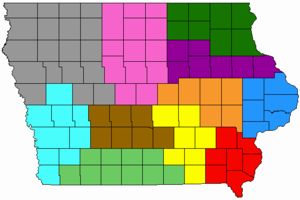
This is what Iowa’s 11(!) congressional districts looked like for the elections of 1882 and 1884. The 5th District is in orange. A mid-decade redraw after a special census in 1885 created a new map that would be used through the 1930 midterms. For more, see this page.
James Wilson, Traer’s most famous resident, served three nonconsecutive terms in Congress as a Republican. The first two were 1873-77, and that’s when he got the nickname “Tama Jim”, to distinguish himself from Iowa Sen. James Wilson of Jefferson. His third term came somewhat involuntarily. He attended the 5th Congressional District convention in Cedar Rapids in the summer of 1882 to show support for a friend. But as time dragged on and no candidate emerged, he was pressured to put his hat in the ring, and eventually agreed.
“But,” said the Traer Star-Clipper later, “he worked against such opposition as no candidate in Iowa ever had to combat. He believed that people had a right to decide whether a prohibitory clause should be engrafted into the constitution of the State, and he said so. This manly stand brought to the aid of his opponent the organized and powerful whisky element. As if this was not enough, he had to face shameful unfaithfulness in his own party, and the combined opposition succeeded in cutting his majority down to 23 votes. He was declared elected and took his seat.” (March 13, 1885)
Wilson’s opponent, Benjamin Frederick, refused to accept defeat and took his challenge to Congress. A subcommittee heard the challenge in June 1884 and then nothing happened — for the duration of the session. It was somewhat academic, as Democrats held an overwhelming majority in the House, but the situation remained officially unresolved.
Wilson was behind the creation of a law in 1884, and of course it was agriculture-related: “An act for the establishment of a Bureau of Animal Industry, to prevent the exportation of diseased cattle, and to provide means for the suppression and extirpation of pleuro-pneumonia and other contagious diseases among domestic animals.”*
A Quad-City Times story interviewed the curator for the State Historical Society of Iowa about the closest congressional races in Iowa’s past. He limited himself to about the past century, starting with a 1916 election where the Republican won by 131 votes in the 11th District. The 11th(!) District was in the northwest corner, from Monona to Dickinson counties northwestward. Only three since then have been within 500 votes, he said.
The Iowa Secretary of State’s Office has general election results going back to 1936, although the 1940 and 1948 U.S. House results aren’t included. Here are the three elections. Maps are here.
Finding results earlier than a century ago is much harder to do. However, I know of at least one election that was decided by fewer than 30 votes, and I’ll go into detail about that one in a later post.
US 69, aka East 14th Street in Des Moines, likely has more stoplights between IA 5 and I-35/80 than it does in the rest of the state combined. The DOT wants to rebuild many intersections on the route, and the plans go beyond adding extra turn lanes. See the PDF here. The release of this plan is the “refine schematic alternatives” stage with a final report in summer 2021, according to this timeline.
I said I wasn’t going to do this. Furthermore, I said I wasn’t going to go all out on it. Perfectionist me begs to differ.
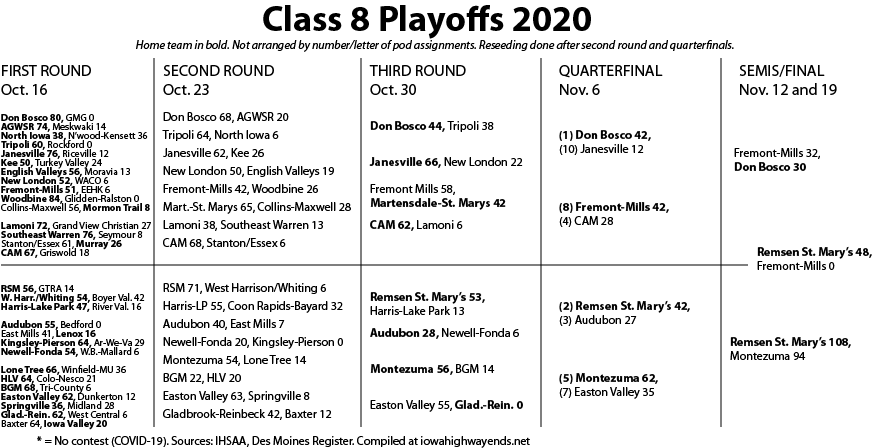
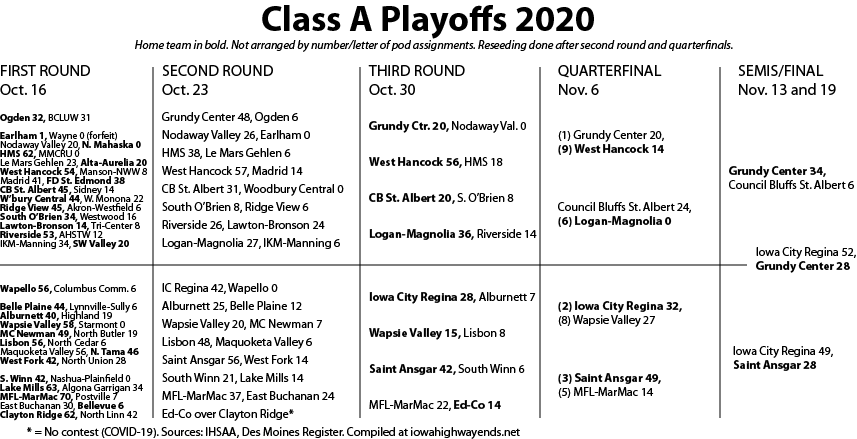
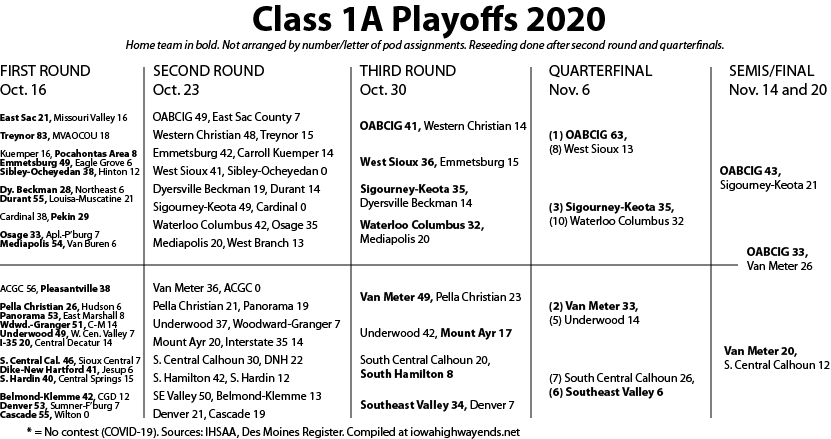
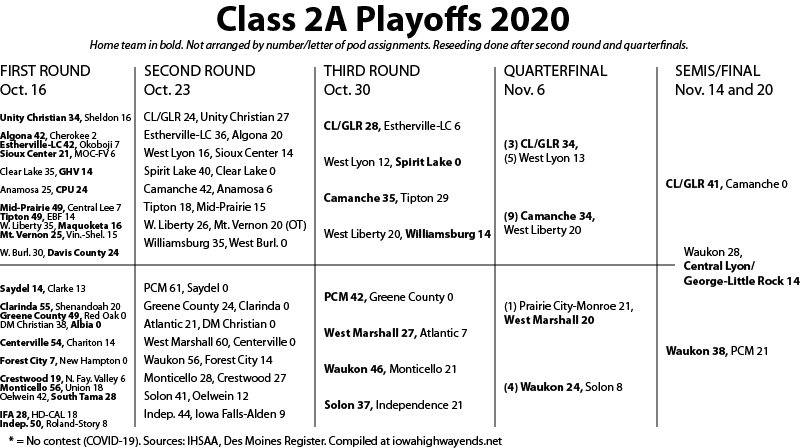
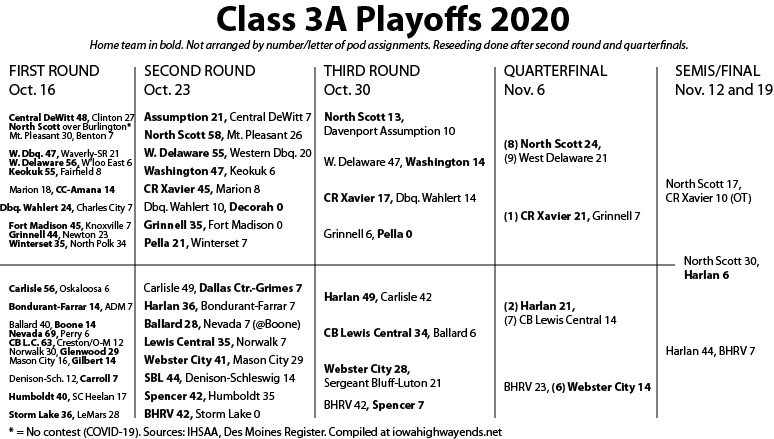
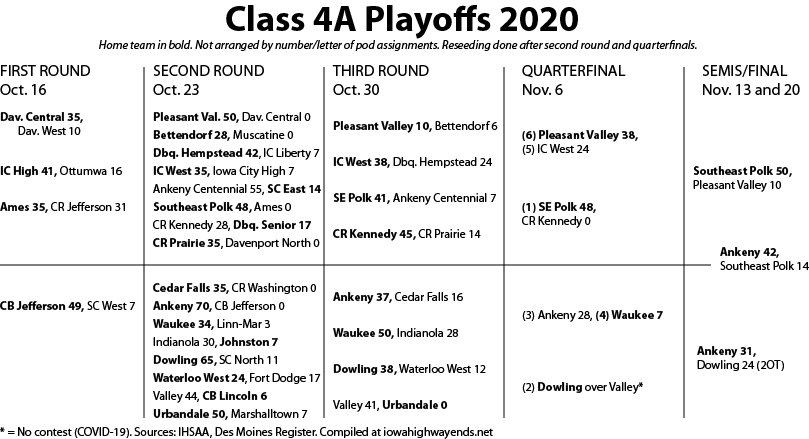
That’s right, the reverse football playoff brackets are back, in a manner of speaking. Once again, trying to wade through the absolute mess that is the IHSAA website put me in my workshop tinkering with a better mousetrap, or at least a competent one.
This year, every team was in the “postseason”, creating a round-of-64 level with a varying number of first-week byes by class. Pods were numbered, then lettered, reshuffled after the second round and the quarterfinals. My main goal with these is to show “path to the championship” lines, and I was doing 1-line scores, so I didn’t set them up by the pod order. If you want those, you’ll have to dig into either a newspaper’s website or the IHSAA’s, and you’ll have to look in multiple places. Home teams are bolded.
I started with each class’s final and worked backwards. The only guiding principle was to structure it such that it looks mostly obvious where the bracket lines would be if I stretched it out more. By the end, or should I say the beginning (first round), I docked a point size to make them all fit. The only time I indicated a seeding was the quarterfinals, which I got from the Register, and I believe are RPI rankings because they didn’t quite match the polls.
The brackets: Class 8, Class A, Class 1A, Class 2A, Class 3A, Class 4A.
Well, this explains some things (Yahoo):
Cyclone tight end Chase Allen jokes about Campbell’s penchant for all-black outfits – “He’s Johnny Cash.” Campbell wears the same black hoodie so often that senior defensive back Greg Eisworth will ask: “Do you wash your clothes?”
The headline is presumptive and probably a jinx. “Generations of futility”, if spelled out by number of eight-win seasons, covers about 40 years. Campbell has had two of those so far, last year’s hyped-up team went 7-6, and his overall ISU record is just above .500 (33-27), although if you take the first year out it’s 30-18.
But, like Earle Bruce, that futility can come roaring back if the coach leaves. How does Campbell, born and raised in Ohio, feel about wearing maize and blue?
Friday’s win over Texas was Iowa State’s third ever win when both teams were ranked, second ever win when ISU was the higher-ranked of the two teams, second ever win in Austin, and first ever road win over a ranked team when also ranked.
In a lifetime of Cyclone fandom, it’s been my position that if Iowa State football ever comes close to sniffing a championship, the world must be coming to an end.
…oh, right.
My header image for the past few weeks has been the Pilgrim Monument in Provincetown, Massachusetts, at the tip of Cape Cod, which would seem an odd choice for a website focused on roads and Iowa. There’s a reason.
The Mayflower Compact, the first document for self-government in the New World, was signed 400 years ago this month, on Nov. 11 (Julian calendar) or Nov. 21 (Gregorian calendar). By the next presidential election, its signing will be closer to the Magna Carta than the present day.
A direct ancestor of mine, a 10th great-grandfather, was on the Mayflower. It’s not just American history I’m commemorating. It’s my own.