
-
Recent Posts
Informational PDFs
- 2010 Iowa City Population Descending Order
- 2010 Iowa County Population Descending Order
- 2020 Iowa City Population Descending Order
- 2020 Iowa County Population Descending Order
- Iowa HS FB playoff brackets 2014
- Iowa HS FB playoff brackets 2015
- Iowa HS FB playoff brackets 2018
- School Directions Booklet FINAL
Key Posts
- College conferences and House apportionment
- How Iowa State has lost football games in the 21st century
- Iowa 2010 population breakdown
- Iowa daily newspaper publication, 2022
- Iowa school enrollment changes, 2001-15 (maps)
- Iowa's largest school enrollment gainers, 2001-15
- Kossuth County Area Schools and Rural Iowa's Population Collapse
- Post offices targeted for closure (1)
- Post offices targeted for closure (2)
Roadgeeking
Categories
Apr
28
Politico goes inside the Register
Posted in Iowa Miscellaneous
Comments Off on Politico goes inside the Register
Apr
26
Not drafty in here at all
Iowa tight ends in the first round of the 2019 NFL Draft: 2
Iowa football players, all positions, combined, who have been first-round draft picks, according to Ron Steele of KWWL: 23
Iowa State football players, all positions, combined, who have been first round draft picks, 1974-present: 0
Iowa State football players, all positions, combined, who have been first-round draft picks, all-time: 1
Kirk Ferentz’s base salary per hour (awake or asleep), according to his 2016 contract extension (PDF): $293.38
Months since “What needs to happen for Ferentz to be fired” thread started at Hawkeye Nation: 18
Posted in Sports
Comments Off on Not drafty in here at all
Apr
24
3 1/2 counties, 2 newspaper offices
It’s been more than a year since the Traer Star-Clipper office closed.
When the owner of the paper relocated everyone working on a Tama-Grundy Publishing weekly to Tama, seven publications total, everything was left behind. Look in the front window and, aside from the clock that stopped sometime in the fall, it appears someone should walk through the door at any minute.
The racked weeklies from early 2018, now yellowing, still there.
A handful of Centennial Editions from 1973, potentially unmoved since that year, still there.
Most worrisome, the bound volumes, potentially the only physical copies of decades’ worth of both the Star-Clipper and Dysart Reporter, might or might not still be there. Despite multiple offers to find them a new home, their whereabouts are unconfirmed. There are plans to digitize the papers through around World War II, but I really hope we can get them all. There are two file cabinets of card catalogs painstakingly listing references to every person, place, and event, lines typewritten in one at a time over decades. The fate of this invaluable resource of Tama County history, too, is in question.
The owners didn’t even take the shingle down to give to the museum.
The Star-Clipper editor’s time is divided with one other paper. That’s better than some weeklies to the south.
As of earlier this year, four newspapers — which used to be more — in Iowa, Poweshiek, and southern Benton counties are all in the hands of one “community content specialist” from her home in Homestead. The papers are technically subsidiaries of Gannett, bought by The Des Moines Register in 2000. Editors of other publications in the group took a different job and early retirement since last summer.
But they are, at least, still being published.
UPDATE 5/31: The Star-Clipper shingle has been taken down. Everything else remains inside, untouched.
Posted in Tama County
Comments Off on 3 1/2 counties, 2 newspaper offices
Apr
23
A mea culpa on King Tower Cafe
In 2011 I linked to a news story saying the King Tower Cafe in Tama had closed. It turns out I needed to follow up on that. It’s up and running, as this KCRG story from last year shows.
Posted in Tama County
Comments Off on A mea culpa on King Tower Cafe
Apr
22
US 30 study both limited, expansive
An “online meeting” has been posted regarding US 30 in Cedar and Clinton counties from the end of the impending Lisbon bypass to De Witt. There’s a 20-minute video that you have to sign up in order to see, but PDFs with the same information are available at the public meeting link.
This takes all of 30 in eastern Iowa that is not yet four lanes, but it’s the most preliminary of stages. If a shovel is turned before New Year’s Day 2030 I would be shocked.
While the increase in the state gas tax earlier this decade carried the promise of four-laning both US 20 and US 30, doing it for the latter will be much more difficult. A large part of 30 in the study corridor is sandwiched between the railroad and Yankee Run creek and there are towns about every five miles. The study area, right now, doesn’t go too far from the current route, so any future major bypasses would require changing that. (So, please, no one else build on the south side of the road at Mechanicsville.)
The video and files suggest that four-laning this segment is not a sure thing. Keeping it as two lanes remains under consideration, as is making Super-2’s, where there are frequent passing lanes.
The comment period runs through Thursday.
Posted in Highway Miscellaneous
Comments Off on US 30 study both limited, expansive
Apr
19
100th anniversary of Iowa’s Primary Road Act
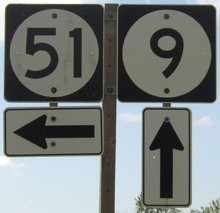
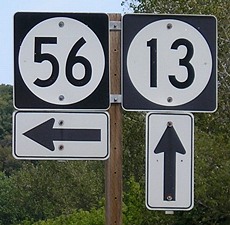
May 19, 2004 / September 7, 2006: There are only two places in Iowa where original 1920 numbers still meet in 2019 — IA 9/51 in Allamakee County and IA 13/56 in Clayton County. Neither intersection is in the same location it was a century ago.
Iowa’s Primary Road Act turns 100 years old today. It laid the groundwork for numbering, building, and maintaining the transportation system that this website is (mostly) about.
A long-ago typewritten report called “Iowa Roads: Historical Sketch of Developments in Administration 1838-1929” (large PDF) says this:
The Thirty-Eighth General Assembly in 1919 gave Iowa a long boost toward road improvement. The law established a primary road system of 6,400 miles; a Primary Road Fund to finance construction and maintenance; and a comprehensive plan by which the entire system was to be improved. The primary road system selected was the same as designated two years previously as the federal aid system though somewhat enlarged. It was specified that it should provide connecting highway links between all the larger towns and market centers. It did, in fact, link up practically every town of 1,000 population, or over.
From then until the Great Depression, counties and cities would determine if their roads would be paved and how much money would be spent on them. According to a 1950 piece about county-issued road bonds, the first two counties to have bond votes, Black Hawk and Palo Alto, went 1-1 on the issue. Greene County’s vote July 28, 1919, a scant 14 weeks after the law passed, would make the Lincoln Highway there a shining star in the Good Roads Movement (and for a decade, the only paved road between Madrid and Cushing). By early October, according to the Cedar Rapids Evening Gazette, 24 counties had “voted in favor of hard surfacing,” including almost all of the most populous, and nine against, including Tama and, ironically, Story.
Over the course of the next year or so the primary system would be figured out — this is why the state’s first road map is dated 1919 — and in the middle of July 1920 highway markers were painted on telephone poles across the state.
It wouldn’t be until 1925, though, that authority of maintenance of the primary roads would be put in the hands of the state, and not until 1938 that cities relinquished maintenance of highways within city limits. Authority over all county roads was given to supervisors on January 1, 1930.
This week is also the 115th birthday of what today is the Iowa Department of Transportation. It was established April 13, 1904, as the Iowa Highway Commission, part of the Iowa State College of Agriculture and Mechanical Arts. The first two men of the commission, Anson Marston and Charles F. Curtiss — the deans of the colleges of engineering and agriculture, respectively — have important buildings at Iowa State named for them today.
Posted in Highway Miscellaneous, Iowa Miscellaneous
Comments Off on 100th anniversary of Iowa’s Primary Road Act
Apr
18
Online mapping and geographical illiteracy
I was all set to cite this story to weep and wail about the state of education — for the most part I still should — but then I stopped to think.
‘Many people can’t find themselves on a map,’ laments Alabama meteorologist
“If I were to give you a blank map with no labels, no highways, just county lines and state lines, could you draw a dot within 50 miles of your house?” he asked. “We’ve seen some studies which show about 85 percent of the population cannot.”
Because here’s the thing. How many times, immediately, besides the situation at hand (weather alerts) does a person need to know what county she’s living in? Voter precincts are only a small part of a county. If you do your vehicle registration online or by mail, you don’t even need to know where the courthouse (or county services building) is. One exception that comes to mind would be jury duty. This is also, very indirectly, an argument for mandating county names on license plates.
For the vast amount of people who rely on GPS’s, and GPS’s built into their smart phones, and all those “location services” based on GPS or ZIP code, it’s not the person who’s doing the thinking. But there’s another part to it.
GOOGLE MAPS HAS NEVER SHOWN COUNTY LINES. In fact, to me, it seems Google has intentionally gone out of its way to avoid showing them. Only if you type “X county [state]” into a search do you get a shaded area, and then if you zoom in too far it disappears. Apple Maps has the same issue. The redesigned Mapquest made county lines virtually invisible and, when they are visible, render the names in small gray type.
So maybe, maybe, the first step in helping people who don’t look at maps all that often is for online mappers to acknowledge the existence of county lines. Beyond that, if large parts of the population can’t even pinpoint what part of a state they live in, there are some deep questions and reassessments to be made.
Apr
17
Webster County Museum in trouble
The roof of the former Otho Elementary is in horrible shape and has put the Webster County Museum’s future in question, reports the Fort Dodge Messenger. The museum also has mold.
One of the museum’s volunteers was killed in a traffic accident and the curator is in a wheelchair.
The article says the museum opened in the school in August 2001, which contradicts a Messenger article from 2015 — also about the building’s leaky roof — when the curator said the museum opened in August 2003. Unfortunately, I think I’d need someone living in Webster County to tell me exactly when Otho Elementary was closed, because some things from the early 2000s are surprisingly hard to find.
Posted in Iowa Miscellaneous
Comments Off on Webster County Museum in trouble
Apr
16
30 years of changes on the Illinois Tollway
Not Iowa, but still relevant to Midwestern roadgeeks and the reporter who sounds like she’s one herself.
EDIT: I was going to embed the video but it autoplays. Sorry. Video’s at the link.
Posted in Highway Miscellaneous
Comments Off on 30 years of changes on the Illinois Tollway
Apr
15
Fictional candidate places real newspaper ad
And may be polling higher than John Delaney.
Iowa would do themselves the honor of selecting me as their candidate for president! Join me!! #newselinanow #veep #hbo #selinameyer pic.twitter.com/cv8vf3xKd9
— Selina Meyer (@OfficialSelinaM) April 13, 2019
One of the other characters from “Veep” also had an ad in The Des Moines Register on Friday.
Despite this attention from HBO, the writers apparently did not know there’s no such place as Waterloo County. (A joke relying on a fictional Cedar Falls Airport that kicked off the first episode of the final season was both less egregious and allowable under the Rule of Funny.)
Posted in Iowa Miscellaneous
Comments Off on Fictional candidate places real newspaper ad