Sept. 30, 2013: InfoCision Stadium in Akron, Ohio.
Iowa State football’s occasional tour of the Mid-American Conference (NOT as an audition for membership, God willing) adds a never-before-visited location: Akron, Ohio. This is the tenth current MAC school ISU will play against, and the nice thing is it’s not Ohio or Kent State again. If ISU is going to do home-and-homes like this, it’s good to go to other places.
ISU’s last appearance in the Buckeye State (4-2 all time) ended in an overtime loss through a missed field goal at Toledo in 2015. ISU and Toledo both beat two power-conference teams that year — Toledo beat ISU and Arkansas, ISU beat Kansas and Texas. It was the beginning of the end for Paul Rhoads.
At the end of that season, in at least the second case of “if you can’t beat ’em, buy ’em” among power-conference teams this decade (Jerry Kill), ISU hired Toledo coach Matt Campbell.
Saturday’s game is also the first for ISU football on CBS Sports Network.
Over the past school year, the Mid-Prairie School District (Kalona, Wellman, and West Chester) was trying to figure out what to do with unbalanced class sizes in geography-based elementary attendance centers.
In April, the school board decided to divide by grades instead of geography. According to KCII Radio, Kalona will be kindergarten, first, and second grade; Wellman will be kindergarten, third, and fourth grade; fifth-graders will go to the middle school in Kalona (5-8); and the elementary buildings have been renamed.
Left out of the reconfiguration was Washington Township school, which is in southwest Johnson County on Angle Road at County Road F67. This is a rare 1960s-era rural school, although it’s not totally so; on the state map, it’s very near Joetown, which is the location of Iowa Mennonite School. Washington Township will be used for Mid-Prairie’s “Home School Assistance Program” but won’t have students anymore.
Washington Township might have been the last active school built for a township. It’s not the last one named for a township, because the district right next door is named for Highland Township in Washington County when Ainsworth and Riverside consolidated in 1963 and built a school between the towns in 1965. (Plus, the Dysart-Geneseo name lives on in the elementary in Dysart.) See also this 2016 blog post that lists other names that still include a township component. The official name for Cedar Rapids Prairie is the College Community School District, after College Township, which used to be about a regular square running up to 29th Avenue Southwest but now only officially includes parts not absorbed into the city of Cedar Rapids.
(Half-hat tip: This Gazette article about increased enrollment in urban areas, which has a map at the bottom of “public schools opened and closed in 2017-18”. This is from state data, but the labels can be misleading. For example, Laurens-Marathon and Charter Oak-Ute are marked because they lost their high schools, but they still have elementary grades. And it goes by high school location, so the marker over Fairfield is for Libertyville Elementary.)
UPDATE 9/24: Link to blog post with other names, and some information about C.R. Prairie.
Posted inSchools|Comments Off on Mid-Prairie grade reconfiguration closes* school
Today will be the last time that school board elections and school-related votes will take place in September. In spring the Iowa Legislature approved combining city and school elections into November of odd-numbered years (bill text here) along with a tweaking of acceptable other dates throughout the year for special elections. This is probably ill-advised because of the jurisdictional issues — school and city ballots will have to be separate or else multiple versions will be necessary — but that’s what’s going to happen.
But of equal or maybe greater importance, in terms of the message it carries and the lasting impact, is the decision on whether to dissolve the Gladbrook-Reinbeck school district. It has finally reached a vote after a false start, because if at first you don’t secede, try, try again.
In the GR election, a “No” is to keep the district as it is, and thus keep a school in Reinbeck; a “Yes” is to dissolve Gladbrook-Reinbeck.
PRE-POST UPDATE: The pro-dissolution side made a TV commercial. Former GR school board member Michael Bearden — who according to Radio Iowa is “spearheading the movement” speaks: “The consolidation of the Gladbrook-Reinbeck school was a great partnership. That partnership ended with the closing of the Gladbrook campus. … Voting YES to dissolve the GR district is a win-win situation for all students.”
That’s not just burning bridges; that’s napalming them.
RESULTS UPDATE: Resolution fails by 69%-31% margin.
Posted inSchools, Tama County|Comments Off on The last September school election in Iowa
When I saw the copies at the Alumni Center, I thought what was there was either an insert or a mistake. But then I looked closer.
An eight-page paper the same physical size as a Farm Bureau Spokesman, with four news articles (two of which were mostly graphics), one sports article, an editorial and an opinion column, carried the masthead of the Iowa State Daily. The issue the day before the UNI game was 12 pages.
“So, over the summer, our staff worked to vastly redesign our paper to better fit the feedback we’ve received from our readers during the last few years,” the Daily’s editor in chief wrote Aug. 20, on a website that has had a definite mobile-first mindset for years. “The new design includes three main changes: size, style and type of content.”
Size: Smaller. Style: Lots of white space. Type of content: Well, there is some, with big graphics.
The Iowa State Daily has whacked the print product down to a shell of its former self. This carries some emotional heft for me, because it is there that I started a professional journalism career 16 years ago today. (Yes, that day.) To see a newspaper from the first week of classes, when I would have scrambled for wire articles to fill the extra-large ad-filled sections, reduced to a pamphlet was very sobering.
Or, to put it another way, as someone whose income depends on the existence of a physical medium: eep.
Posted inIowa Miscellaneous|Comments Off on The incredible shrinking Iowa State Daily
Kirk Ferentz, who became the longest consecutively tenured head coach in college football this season, has yet to have a winning record against what is now the fourth-worst power-conference team in history.
Posted inSports|Comments Off on Option read, White’s got the corner…
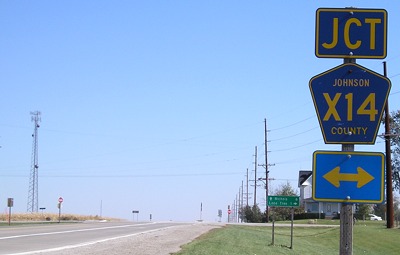
October 13, 2006: Eastbound IA 22 at old north end of IA 405.
Throughout the 45 years that the intersection of IA 22 and the road leading into Lone Tree was a state highway (IA 405), 22 was always the through road. Now, though, the Iowa DOT is going to convert the intersection into a four-way stop. That’s going to happen next week.
IA 22 has one other four-way stop, with IA 1 at Kalona. I would have to do some digging to find a four-way stop with a state-maintained highway at a county road that did not involve the highway turning. (UPDATE: IA 13 at E34/County Home Road in Linn County is a four-way stop, so there’s one.)
The Baby Boom-related expansion of high schools in Iowa began in 1967, when Iowa’s two largest cities opened new buildings.
Des Moines Hoover celebrated its anniversary last week (above). Herbert Hoover, Iowa’s only native son elected president, had died three years earlier.
A half-century after those two opened, Iowa City Liberty High School started classes, this time as a sign of urban sprawl. Hoover and Kennedy remain among the ten newest high schools to open in Iowa that were not a reconfiguration or relocation of existing ones.
Posted inSchools|Comments Off on 50th anniversary of Cedar Rapids Kennedy, Des Moines Hoover schools
KMEG Channel 14 in Sioux City, a CBS station, is the only such affiliate in Iowa on the UHF spectrum. The switch to digital has largely rendered the VHF/UHF distinction obsolete — as has the random channel assignments cable companies do nowadays — but keeping the “classic” identification is a tie to history.
In back-to-back games eight months apart, Iowa State went toe-to-toe with college football royalty and blinked. Or, alternatively, the college football gods noticed what was going on and engineered a snap recalibration.
December 27, 2001, Purgatory Shreveport LA
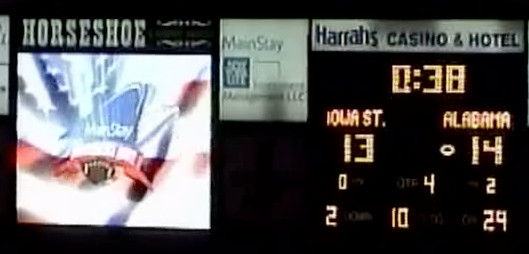
The year after Iowa State’s first bowl win and only nine-win season since Oklahoma became a state, the Cyclones went 7-4. Two seasons removed from (and one season ahead of) 10-win campaigns, Alabama was 6-5. The final game for both was, as so many bowl games are, in SEC country — Iowa State’s first time down there since playing at Vanderbilt in 1983.
Iowa State led the game until an Alabama touchdown with under five minutes to go. But the only thing anyone remembers happened with 51 seconds remaining, when Tony Yelk kicked a 47-yard attempt over the right upright.
Over.
The ruling on the field was “wide right.” The video board at the stadium did not show the replay. Alabama 14, Iowa State 13.
In the decade-long interregnum between Gene Stallings and Nick Saban (1997-2006), the Crimson Tide had three 10-win seasons and went 67-53 on the field (setting aside NCAA adjustments). Alabama fans unironically refer to this era as “the dark ages.” After going 7-6 in Saban’s first year (2007), Alabama has posted double-digit-win seasons since. Oh, and won four national championships, thanks in no small part to Iowa State, and a “missed” field goal. You might have heard a little about that.
August 24, 2002, Kansas City MO
Through a preseason-game exemption and a calendar that opened an experiment to extend the schedule, Iowa State had a 13-game regular season in 2002. The season opener was the Eddie Robinson Classic on a warm night in Arrowhead Stadium. The opponent was Florida State, which had posted double-digit-win seasons every year from 1987 to 2000, coached by legend Bobby Bowden. The Seminoles, before going 8-4 in 2001, had been in the national championship game three years in a row, winning one; another one was more than a decade in the future.
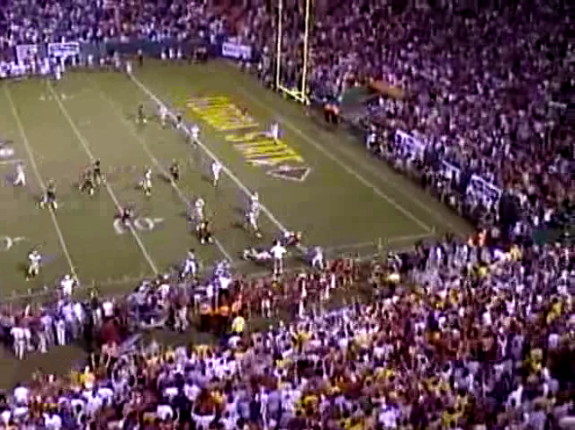
The Cyclones trailed 24-0 early in the second quarter, then started clawing back, until the Seminoles only led by 7. With 21 seconds remaining in the game, on the second-to-last play, Seneca Wallace did what he would do so well that season and take off, both metaphorically and literally, holding the ball over the pylon in the corner of the end zone.
Over.
August 24, 2002: Still frame from family video of Seneca Wallace’s run toward the end zone in the fourth quarter of the Iowa State-Florida State game.
Instant replay for official review in college football did not start until 2004 in the Big Ten Conference and 2005 elsewhere. For what it’s worth, the official right there made the call right away, and even a touchdown would have required a good PAT and overtime. But officially, the ball was not in, and, FSU kept Wallace out of the end zone on the last play. Florida State 38, Iowa State 31.
Florida State finished the season 9-5, winning the ACC and losing the Sugar Bowl to Georgia Tech. Iowa State won its next six games, earning the first AP Top 10 ranking in program history, then suffered a loss to Oklahoma so brutal and traumatic that the Cyclones lost all but one remaining game by double digits.
From August 24, 2002, to September 1, 2017, Alabama lost 46 games and Florida State lost 55. Iowa State lost 118, more than the two of them combined. Tomorrow night, the Crimson Tide and Seminoles will play the first college football game in Atlanta’s new stadium. Tomorrow night, Iowa State will be on its fourth coach since 2002 and is widely expected to finish third-to-last in a 10-team conference.
Would things be different if the ball moved just a little bit on either of those plays? Probably not. But for a fleeting time, a rising Iowa State intersected the lines of two well-known teams, and the next step was tantalizingly close.

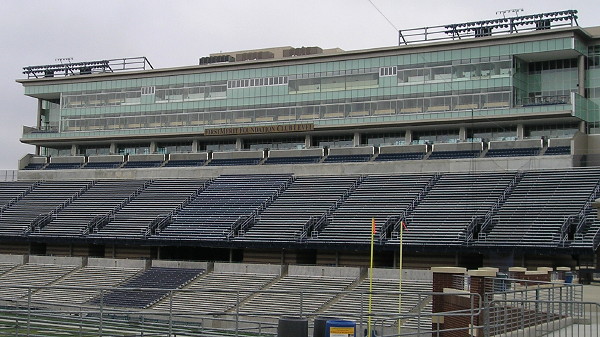 Sept. 30, 2013: InfoCision Stadium in Akron, Ohio.