May 19

Notes on 2022-26 five-year plan (1)


June 20, 2017: This intersection on the south side of Nevada will not be closed in 2023 in favor of an overpass between here and the S14 intersection in the deep background. UPDATE/CORRECTION 6/25/21: Current plans leave the intersection intact at the bridge’s completion.

Here is the first part of a list of major projects or interesting things I saw in the draft five-year construction plan, released after the Iowa Transportation Commission’s May meeting. The highway stuff begins about halfway through the PDF.

Not mentioned below are the continuation of the I-80/380 interchange replacement, I-29/480 interchange, or future redesign (again) of the northeast mixmaster in Des Moines.

  • The draft plan does not include mileage for any project.
  • The I-74 bridge is to be completed this calendar year with demolition of the old ones next year. The final piece of the arch of the Illinois-bound bridge was set May 5; here’s a video from the Quad-City Times.
  • US 30:
    • Four-lane in Tama County plus the IA 21 interchange in 2022, i.e. hopefully finished by midsummer next year.
    • Four-lane in Benton County in 2022-23.
    • New exit at R70, 2 miles east of I-35, in 2023-24, slightly extending the controlled-access portion. The Nevada Journal wrote about it last March. This and the next item have been discussed for nearly a decade; see these blog posts from 2015 and 2017.
    • A new bridge, but not a new exit, between S14 and 6th Street (former IA 133) in Nevada in 2023. This will close both intersections of those roads with 30. (UPDATE: 6th Street will stay open.)  The Nevada City Council endorsed last year (story: Ames Tribune) after un-endorsing it in 2015. It’s based on promise/hope of a future exit at Airport Road, which is not in the program yet.
    • Missouri Valley bypass programmed for bridge and grading later, with paving likely in 2027.
  • I-80:
    • Six-laning from Alice’s Road Grand Prairie Parkway to Jordan Creek Parkway, 2023-25
    • Six-laning from where it currently ends just west of Herbert Hoover Highway to West Branch, through 2025. The first part of that started this spring with closure of a ramp at the HHH exit.
    • Around the IA 38 exit, including redoing it with space for the ULTIMATE LANE, in 2023
    • New Raccoon River bridges near the De Soto exit in 2022/2024. The PDF shows “bridge for 6 pave for 4”.
    • Continued replacement of the North Skunk River bridges, which is also “bridge for 6 pave for 4”, in 2022.
    • The IA 146 exit, also a “bridge for 6 pave for 4”, in 2022; the original eastbound lanes are in the space for the new median
    • Paving, with bridge widening, between University and Douglas avenues in 2025-26. This is through the Living History Farms area. I figure this is to turn I-35/80 from three through lanes with a dedicated exit lane to four through lanes with a dedicated exit lane.
    • “Improvement”, which I suspect means replacement, of the westbound Underwood rest area in 2025
    • “Improvement” of the eastbound Iowa County rest area, which used to be a welcome center in the middle of the state, in 2024
    • Any chance future five-year plans could specify “6-lane” or “prepare/bridge for 6 pave for 4”? Just asking.
Posted in Construction | Comments Off on Notes on 2022-26 five-year plan (1)
May 18

Algona, Lu Verne look into consolidation

What’s left of what once was the Corwith-Wesley-Lu Verne school system — officially never consolidated but together for three decades — is probably going away soon.

Algona and Lu Verne have formed a reorganization committee, Radio Iowa reports. Realistically, this means the absorption of the Lu Verne district, which officially got most of C-W’s land in 2015 but maintained only an elementary for those students while CWL’s sixth grade and up went to Algona. Algona High School, never renamed, directly includes Burt, Titonka, and Whittemore, and through the present sharing agreement includes Corwith, Wesley, and Lu Verne.

Barring any shaving off of Lu Verne’s land to the south, the Algona district would be 550 square miles. It would be Iowa’s largest single-high-school unified district, but just a shade below MVAOCOU in single-high-school area (two districts) and Western Dubuque in overall area. For more about that, read my series from June 2016.

(NOTE: Present school/district size numbers are slightly different from this 2014 blog post, following a “2015-2016 School District Review Program (SDRP) effort through the U.S. Census Bureau” that allowed for digitally-pegged maps and more accurate area measurements. I don’t blame Western Dubuque for sticking with 555 square miles instead of 553.96, though.)

Posted in Schools | Comments Off on Algona, Lu Verne look into consolidation
May 17

Diverging diamond interchange coming to Coralville

I-80’s 1st Avenue exit in Coralville, scheduled for replacement in 2023, will be Johnson County’s first diverging diamond. That will be a year after I-380 at Tower Terrace Road becomes the first such exit in eastern Iowa.

The interesting thing about this plan (link to lots of renderings here) is incorporation of a trail crossing. The trail, on the east side of the interchange, will have underpasses at three places:

  • Under a new connection between the Iowa River Landing area and 1st Avenue, approximately where the eastbound ramps meet 1st today. This will be a new intersection between the ramps (closer to I-80) and the present stoplight at 9th Street. The future street connection has a paving stub west of Von Maur/north of the UIHC clinic parking ramp already.
  • Under the eastbound onramp to I-80, after which the trail takes a huge bend eastward for a pedestrian bridge and comes back.
  • Under all four lanes of 1st Avenue at the westbound ramps, which means the tunnel is even longer than it would be to simply go under four lanes. The tunnel goes from the southeast corner of the westbound ramp junction to the northwest corner near the Hampton Inn.

The exit will serve the arena whose naming rights deal hasn’t been disclosed because of Coralville’s assertion that actually a nonprofit that the city created made the deal, not the city, and therefore it’s not public record.

Posted in Construction | Comments Off on Diverging diamond interchange coming to Coralville
May 14

790,150: Not officially a magic number, but a curious one

We have a lot of census-related numbers floating around right now, and each makes one piece of a puzzle, but it will be hard to put them all together until the granular data comes out later this year. Here’s what I DO know:

  • The OFFICIAL April 1, 2020 population of Iowa is 3,192,046. This is 30,000 greater than the July 1, 2020 estimate of 3,163,561. The estimate is “without incorporation or consideration of the 2020 Census results” but still, that’s a LOT.
    • That’s 798,011.5 per congressional seat. Anyone got a house straddling county lines?
    • That’s officially 31,920 per state House seat (larger than 77 individual counties) and 63,841 per Senate seat.
    • The 2020 estimates amount to 790,890/31,636/63,271.
    • That’s a difference of 7,121 per between estimates/actuals per district — more than the populations of 12 counties. (Three more are under 8,000.)
    • The 2020 county estimates released May 4 will be superseded when intercensal numbers come out in 2022.
  • The fear of Iowa losing a seat in 2030 is far-fetched. In 2010, when Iowa went from five representatives to four, it had the third-most people per district of states with more than one representative. One of the two with more, Oregon, is getting another seat for 2022. Iowa will have four people in the U.S. House in the 2030s.

All that said, I can still make maps based on the data that doesn’t count — for entertainment purposes only, of course. Maps with those numbers (the estimates that will be voided in 2022) will come later, but I’ve already found one wacky circumstance.

790150-twice-2

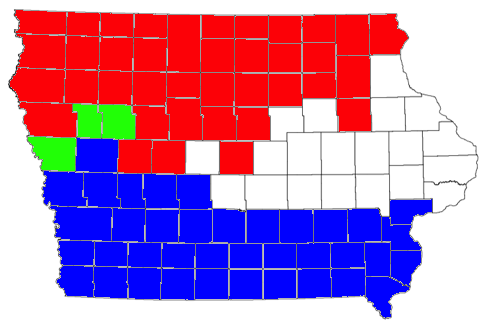
The BLUE counties plus Ida, Sac, and Monona = 790,150. The RED counties plus Ida, Sac, and Monona = 790,150. This number is 740 less than the per-district division from the 2020 estimates, thus a functional number for the second iteration of my redistricting game. If I assign Boone County to the Blue Group and the other three to the Red Group, both will form districts that vary from the 2020 estimate ideal by less than 1000 — and look like plausible districts, to boot. This also means that the remaining 19 counties account for half the state’s population.

Coming up with exactly 790,150 people through two almost completely different county combinations? That’s far out, man.

Posted in Iowa Miscellaneous, Maps | Comments Off on 790,150: Not officially a magic number, but a curious one
May 12

RAGBRAI XLVIII, v3.0

Maps for this summer’s RAGBRAI route, which is last summer’s RAGBRAI route, were released online May 3. Wait, didn’t we do this already? Yes, we did! But what’s presumably the final route has some notable differences from the previous final route, especially in omission of towns. The January route, in turn, had some subtle differences from the FIRST map, released only in line form. This is my analysis of the differences, through saved daily images and this zoomable map.

  • Day 1: Le Mars to Sac City (v1: Le Mars to Storm Lake)
    • Oyens, though marked as being on IA 3, is technically a mile north.
    • Marcus (v1/v2), Cleghorn (v2), and Meriden (v2) are out, replaced with IA 140 and C38. It would have been RAGBRAI’s first visit to the latter two.
    • IA 3 and IA 7, not S Avenue and 550th Street, between the east side of Cherokee and Aurelia.
    • Alta is still on, losing its spot as the largest non-suburb RAGBRAI hasn’t visited.
    • Schaller (v2) is out; the route will turn from IA 110 to D15 a mile north.
    • The v3 daily map has “IA 71” south of Early instead of IA 471. It also marks D36/old 20 as only 255th Street. I have a strong hunch that the daily maps were compiled based off Google, which still has US 71 running south of Early and does not have a D36 marker west of Sac City.
  • Day 2: Sac City to Fort Dodge (v1: Storm Lake to Fort Dodge)
    • The “old 20” component of this day has dwindled with each map.
    • Lake City has replaced Rockwell City as meeting town.
    • A little notch between N28 and D53 moves the route through tiny Yetter, though the town’s not marked, perhaps because you have to zoom deep in Google to see it.
    • “330th” and “Harris” are D53 and N37.
    • Somers (v2) and Roelyn (v2) are out in favor of Callender, via D46 and P33. Prairie Valley Elementary is in, too.
    • Including a route through downtown Moorland, crossing the railroad at Western Street.
    • Into Fort Dodge: Kenyon Road, S 8th Street, 1st Avenue S (camp by river)
  • Day 3: Fort Dodge to Webster City
    • Nearly unchanged since original, with the addition of two long optional gravel segments I will not attempt to discern.
    • Out of Fort Dodge: 1st Avenue S, S 15th Street, 2nd Avenue N, MLK Drive (past high school), 10th Avenue N, D18, P63
    • The main route does not go through Williams. Blairsburg to Williams (v1) was straightforward old 20: D20 and R75. The newer versions go north from Blairsburg, specifically on US 69, then east to Williams on D20…but Williams is not on the east-west part of D20. Nor is Williams due west of Alden, as shown on v2 and v3. The official interactive route map follows 69 and D20, missing downtown Williams by 2 miles.
    • D15, not D16, as the route goes down Alden’s Main Street.
  • Day 4: Iowa Falls to Waterloo
    • After ditching Dike and Hudson from v1 for Janesville, v2 and v3 are identical.
    • New Hartford to Waterloo airport: Main Street, C67, T75 (this part is marked C67 on the v3 map), C55, V14 (old 218), C57/Cedar Wapsi Road, V25/Wagner Road
    • In Waterloo, from KWWL: Big Rock Road, Burton Avenue, Conger Street, River Road, Commercial Street. This ends at the downtown festival.
  • Day 5: Waterloo to Anamosa
    • Out of Waterloo: Lafayette Street, Evans Road, Dubuque Road/old 20
    • Elk Run Heights is on the route but unmarked on the daily map.
    • Gilbertville, Brandon, and Urbana have all been cut, in favor of Jesup and Rowley.
    • Shady Grove, at the V65/D47 intersection, is a rural collection of houses, but it shows up on a high zoom level on Google.
    • The road south of Walker hasn’t been IA 920 for 18 years, but Google doesn’t know that. It’s W6E as opposed to a southward extension of W35, which would have made more sense.
  • Day 6: Anamosa to DeWitt (v1: Anamosa to Maquoketa)
    • Everything east of the IA 136/Y32 intersection was changed from v1 after Maquoketa dropped out.
    • E45, IA 136, and E63 markers are in incorrect places on the daily map, and some markers are omitted, so I am going to list turn-by-turn below.
    • Anamosa to Calamus: IA 64, IA 38, E45, IA 136, Y34, E63, Y44
    • Calamus: Davenport, Spring, 2nd, Main, 5th streets. Not quite the Lincoln Highway, which is signed on Grove instead of Main, but close.
    • Calamus to De Witt: 245th Street, Y52, F21, Y54, 255th Street, Y62, 225th Street, just missing Grand Mound.
    • The entrance to DeWitt in v3 differs from v2: 18th Avenue, 17th Street, 14th Avenue, 14th Street, 8th Avenue, 10th Street to Lincoln Park.
  • Day 7: De Witt to Clinton (v1: Maquoketa to Clinton)
    • Six Mile is still just an extinct map dot. As a Huebinger map from the 1910s would say, “No accommodations.” Not even a blacksmith.
Posted in Maps | Comments Off on RAGBRAI XLVIII, v3.0
May 11

Well, that’s embarrassing

My chronology of Iowa congressional districts had Tama Jim Wilson’s election years off by a decade. He was elected to the U.S. House in 1882 and 1884. Blog-me should’ve told map-me about this, but even then the error has been displayed for a decade.

So corrected.

Posted in Maps | Comments Off on Well, that’s embarrassing
May 10

Council Bluffs dual, divided freeway completion this week

An e-mail from a mailing list and this DOT press release bring good news for western Iowa: The I-80 dual, divided freeway separation will be completed this week.

There will be some closures to get lane shifts complete, but starting Thursday, a traveler getting on I-80 at 13th Street in Omaha can go straight through to Madison Avenue in Council Bluffs with only the I-29 exits in between. The I-29/local/outer lanes have the South Expressway and South 24th Street exits. The entrance ramp at South Expressway will have its own bridge and lanes to southbound I-29 and eastbound I-80.

Technically, if you’re really hard-core about it, this means you can travel I-80 without traveling I-29, and travel I-29 without traveling I-80.

The wrap-up of this part of the Council Bluffs Interstate System project comes just as the next part starts. Construction on the I-29/I-480 interchange, which will include a complete rebuild and changes to the Nebraska Avenue, Avenue G, and 35th Street ramps, began in April (KETV). At the same time, the I-480 Missouri River bridge is undergoing major rehab on the Nebraska side that will last 2½ years (WOWT).

Posted in Construction | Comments Off on Council Bluffs dual, divided freeway completion this week
May 07

KSO: A saga in three paragraphs

KSO, Iowa’s other three-letter AM station starting with a K, debuted Nov. 2, 1925. The Berry Seed Co. of Clarinda had specifically applied for the letters: “Keep Serving Others.” The following articles are from the Clarinda Journal in 1932, which became the Clarinda Herald-Journal at the start of 1933.

New manager at KSO takes over station (March 10)

L.H. Greer of Des Moines is now in Clarinda, as director of KSO, the local broadcasting station of the Iowa Broadcasting Co. Mr. Greer, who succeeds Morton R. Duff, has been chief engineer for several radio stations, and was the engineer in charge of reinstallation here several months ago when the KSO equipment was revamped. He states that he will soon announce reorganization plans which will include important personnel changes, and contemplates more localizing of programs.

KSO hearing in September (July 14)

The federal radio commission will not hand down their decision on KSO’s petition to move from Clarinda to Des Moines until September, according to dispatches from Washington news headquarters. The hearing of the Iowa Broadcasting Co., the Register and Tribune subsidiary company, was given July 7th. [KSO had signed off June 24.]

Will dismantle KSO radio tower (August 11)

Engineer L.H. Greer dropped into Clarinda from Des Moines Wednesday with A.J. Newman, structural engineer with the Newman Construction Co. of Des Moines, to survey the possibilities of salvaging the tower in case the federal radio commission gives their final approval to move the local KSO station to Des Moines. The transmitter was found to be too big for Des Moines, an thus it will be disposed of, either dismantled or sold to someone else who might be able to use it.

“Reorganization plans” indeed, eh? For way more details on KSO, see this page from the Des Moines Broadcasting website. The radio waves get crossed, so to speak, in 1935, when KSO was renamed KRNT, for the Des Moines Register ‘n’ Tribune. The KSO letters were moved to KWCR, a Cedar Rapids station whose license was relocated to Des Moines after its acquisition by Iowa Broadcasting. That KSO, after a series of ownership and call letter changes, is now KXNO 1460 AM, a sports-talk station in Des Moines.

Posted in Iowa Miscellaneous | Comments Off on KSO: A saga in three paragraphs
May 05

License Plate Letters — KMA

KMA 960 AM is one of Iowa’s oldest radio stations. Its call letters, chosen specifically by the May Seed & Nursery Co., mean “Keep Millions Advised.” The May family owned the station from its beginning in 1925 until 2019. Here is a book from 1985 (large PDF) chronicling the station’s first 60 years.

KMA is one of the few three-letter K stations remaining east of the Rockies. The codes had been “assigned to the Merchant Fleet of War Vessels during the late World War,” said the April 30, 1925, Clarinda Herald. Two in Pennsylvania have weird histories and one of those may have been an accident.

KMA’s letters came after the K/W line was moved to the Mississippi River, but before 1930 while stations were still able to apply for both three-letter and personalized call letters.

(The K/W switch in early 1923 grandfathered in such well-known Iowa stations as WOI and WOC. WMT came in slightly later as a change from WJAM, which started in 1922. However, from what I can gather, the only way WHO could have gotten those letters on April 15, 1924, is by request, contradictory to its Wikipedia page. The only other three-letter W that month went to Sears Roebuck — the World’s Largest Store.)

The Early Radio History website, nearly 25 years old, is a treasure trove of information about early radio. Its creator painstakingly has dug up a lot of history.

There was another three-letter K station owned by a seed company a few miles down the road from KMA. That’ll be covered in a future post.

Posted in Iowa Miscellaneous, License Plates | Comments Off on License Plate Letters — KMA
May 03

US 61 four-lane: Where the rest stands now

The DOT has released final plans for four-laning US 61 from the north end of the future Mediapolis bypass to just north of IA 78, including a new interchange with a slightly extended IA 78. Typically, there would be a scheduled meeting, but it’s been replaced with a 12-minute video instead. (NOTE: There’s a typo in the filenames; they say “US6” instead of “US61”.)

As the project statement affirms — or perhaps admits — this is the continuation of a process that got under way in the fall of 1996! The idea of four-laning all of 61 in Iowa goes back 30 years before that! It’s one of the projects killed in late 2001 when the DOT said it was expecting a $300 million funding shortfall. It’s also one of the projects currently on the schedule only because of the increase in the state gas tax a while back.

US 61 between Burlington and Grandview has four chunks, and based on last year’s five-year plan and some media coverage, here’s what I know or think:

  • Burlington to south of Mediapolis: To be done by the end of this year. Parts of 61 are being left behind.
  • Mediapolis bypass: Paving currently scheduled for 2024.
  • North of Mediapolis to IA 78: This is the subject of this spring’s meeting. With grading scheduled for 2024, paving wouldn’t happen until 2026. Nearly all of present 61 will be left behind.
  • IA 78 to IA 92, including Wapello bypass: This is the last link in four-lane 61 in southern Iowa and the most environmentally sensitive part, through the Iowa River valley. My estimate is that Thanksgiving 2028 is optimistic and Thanksgiving 2030 more realistic, which would be 16 years after a commitment was made to bypassing Wapello and not five-laning the current road. How traffic would then get between the four-lane and Wapello has been a tug-of-war. An agreement has probably been reached, but I think you’ll understand my hesitation on that point.
Posted in Construction | Comments Off on US 61 four-lane: Where the rest stands now