Apr 03

D is for Dumont

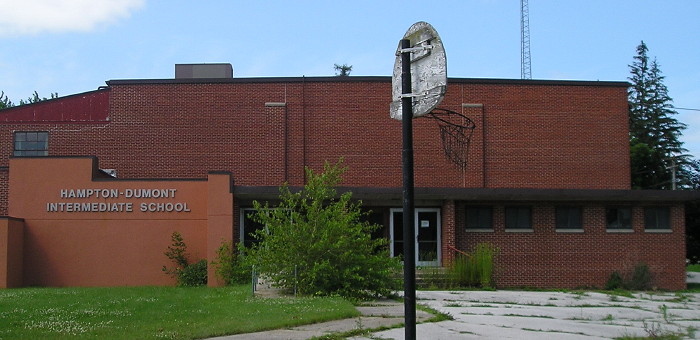
July 7, 2015: The closed Hampton-Dumont Intermediate School in Dumont. The lighter-colored concrete portion with the school name is where the connection to the original school building was; that part was demolished in the 2005-06 school year.

The passage of a bond issue in 2004 made the closing of Hampton-Dumont’s site in Dumont a matter of time. The voters in Dumont probably knew it, too, because they had voted in large numbers against the referendum before — twice in 2002 alone. The main thrust of the bond issue was to build a new middle school in Hampton, because the existing one had assorted age and Americans with Disabilities Act issues.

The Mason City Globe-Gazette quoted Superintendent Lee Morrison in 2004, when a $7.9 million bond issue passed: “I think they realized we have a commitment to that building,” referring to the fear expressed by some Dumont voters that their school building would be closed.

But by 2009, after the new middle school had opened, HD’s enrollment had dipped about 5% since 2000. That was enough for the school district to decide to end attendance at Dumont, which by then was down to fourth-graders only.

When I saw the building in 2015, except for the grass in the asphalt play area and slightly-too-big foliage close to the building, the Dumont school looked like it could have been in use yesterday and reactivated tomorrow. Archived stories from the Globe-Gazette used for this blog post also merited some tweaks to the Hampton and Dumont year entries on my school timeline.
Posted in Schools | Comments Off on D is for Dumont
Apr 02

Could the state drop IA 922?


May 18, 2017: From the interchange at the south end of IA 922/Business 151. These shields have been replaced with the new wide style and small arrows. The Business 151 page has a bunch of new photos BTW.

The Iowa DOT, freed from its maintenance of spur routes and low-traffic highways in 2003, appears to have a decommissioning strategy the past few years. Urban arterials have been prime candidate for deletion, and it’s easy to see why: They don’t carry much long-distance traffic, it cuts out lots of lane miles for the distance involved, and then cities are free to reshape the roads as they please (or as they need, with underlying infrastructure issues).

  • Perhaps the most known and longest-issue case is University Avenue in Cedar Falls and Waterloo (IA 934), which feels like the state wanted to unload since it re-established jurisdiction in 1998. The state paid Waterloo $28 million (PDF) — $1873.86 per foot — to be rid of that portion.
  • Business US 169 (IA 926) was turned over to Fort Dodge in 2014.
  • IA 92 was rerouted around Muscatine when Mississippi Drive was transferred to the city (PDF).
  • West Broadway in Council Bluffs — a road that, as the Lincoln Highway, pre-dated the state system — was transferred to the city of Council Bluffs in 2016, along with the north half of IA 192, and earlier this month the rest of 192 followed. For now, at least, Kanesville Boulevard remains under state control.
  • When the Southwest Arterial is completed in Dubuque in 2019, US 52 will be rerouted onto it. Central Avenue and the one-way pairs downtown that carry it and IA 3 will be given to the city.
  • Not transferred to city control, at least not yet: Business 61 through Davenport, now IA 461.

Untouched in all of this is Business US 151 in Cedar Rapids, which is IA 922, nearly 9 miles long. It’s all urban arterial surface street, four or five lanes throughout. There is an ongoing construction project on the northern part of the route, 27th Street to 40th Street.

Combined with earlier work, this is putting the north half of the route in pretty good condition. So how about talking about a turnover? The state could dead-end the 922 designation at the end of the construction, or farther southwest, maintaining the 1st Avenue Bridge and the Williams Boulevard portion.

(This is all speculation, if it’s not clear. There is no discussion about this at the moment, yet it seems like something that should be, especially as the state will add Linn County mileage with the IA 100 bypass. I suggested the same thing regarding US 69 between Des Moines and Ankeny as it is upgraded this year.)

Posted in Highway Miscellaneous | Comments Off on Could the state drop IA 922?
Mar 30

Square 218 shields a threatened species


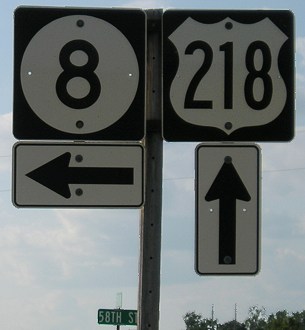
July 15, 2007: Despite the difference in digits, these shields are the same size around. The east end of IA 8 is one of the few places left in Iowa where you see square US 218 shields as you drive the latter route.

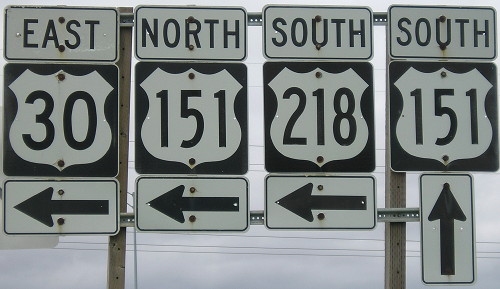
In about the middle of the decade, Iowa started moving toward larger shields at two scales: Wide shields (3 feet wide by 2 feet high) for all three-digit routes, and jumbo signs on four-lane roads. (Ironically, this has not been applied to interstates…yet.) In my opinion, the wide shield is wildly unnecessary, especially in Iowa, where only one three-digit US route does not have a 1 in it.

With mass replacements going on across the state, there are only three segments of US 218 where wide shields are not the order of the day: Between the IA 57/58 interchange and US 30, along I-380, and the short final standalone segments from Donnellson to Keokuk. But with a February sign letting for southeast Iowa, the latter isn’t going to be in this case for long. The 218 shields in the city of Keokuk, and all the US 136 shields, aren’t included in that letting, so they’ll stay for now.

Since the bulk of 218’s entire route is in Iowa, replacement like this will spell the end for the squares — but they won’t be gone entirely. All of the county roads that intersect 218 — including those from the Second Great Decommissioning — retain the squares. We just won’t see them on the mainline while traveling the route.

Posted in Construction | Comments Off on Square 218 shields a threatened species
Mar 29

Return of the Demon Sheep

It’s probably not news that footage used in campaign ads will be reused and recycled over the course of multiple elections. But there’s one now that takes the reuse to a new level because the original content is somewhat notorious.

The ad is from the Iowa Credit Union League, in response to a bill in the Iowa Legislature that would tax credit unions the same as banks while reducing banks’ tax rate. It aired on KGAN between the Kansas-Duke Elite Eight game and the “60 Minutes” Stormy Daniels interview (right in that period when a network goes through an unavoidable tonal shift).

The clips originated with Carly Fiorina’s 2010 Senate primary campaign in California. Time magazine reported at the time:

The ad was so weird — employing montages of pigs and sheep, a robotic wolfman dressed in wool, graphic illustration evoking Monty Python — that it spread online like swine flu on a pig farm.

The Demon Sheep segment starts around the 2:20 mark; frames above match around 2:26 and 2:51.

I’d put a string of sheep puns here, but the ads covered all of them already.

Posted in Uncategorized | Comments Off on Return of the Demon Sheep
Mar 28

Benton County closing front door to courthouse, installing metal detector

IFJuly 23, 2015: When RAGBRAI had a noon stop in Vinton, the south-side front door of the courthouse was open.
A procedure once reserved for only the biggest county courthouses in Iowa is trickling down to at least one more.

Starting Monday, all visitors to the Benton County Courthouse in Vinton will be restricted to the west entrance and will have to go through a metal detector, reports the Cedar Valley Times. The north and south doors will be restricted to emergency exits. The article does not say what, if any, extra costs will be incurred from the added security (or the metaphorical effects of slamming the front door shut).

According to a Quad-City Times article reprinted in the Sioux City Journal, in summer 2014 only 10 courthouses in Iowa had metal detectors including Woodbury which had just started that August.

Posted in Iowa Miscellaneous | Comments Off on Benton County closing front door to courthouse, installing metal detector
Mar 27

Analysis of 2018 RAGBRAI map


July 23, 2008: RAGBRAI passed through the center of Iowa (well, close enough) in 2008 and will again this year.

The Register’s preview appears to be trying to tell me something.

If you can locate Ute, Aspinwall, Dana, Peoria and Harper on a map, you should launch a candidacy for statewide office.

*clears throat, raises hand*

If nominated, I will not run; if elected, well, you’ve done worse.

Since the Register switched to releasing daily maps on the RAGBRAI website, there’s been a little less of the history invoked in the main route stories. This route passes through five towns that have never been on it before, and despite being a short central route travels some roads that haven’t been used either ever or recently.

  • Towns RAGBRAI has never been to but will hit in 2018 are Aspinwall, New Sharon (on the century loop aka Karras Loop), Wellman, Kalona, and Blue Grass.
  • Towns not visited in the last 30 years are Soldier (1987), Moorhead (1981) (gravel loop this time), Ute (1987), Charter Oak (1987), Melbourne (1976), Harper (1986) and Keota (1986).
  • Given the map, if Lambs Grove ends up on the route, the ride will pass through 46 incorporated places including 2 on the loops.
  • Parts of the Lincoln Highway in Greene, Boone, Story, and Marshall counties will be followed. The segments from Scranton to Boone and Ames to State Center repeat 2008.
  • Segments RAGBRAI has never used before: IA 141 through Aspinwall, through Ledges State Park, the roads in the Karras Loop, Keota to Riverside (mainly IA 22), and Wilton to just north of Blue Grass.
  • Bettendorf gets stiffed AGAIN. This is just mean. The city should lobby hard to be the endpoint in 2022, after the I-74 bridge is completed. The cycle would be just right.
  • Because the ride passes through Kalona this year, Traer is now the second-largest community not adjacent to a metro area that RAGBRAI has never been through, behind only Alta. (Alta’s been left out of FIVE separate Sioux-City-to-Storm-Lake segments; is the railroad crossing an issue?) Overall, Traer is the 12th-largest city completely unscathed by the pie-eating hordes, although there are five larger that haven’t seen riders in at least 30 years.

I have updated my RAGBRAI towns list to include the 2018 list.

Posted in Iowa Miscellaneous, Maps | Comments Off on Analysis of 2018 RAGBRAI map
Mar 26

New-look license plates coming out

A revised design for Iowa’s license plates is being phased in next month, the Des Moines Register reported last week. (I honestly forgot this was happening.) Eight counties running low on inventory will get them first. A photo with the story shows GXV’s for Crawford County rolling down the line, which means that we’re going to have a random switch in mid-sequence (instead of, say, waiting for the H’s).

I ranted about the arbitrariness and mismatch nature of the current strategy last year.

Posted in License Plates | Comments Off on New-look license plates coming out
Mar 23

Traer Star-Clipper office closing

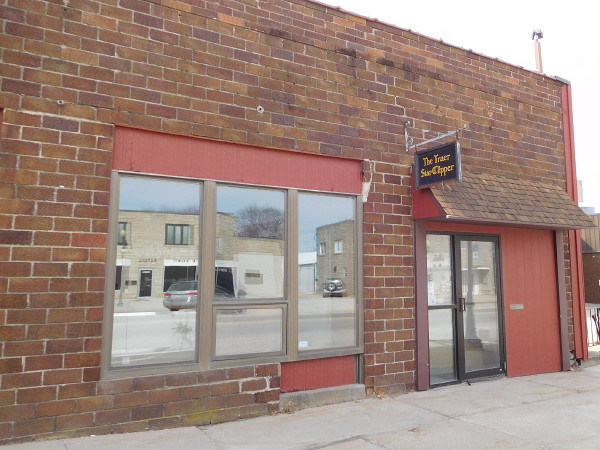
IFMarch 16, 2018/June 27, 1930: “The Traer Star-Clipper is still ‘the best weekly newspaper in the United States,’ according to the judges of the annual contest conducted by the National Editorial association for the promotion of better weekly newspapers…”
Traer isn’t losing its newspaper, but it’s the next-worst thing. The office and home of the Traer Star-Clipper is going to be shut down at the end of the month, its functions moved to Tama. There will be no one in town putting out the town’s news every week.

The office isn’t what it used to be, even from when I popped in many days at a time to do research for some of my first published pieces. (At the end of the 20th century, I did countdowns of the most important school and athletic events. Ironically, I’d never done a deep dive for highway purposes … until last Friday.)

The closure means the end of a cherished small-town tradition — picking up the paper a day early. People would line up to get their news hot off the press. From 1894 to 1953, that meant standing on a winding staircase you might have heard about. After that, it was a little less dramatic, just walking into the current building (above).

Elmer E. Taylor, the second generation of the family that founded and ran the paper for more than a century, died three days after he retired. The paper hasn’t been locally owned for a long time; Ogden Newspapers owns it and every other weekly in Tama County. The Dysart Reporter’s base was relocated to Traer a few years ago.

My concerns next go to the bound volumes and card catalog (yes, there’s an index in a file cabinet, meticulously curated over decades). Not having those available — or worse, seeing them discarded — would be a deep blow to local history. It would be best for them to end up with the museum or library.

It’s the end of an era, and the end of my dream of one day winning Powerball and thinking it would be fun to run a newspaper.

UPDATE: The official announcement. “Exciting new changes” is, to put it mildly, an interesting choice of words.

UPDATE 4/13/26: Yes, eight years later. The Master Editor-Publisher award was given to Elmer E. Taylor Sr. in 1932 and Elmer E. Taylor Jr. in 1956. This blog post conflated the two. The offending sentence has been cut and the writer flogged.

Posted in Tama County | Comments Off on Traer Star-Clipper office closing
Mar 22

License Plate Letters — GTE and a rogue CTY

GTE used to be a household acronym in much of rural Iowa; it was the phone company. At the turn of the 21st century, GTE’s Iowa assets were sold to Iowa Network Services, which within a year turned into Iowa Telecom. Iowa Telecom, in turn, got eaten up by Windstream in 2010.

But also spotted this month was one that’s making a Logan’s Run-esque escape from the authorities: a light-blue embossed numbers-first CTY. This plate would have been issued in Tama County in April 1997, making it old enough to buy a lottery ticket soon.

(I miss when counties got substantial blocks instead of a couple thousand at a time.)

Posted in License Plates | Comments Off on License Plate Letters — GTE and a rogue CTY
Mar 21

Stories from the Bureau of Justice

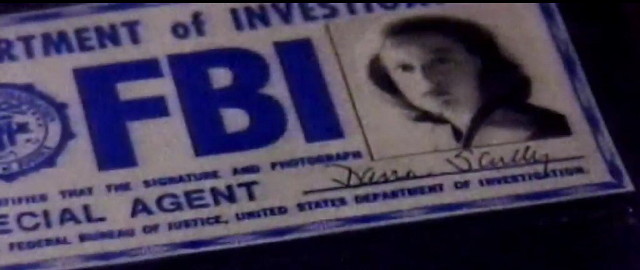
In the opening credits of “The X-Files” (a show whose return didn’t conceal the fact it was old enough to have a theme song) is an intentional error I hadn’t noticed until this season.

The ID badges in the opening credits are for “Federal Bureau of Justice, United States Department of Investigation.” The IMDB says this is intentional because “making a fake FBI badge, even for fictional purposes, is illegal.” Tonight is the last time we’ll see those badges on screen, with the series finale (and they probably mean it this time).

(Now, how can I age half as well as Gillian Anderson? THAT is a mystery worth investigating.)

Posted in Uncategorized | Comments Off on Stories from the Bureau of Justice