
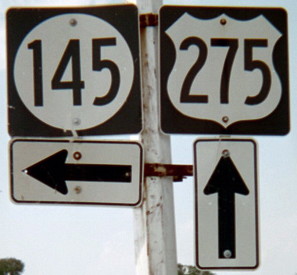
June 24, 2003: West end of IA 145, one of three state highways in Fremont County killed off in the Second Great Decommissioning. Originally a spur to Thurman, after 1980 it connected US 275 and I-29.
June 24, 2003: West end of IA 145, one of three state highways in Fremont County killed off in the Second Great Decommissioning. Originally a spur to Thurman, after 1980 it connected US 275 and I-29.
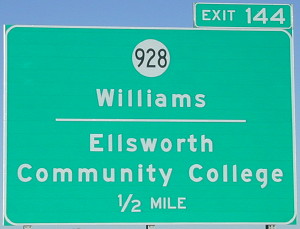
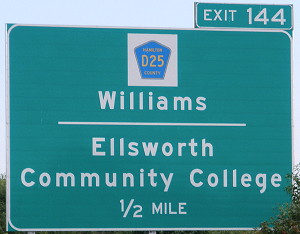

December 8, 2002; July 29, 2010; July 6, 2011: Three views of northbound I-35 in northeast Hamilton County. This was the original junction with US 20, evident with the Pilot and older Boondocks truck stops at the interchange. Since the freeway west of I-35 was done much earlier than the route heading east, US 20 shared at least this portion of the interstate.
The first photo is the only on-site evidence of IA 928 (duplicated on the other signs). The road was unsigned otherwise. The second shows the same sign as it appeared in 2003-10, with the county road marked. That sign, possibly the biggest non-freeway-to-freeway BGS in Iowa, was replaced very early in the 2010s. Ellsworth is still in Iowa Falls — you have to follow old 20 — but for whatever reason it’s off the signs now. Iowa Falls is signed at US 20, so I guess this was a way of getting around the destination limit there. (But Iowa Falls was never signed in either direction at I-35 exit 147, where it’s a straight shot east. Go figure.)
By the way, the sign color doesn’t actually change. That is a result of photographing the spot with three different cameras, and also the time of day and season.
While I was spending ten minutes* waiting for my exorbitantly priced** food to arrive during Saturday’s women’s basketball games at the Iowa Events Center, I had nothing better to do than look closer at the stuff by the concession stand (in this case, the one in the “club section”).
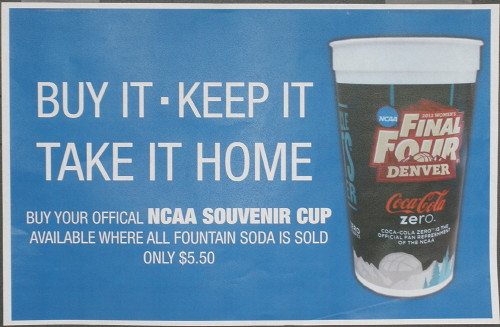
What’s wrong with this picture? No, besides the $5.50 charge and use of the word “soda” instead of “pop.”
The word official is misspelled. There’s only one I there.
I do not know if these posters are unique to Des Moines or are for all venues. Either way, someone erred.*** (By the way, the women’s Final Four is at the Pepsi Center. How will that situation be handled?)
That wasn’t the only adventure in spelling of the day. It turns out that the scoreboard on the ad ribbon around the second level has an eight-character limit. “Tennessee” was “Tennesse.” After I pointed this out to someone who relayed the message, it was changed to “UT” for the game, although “Tenn” would have done just fine. Better an abbreviation than questions about “is that misspelling intentional?”
*That was after six to eight minutes in line. I did two things during the 27-minute break between games: Use the restroom and wait in line for food. This was crunch time — 1-1:30 PM, between the games so all the fans are there, and all hungry because they arrived before 11. From my limited perspective, it was a disaster. One person received a cheeseburger with no burger. The food was being put out as fast as they could make it, but ten minutes! Once I got the food, it was actually quite tasty, but I had to eat it from my seat after missing the opening tipoff of the Baylor-Georgia Tech game.
**Five bucks for a slice of pizza! Seven for a cheeseburger and fries! Is that how the Iowa Events Center is trying to convince everyone it’s big time, by charging big time prices? Can price-gouging laws be applied to concession stands?
***Yes, I realize this can be throwing stones at glass houses because I’ve been there. However, I point out the errors in an effort to be more conscious myself.
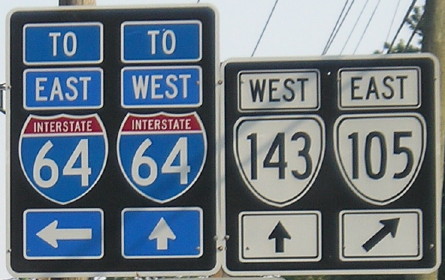
July 12, 2008: These one-panel sign sets are in Newport News, Virginia.

November 6, 2009: The left exit for US 65 north in Altoona was part of the original interstate construction. It made a lot of sense since the road underneath was not perpendicular to I-80 but at an angle. This enabled traffic to exit and merge without stopping.
However, after the beltway opened in 1994, it became problematic: Traffic merging from US 65 onto I-80 had to shift across three lanes of traffic within a mile to get to the exit. Increased traffic and increased dislike of left exits meant this ramp’s time was numbered. It was closed and removed in 2010. Now all traffic exits to an intersection with Hubbell Avenue.
There is a five (or so)-year plan in place to rebuild I-80 in this area, including a new interchange, expanding the mainline to six or eight lanes.
The Sioux City Journal reports, based on talks with the Woodbury County Treasurer, that Iowa’s license plates are indeed being replaced — but only the earliest ones. As far as replacements go, this is about as anticlimactic as you can get, aside from nothing at all.
The release says 1996-97, but the plates were handed out starting Jan. 2, 1997. People whose registrations expired in December 1996 could, and did, get the new ones if they waited to renew until January. These plates are old enough to get their own learner’s permits.
The sequences in question were the first of two sets issued to counties in substantial blocks. After the first two rounds, issuance came down to just one or two three-letter sets at a time for the small counties and maybe eight to ten for the larger ones, without any sequence other than “we’re out, send the next ones you have.” Each letter sequence has 1000 plates.
Plate 000AAA belongs to someone in Adair County. But in a twist, that won’t be among the replaced rolling stock yet — the press release says the reissue starts with May registrations. (That is likely when the sequential rollover will occur.)
By the way, 19 out of every 100 plates excluding the first 100 in a sequence have a zero in them, so if you want to avoid that ugly slash, your odds are about 4 in 5. Overall, with the first 100, the ratio then changes so 271 out of every 1000 plates have a zero.
If I had my way, each county in 1997 would have been allotted a total greater than the number of existing registrations in the county, but that didn’t happen. With this “rolling rollover”, that’s not really an option.
EDIT: Some bad math.
 (All images CBS)
Tuesday was the 15th anniversary of Iowa State’s 1997 appearance in the Sweet 16, its first since 1986. Those who remember it will recall it as a Bittersweet 16. The Cyclones blew a 16-point lead to UCLA in the second half and lost in overtime. Rewatching all three games now makes you think not only about the games themselves, but the presentation on TV.
It’s the late ’90s. We have both Cyclone Illustrated and the Internet, plus in-game statistics sponsored by a cell phone company. Gus Johnson will be calling the first two games, but he’s not quite GUS! JOHNSON! yet. Two years into the athletics program rebranding, Evil Cy lurks on the sidelines. In Virginia, Bill Fennelly’s second women’s team is losing its first ever NCAA Tournament game.

The letters are supposed to be in motion, cf. the wordmark logo. The illusion/appearance here is mixed at best. Player is Jacy Holloway.
Iowa State will wear its gold uniforms all three games, as the high seed in the first but the low seed in the second two. In all three games, few if any players on the floor sport visible tattoos.
The first two rounds are in the Palace at Auburn Hills, Michigan, hosted by the Mid-American Conference and its angular logo. It will be three more years until the Cyclones lose the de facto national championship game here. While the Palace is using a generic court, it’s a unique generic court, and not the uniform cookie-cutter court imposed a decade later. The regional semifinals and final are played in the Alamodome using the court from Texas-San Antonio.
A notable characteristic about the telecasts: Neither the scoreboard nor the clock are yet shown at all times — even when the UCLA game goes into overtime. When the scoreboard does appear, it takes up nearly the bottom quarter of the screen. Much of the game, all you see is the action on the floor. Compare that with today, when you can get bombarded with more data and ads than you know what to do with, and suddenly the minimalism is downright nostalgic. (On the other hand, the score, clock, and timeouts remaining are good things to know.)
Both Cincinnati and UCLA get called for traveling with less than a minute remaining in the second half, giving Iowa State the ball both times. Both times, a foul could have been called on Iowa State. Is it my imagination or do the officials just not call traveling like they used to?
The big difference between 1997 and 2012 gametimes is in the timeouts. ISU-UConn went to commercial eight times in the first half on March 15, 2012, while ISU-ISU went to commercial eight times the entire game on March 13, 1997. ISU-Cincinnati on March 15, 1997, had six in-game breaks total. The modern-day “bumpers” take up less time than you’d expect because the announcers are talking over them.
“While you’re rocking on the road to the Final Four,” Johnson says in a plug, “jump on the information superhighway with CBS Sports online. You’ll find breaking news, scores, highlights, and other great stuff at cbs-dot-sportsline-dot-com.” Remember, this is March 1997; the metaphor is still fresh. Only a quarter of Americans are online.
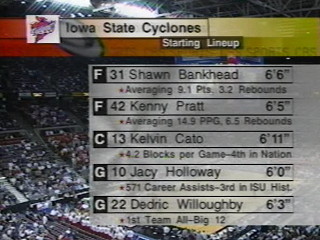
The starting lineup for the Illinois State game
The scores: (6) Iowa State 69, (11) Illinois State 57; (6) Iowa State 67, (3) Cincinnati 66; (2) UCLA 74, (3) Iowa State 73 (OT).
There are six key parts/moments in the UCLA game that add up to a case of heartburn for Cyclone fans today:
Iowa State avenged its loss to UCLA with a win in 2000, but its current Sweet 16 drought is 12 years.

Evil Cy doesn’t like the Bruins either.

August 31, 2008: Fading signs on new-ish metal pole northwest of Denison. The US 59/IA 141 duplex northwest of Denison is one of the few tiny non-interstate four-lane segments in western Iowa.
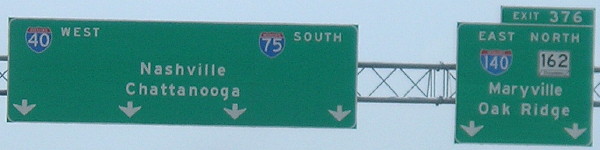
August 12, 2005: West end of I-140 outside Knoxville. (Or north end, kind of.) Mainline I-40/75 is four lanes in each direction here.

May 18, 2004: There was some strange signing going on in the mid-’90s. When the US 63 bypass of Denver was built, this was one of the signs put up. The exit BGSs had the same thing going, with the oddly spaced letters and slightly “off” font. What makes this more interesting is that the previously existing leaving-town sign is on 63 too, but it lists Waterloo, Hudson, and Oskaloosa.
Denver is farther from Ottumwa than Moberly MO is.