Nov 20

All-State, No-State

Right now, Iowa’s best high school singers and musicians are supposed to be at Hilton Coliseum for All-State. A month ago they found out they would not be. The All-State honor was bestowed as if they would have performed, including to three students from South Tama, but there will be no concert. There will be no honor bands for other students, either.

Last weekend was supposed to be the Cedar Rapids Festival of Trees. I am supposed to be a month in on trying to fly through my winter’s bane, “Sleigh Ride”. I am not. My band should be preparing for performances at multiple nursing homes. One of them has been drowning in coronavirus cases.

I fear for the long-term damage this effective ban on group music will do to the arts, not just concert bands but church choirs and school musicals and community theatre. You can’t Zoom your way through “South Pacific.”

(P.S. Traer’s ecumenical Thanksgiving Eve service has been called off.)
Posted in Uncategorized | Comments Off on All-State, No-State
Nov 18

Video drive across I-74 bridge

From WQAD.

Strangely, the I-74 Bridge website stopped updating months ago. The webcams are stuck on June 1.

Posted in Construction | Comments Off on Video drive across I-74 bridge
Nov 16

‘Butter Cow Lady’ statue needs to be restored

In Toledo, on a hill just north of the US 63/Business 30 intersection, is a non-butter sculpture from Iowa State Fair Butter Cow sculptor “Duffy” Lyon. It is of a cow and her calf. The Aug. 10 derecho ripped the calf’s head off. The KCRG story, which I can’t embed, says that all the pieces have been found, but now the statue needs to be restored and preserved, and that cost will run into the tens of thousands of dollars.

See also this story from Radio Iowa.

Posted in Tama County | Comments Off on ‘Butter Cow Lady’ statue needs to be restored
Nov 13

Iowa-bound I-74 bridge opens today

It’s happening! (To steal the first line from KWQC’s story.) (WQAD’s story above.)

The Iowa-bound/westbound/northbound I-74 bridge was expected to open early this morning. This replaces the 1935 bridge, the original of the twin bridges.

Hopefully next November we can have a dedication ceremony.

(Wait, Friday the 13th? In a year like this? Better send an army of black cats across it first.)

Posted in Construction, Highway Miscellaneous | Comments Off on Iowa-bound I-74 bridge opens today
Nov 11

Iowa’s 1920 Highway System: Plymouth County


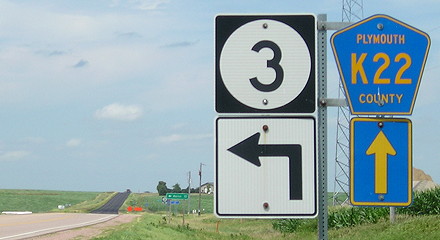
July 17, 2020: The loneliest intersection of 1920. IA 29 ended here; IA 27 went east and west.

Western Iowa had nearly all of the primary numbers, save for 28, in the 26-through-37 span. As far as I know, it just sort of happened. Three of those routes were predominantly in Plymouth County.

  • IA 27 covered what’s now the westernmost part of cross-state IA 3 because the auto trails had enormous pull at the time. The Hawkeye Highway veered southwest from Le Mars to Sioux City, leaving a gap in the county. In Akron, 27 met IA 12 and both ended.
  • IA 29 spent a lot of time getting out of Sioux City, but after that was all in Plymouth County, not touching any other town. This was the “Perry Creek road”, as it stayed close to the creek halfway into Liberty Township. It passes 2 miles east of the extinct map dot of Adaville, which today is only a church, and 2 miles east of the extinct map dot of Ruble, which today is an abandoned business building, an abandoned one-room schoolhouse, and one house, and is not to be confused with the town of Struble elsewhere in the county.
  • IA 30 started with a lot more corners between Moville and Kingsley than IA 140 has today. Its endpoint could be considered “just outside” of Remsen at the time, but one could see the town from the intersection. But in 1919-20, there was a lot of flip-flopping as to whether 30’s north-south segment from Kingsley would be where 140’s is, or a mile west. Also, straightening the Hawkeye Highway to avoid downtown Remsen and Marcus appears to have been a last-minute change but I have no set date.

IA 29’s endpoint in this group deserves a little more discussion. In every other route, numbers were extended, sometimes by great distances, redundantly along other roads so every endpoint was in a town. With 29, that wasn’t possible without taking a giant turn toward either Le Mars or Akron. Brunsville, 5 miles east, had “Gas and oils” and a blacksmith in 1912, according to Huebinger’s Automobile and Good Road Atlas of Iowa.

Posted in 1920 Highway Sytem | Comments Off on Iowa’s 1920 Highway System: Plymouth County
Nov 10

Alex Trebek, 1940-2020

Posted in Uncategorized | Comments Off on Alex Trebek, 1940-2020
Nov 09

License Plate Letters – KAT


August 16, 2000: Shadow had the run of the corn crib — run of the farm, really — and we threw her kibble from a big bag bought at the elevator. She purred very loudly and enjoyed climbing onto my shoulder after being picked up. Shadow was a good kitty.


October 20, 2018: Washta. Second appearance on the blog.


October 23, 2019: Albion.

Anyway, we got into the K’s before 2020 closed out.

Posted in License Plates | Comments Off on License Plate Letters – KAT
Nov 06

Label-o-matic

Labels are important when creating maps. This is an obvious truth, but I have a habit of missing the forest for the trees. Thus, when I created highway chronologies, I didn’t really consider the idea that my maps could be disassociated from their context and appear as standalone images elsewhere. This dawned on me after discovering that my 1925 map of Waterloo-Cedar Falls made it into a National Register of Historic Places application for “Historic and Architectural Resources of Downtown Waterloo” (very large PDF).

Naturally, I am thrilled by this recognition and citation. However, it’s also a reminder that I have to be on my game. I have now gone through all of those maps and squeezed in a notation about what metro area is being featured, rectifying the oversight of (gulp) nearly 15 years ago in some cases. Similarly, I squeezed in a title in the maps for Iowa’s four-lane highway progress while updating the 2019-and-beyond section.

I’ve also fixed some glaring and not-so-glaring typos on assorted 1920 system pages, clarified IA 40 in St. Ansgar, and added notes to IA 10 and IA 26 in light of newly seen construction documents.

Posted in 1920 Highway Sytem, Maps | Comments Off on Label-o-matic
Nov 04

The Avenue of the Saints’ only left turn … is staying

The DOT has a public meeting video and PDFs for changes at IA 27/58 at Ridgeway Avenue and US 20. The Ridgeway intersection and the diamond interchange are not going away. The biggest change is the addition of a left-turn lane and stoplight for southbound 27/58 to eastbound 20. This is the turn for the Avenue of the Saints.

This is the only place along the Avenue that the Avenue traffic must turn left. The most significant other change in direction, at I-35 and US 18, is a cloverleaf with collector/distributor lanes.

US 218 through Waterloo is an option, of course, taking the southbound 218-exit-from-itself loop at the north end of 58. But that way, too, involves stoplights. Following IA 27 there are only three intersections now: 20, Ridgeway, and Greenhill Road.

Posted in Construction | Comments Off on The Avenue of the Saints’ only left turn … is staying
Nov 02

The Hill Valley election cycle

June 6, 1990. “Doc” Emma Brown finds a strange woman at her door who says she’s a time traveler.

“Then tell me, Future Girl, who’s president of the United States in 2020?”

Jennifer winces and gives out a Sam Beckett-esque “Oh, boy.”

Let’s talk about the Hill Valley mayoral election. As we see in Back to the Future, the incumbents are running for re-election in 1985 and 1955. (This component, aside from the 2015 World Series, is really the only element placing the first movie-and-a-third in fall, since there are no Halloween decorations anywhere.) Election Day 1955 was Nov. 7, the week Marty was there, and Election Day 1985 was Nov. 5, 11 days after the weekend the trilogy took place.

City elections in odd-numbered years are very common. What’s less common is having those elections not on a four-year cycle. This means that Hill Valley’s mayor probably serves a two-year or six-year term. Three is a possibility, but an odd one.

Until recently, Iowa had three-year election cycles for school board, but then combined them with city elections due to low turnout. But it would be weird if someone drove around in a car with a loudspeaker promoting a school board candidate.

Posted in Uncategorized | Comments Off on The Hill Valley election cycle