Jun 28

Smallest districts of 1996 by enrollment — where are they now?

I have a map of the state of Iowa’s school districts as they were in the 1996-97 school year. As with any district map, it doesn’t reflect what sharing arrangements were at the time, but counting up the numbers then and now is another way to gauge developments in rural districts.

There were 24 districts in 1996 with a certified enrollment under 250. This fall, only four of that group — Diagonal, Luverne, Paton-Churdan, and Stratford — will be left standing. Only two, Diagonal and PC, have a high school. Thirteen were involved in mergers — including Prescott, which officially ceases to exist July 1 — and seven were dissolved.

There were 47 districts in 1996 with a certified enrollment between 250 and 400. Slightly more than half, 26, will still be around next fall, and 11 of those don’t have a high school.

Twenty years later, districts that formerly had much higher numbers have fallen down to take the place of the vanished. In fact, in 2015, there were 24 districts with a certified enrollment under 250, and 47 with a certified enrollment between 250 and 401. (Edgewood-Colesburg and Coon Rapids-Bayard flex the line a smidgeon.)

Posted in Schools | Comments Off on Smallest districts of 1996 by enrollment — where are they now?
Jun 27

Largest one-high school areas in Iowa

This is a list of the top 10 places in Iowa, by size, served by one high school, in five-year increments. In most cases, it involves whole-grade sharing followed some time later by consolidation, but in some cases there is only one-way sharing, where a district sends grades 7-12 or 9-12 to the larger school. Those cases are indicated by “plus” in the text.

NOTE 6/27/16: Western Dubuque, 554 square miles, has two high schools, Western Dubuque and Cascade. It has been the largest school district in Iowa since 1960. Areas are based on a list from the Iowa Department of Management, rounded to the nearest square mile (or tenth if necessary).

Fall 2001: Davis County, 463; Howard-Winneshiek, 426; Allamakee, 423; Mount Ayr, 383; Maple Valley-Anthon-Oto, 374; Fairfield, 359, Albia, 338; Benton Community, 332; South O’Brien, 305; North Iowa, 296.

2006: Davis County, 463; Howard-Winneshiek, 425; Allamakee, 423; Mount Ayr, 383; Maple Valley-Anthon-Oto, 374; Clarion-Goldfield plus Dows, 362; Fairfield, 359; Van Buren, 352; Albia, 338; Benton Community, 332.

2011: Davis County, 463; Howard-Winneshiek, 425; Allamakee, 423; Pocahontas Area/Pomeroy-Palmer, 402; Mount Ayr, 383; Maple Valley-Anthon-Oto, 374; Chariton, 374; Sioux Central plus Albert City-Truesdale (adding part of South Clay), 373; Clarion-Goldfield plus Dows, 362; Fairfield, 359.

2016: Algona plus LuVerne, 550; North Union (Armstrong-Ringsted merged with Sentral, sharing with North Kossuth), 540; Van Buren plus Harmony, 520; Southeast Valley (Prairie Valley plus Southeast Webster-Grand), 498; Davis County, 463; Mount Ayr, 425.4; Howard-Winneshiek, 424.6; South Central Calhoun, 424.3; Allamakee, 423; Webster City plus Stratford plus Northeast Hamilton, 422.

2021: MVAOCOU (Maple Valley-Anthon-Oto plus Charter Oak-Ute), 553; Algona plus LuVerne, 550; Pocahontas Area plus Laurens-Marathon, 549; North Union plus North Kossuth, 540; Van Buren County, 532; Southeast Valley, 498; Davis County, 463; Mount Ayr, 425.4; Howard-Winneshiek, 424.6; South Central Calhoun, 424.3. (Four more are in the 410-424 range.)

UPDATE 3/5/22: Now with fall 2021 numbers. Sometime between 2016 and 2019, Davis County and Van Buren swapped 11½ square miles, but I don’t know more. Also, Howard-Winneshiek and Mount Ayr got tweaked juuuust enough to switch places.

UPDATE 7/7/22: After some correspondence, I have updated the size of Davis County throughout. The Department of Education’s 2016 map and Department of Management’s 2016 database appear to have been in error.

Posted in Iowa Miscellaneous, Schools | Comments Off on Largest one-high school areas in Iowa
Jun 25

A note for summer parade organizers

PUT THE HORSES LAST.

Posted in Tama County | Comments Off on A note for summer parade organizers
Jun 24

Updates to the index page on the blog’s fifth anniversary


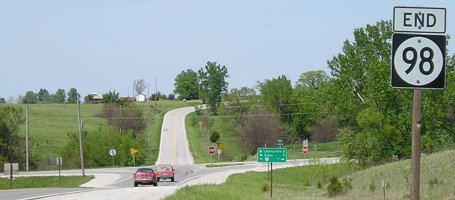
May 10, 2005: IA 98 is expected to be turned over to Van Buren County July 1.

There’s a front door to this place, although it has less action than the blog page. I haven’t done major work on the index since the first few months of this website, and there have been enough changes to the Iowa highway system than an update is necessary. So why not do it on (approximately) the fifth anniversary of my first blog post?

I started Iowa Highway Ends on Angelfire in 2001 and kept it there for years, then moved it to a mac.com site, and then moved it here when Apple shut that down. (Dale Sanderson told me my Angelfire site stopped working, but that appears to be the case only on certain browsers. How that happens, I have no idea. All of the images hosted by Apple are 404’d, but there are still a good many existing ones, showing how many have stuck around since the beginning of the previous decade. However, all of the pages that used to be in the /ia3/roadgeek directory DO appear dead.)

One part of this website update is that SOMEONE neglected to create any page for Business US 30 in Tama-Toledo. Those responsible have been sacked and the page created in an entirely similar style at minimal expense. What else has happened since mid-2011?

  • IA 370 is gone.
  • The state turned over IA 926 (Business US 169) to Fort Dodge.
  • IA 196 is dying and IA 471 is arriving. According to the state’s “Major Construction Projects” website, the reconstructed 196 opened at noon June 14 signed as US 71.
  • On July 1, IA 98 and 192 will be dead, and the rest of IA 934 will be dropped on Waterloo’s doorstep.
  • I’ve added in the secret numbers 404 (Business 75 in Le Mars, north of IA 3) and 461 (Business 61 in Davenport) to the main list.
  • Finally, to cover all 98* active numbers, I’ve thrown in the best-kept open secret in the state highway system. Which one? You’ll have to look at the index for yourself.

*In addition, there is a 99th active number to be named, covering those portions of US 6 and IA 192 that are not turned over to Council Bluffs. It could be “192” — certainly sensible for record-keeping purposes — or something else entirely.

Posted in Highway Miscellaneous | Comments Off on Updates to the index page on the blog’s fifth anniversary
Jun 23

The rise of the 400-square-mile high school, part 4


October 3, 2015: Harmony High School, a one-story building at the intersection of J46 and W46, will become the sole building for Harmony this fall, with all elementary students relocating here from Bonaparte. Junior high and high school students will go to Van Buren High School in Keosauqua, leaving one high school in the county from three in 2001.

In the early 2000s, Benton Community High School in Van Horne covered the eighth-largest area of any school district in Iowa. A student generation later, it won’t even rank in the top 25.

This fall there will be 13 places in Iowa where one high school serves an area larger than 400 square miles. Combined, they cover one-tenth of the land in the state. The 32 high schools overall that cover areas greater than 300 square miles will account for 22.2% of Iowa’s area.

The newest additions to the jumbo list come from southern and northwestern Iowa. This fall, the Harmony district will send grades 7-12 to Van Buren in Keosauqua, and Marcus-Meriden-Cleghorn and Remsen-Union will start whole-grade sharing.

Laurens-Marathon, whose inability to field a girls’ basketball team a year and a half ago kicked off a New York Times story about the power shift to urban areas in Iowa, still has a high school but as of last year is in partial sharing with Pocahontas Area. LM freshmen and sophomores spend a quarter of their day 15 miles away at “Poky”; juniors and seniors spend half. In those periods, Pocahontas Area is supporting nearly 550 square miles’ worth of high school kids, just like Algona. This fall Ar-We-Va, which brought together all its students in the Westside building four years ago, is going to start partial-day sharing with Carroll. (These are similar to what Paton-Churdan has done with Greene County, formerly Jefferson-Scranton, since 2004.)

This series has been all about numbers, but of course the numbers are only part of it. A story about a rural town losing its high school often is also a story about a town’s largest or second-largest employer shedding up to half its workforce. Then, when the junior high or an elementary is closed and students are condensed into one location, that town loses one of its largest employers. Students who once could walk to school now either drive or have to wait for the bus. There are longer drive times for sports teams (and the athletes’ parents). The growing distances can mean that maybe someone in the community who doesn’t have children/grandchildren directly involved decides it’s not worth driving to see an event when it’s 10 degrees outside. It’s created a paradox: Larger areas are bound together, yet tight-knit communities face a Great Unraveling.

The rapid increase in large-area high schools and, in course, large-area school districts should be sounding alarms about both depopulation and school funding. (Hmm… what are the rules on artificial noisemakers by groups at the state Capitol? Would an army of clanging cowbells serve to make a point? Because you always need more cowbell.) It also has effects on the growing urban-rural split in Iowa, because the voices for rural schools will continue to dwindle. One can envision some time in the future that a metro-area legislator will float a bill to force consolidations, and there won’t be enough people on the other side to stop it.

Next week: A look at enrollment.

Posted in Iowa Miscellaneous, Schools | Comments Off on The rise of the 400-square-mile high school, part 4
Jun 22

The rise of the 400-square-mile high school, part 3

OLYMPUS DIGITAL CAMERA
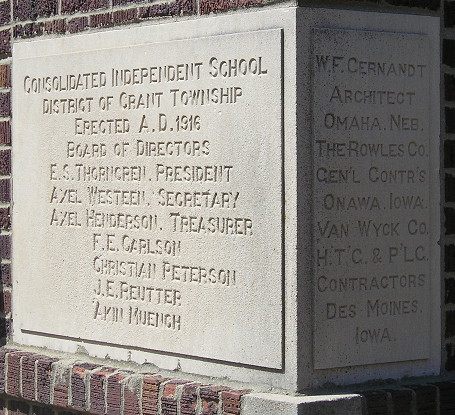
July 25, 2012: The cornerstone of the Boxholm school, last serving as Southeast Webster-Grand Junior High. The Boxholm school is not currently in use.

By the summer of 2013, residents of the Corwith-Wesley district knew their high school was a goner. Corwith-Wesley and LuVerne had voted in April to begin whole-grade sharing discussions with Algona. But when CW was asked how it could be a school district without students, the dissolution process began.

In 2014-15 the Des Moines Register embarked on its “Lost Schools” project, focusing on Corwith-Wesley’s dissolution and the first year of whole-grade sharing between Prairie Valley and Southeast Webster-Grand. Both of these cases dwarfed nearly everything that had come before.

In the September 2014 vote to dissolve Corwith-Wesley, 87.1% of the district was attached to LuVerne, and another 7.1% directly attached to Algona. (Algona Upper Des Moines, 9/4/14) The remainder, split off to West Hancock and Clarion-Goldfield-Dows, turned out to make a difference in the state record.

Algona, which had just finished digesting Titonka (and Burt a while before that), would now get CWL’s junior high and high school students. Algona High School now covers 550 square miles, from County Road A42 to the Kossuth/Humboldt county line and from Whittemore to southwestern Hancock County. It took the title of “largest area in Iowa for one high school” away from neighboring North Union, which had only had it for three years. However, a future consolidation with LuVerne, should one occur, would not result in Algona surpassing Western Dubuque as “largest school district in the state” because of the fraction of CW that went elsewhere.

Prairie Valley and Southeast Webster-Grand, as Southeast Valley, spreads across the southern half of Webster County, west to Rinard, and south to Fraser. It’s a hairbreadth away from being 500 square miles (498) and brings together a dozen towns.

The 2013 sharing arrangement for North Fayette Valley, at 355 square miles in northeast Iowa, was dwarfed that same summer in the opposite corner by Corning and Villisca combining to form 420-square-mile Southwest Valley. The following year Mount Ayr, which had made it into the 350 club by gaining land from Grand Valley’s dissolution, would enter the 400 club the same way, gaining land on its western edge through a crazy-quilt carve-up of Clearfield. The year after that, Northeast Hamilton gave up its high school, and Webster City, through that arrangement and a longtime one with Stratford, crossed the 400 barrier too.

If you threw the three new “Valley”s together — Southeast Valley, Southwest Valley, and North Fayette Valley, six existing districts, three high schools — you would have 1,273 square miles and a K-12 certified enrollment of around 3,000. In comparison, West Des Moines Valley High School has 2,200 students in three grades in 37 square miles.

To be concluded…

Posted in Iowa Miscellaneous, Schools | Comments Off on The rise of the 400-square-mile high school, part 3
Jun 21

The rise of the 400-square-mile high school, part 2

OLYMPUS DIGITAL CAMERA
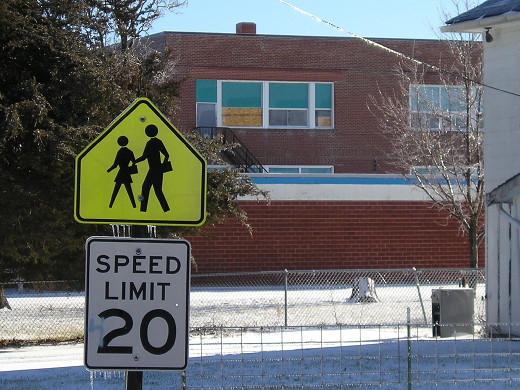
December 28, 2008: Every window in the Russell school building was boarded up shortly after the district was forcibly dissolved. Students in Russell now go to Chariton, which encompasses about 85% of Lucas County.

Lucas County was the home of John L. Lewis, longtime leader of the United Mine Workers of America. It’s perhaps fitting, then, that the Lucas County town of Russell would become the canary in the consolidation coal mine.

On March 11, 2008, the State Board of Education de-accredited the Russell School District because the district had exceeded its spending authority in multiple years and had issues with teacher certification. (A state audit later found $300,000 of local sales tax revenue had been siphoned off to pay salaries, which is expressly forbidden under Iowa Code.) Russell became the second school district in Iowa history to be forcibly dissolved, following Hedrick in 1991. Because 94.5% of the district was in Lucas County, the state simply gave all of that to Chariton (an additional 5% went to Wayne, 0.5% to Albia). In fall 2008, Chariton High School became the ninth in Iowa to cover an area larger than 350 square miles.

In 2009, the wave rolled through northwest Iowa and hasn’t abated since. Battle Creek-Ida Grove and Odebolt-Arthur engaged in whole-grade sharing, a consolidation that has yet to be finalized. Ten. Pocahontas Area and Pomeroy-Palmer did the same. Eleven. When consolidation followed three years later, Pocahontas Area — just barely — became the fifth district in the state to exceed 400 square miles.

In 2010, the last class graduated from Lineville-Clio High School and the Wayne district in Corydon gained that area. When that happened, that little bit of Russell ended up nudging Wayne past the 350 mark, too. Twelve. Also in 2010, South Clay dissolved. It was down to a K-6 district but other students went to multiple surrounding districts. Part of South Clay went to Sioux Central. Since Albert City-Truesdale had been sending grades 7-12 there since 2004, the high school in Sioux Rapids was now covering 372 square miles. Thirteen.

A year later, Titonka and Woden-Crystal Lake went their separate ways, and Titonka’s 91 square miles were attached to Algona’s 283. Fourteen.

Also in the Kossuth County area, where the population decline is especially steep, three districts negotiated the most ambitious whole-grade sharing plan since the formation of North Iowa in 1989. North Kossuth and Sentral of Fenton began whole-grade sharing in 2008 as North Sentral Kossuth, and then in 2012 Armstrong-Ringsted was folded in. Fifteen.

Their resulting three-way sharing agreement, called North Union High School, is a geographic giant, one-seventh larger than the Davis County district, covering 540 square miles. It runs 32 miles along the Minnesota border and extends down to US 18 just north of Whittemore. It brings together seven towns, none of which has a population above 1000.

There were two other large-area whole-grade sharing agreements in 2012: Southern Cal and Rockwell City-Lytton (South Central Calhoun), and East Greene and Jefferson-Scranton (Greene County). Five years earlier, they would have been notable for their size, but were now just thrown on the pile.

In those five years (2008-09 to 2012-13), any informal idea of just how big a school district should be changed. Forget 350 square miles. Rural areas were now looking at 400 — and beyond.

Area figures are based on numbers received from the Iowa Department of Management.

Posted in Iowa Miscellaneous, Schools | Comments Off on The rise of the 400-square-mile high school, part 2
Jun 20

The rise of the 400-square-mile high school, part 1

First in a series on the geography of, and changes to, rural Iowa school districts in the past 55 years, with emphasis on the last 15.

For nearly 50 years the number of places in Iowa where one high school served an area greater than 350 square miles could be counted on two hands. But as rural counties were drained of population and schools continually told to do more with less, whole-grade sharing and consolidation would send this number soaring in the early 21st century.

In this series, here are some things to keep in mind: A township is 36 square miles, a “3-by-4” county like those along the second-southernmost tier in Iowa is ideally 432 square miles, and a square “4-by-4” county is ideally 576 square miles. When the state of Iowa was first settled, a one-room school would typically serve one township. For more background on that era, there’s “Remembering One-Room Schools,” The Goldfinch, Fall 1994.

In one fell swoop in 1960, Davis County went from 62 districts including 48 one-room schools to one covering 474 square miles. Because Western Dubuque is actually a two-high-school district (Cascade is the other), the high school in Bloomfield covered the most geographic space in the state until 2012. Other long-lived large districts are Howard-Winneshiek (1960), Allamakee (1960), and Fairfield.

Maple Valley-Anthon-Oto broke the 350 barrier with a whole-grade sharing agreement in 1993. Mount Ayr followed in 1998 by absorbing part of Grand Valley and Van Buren did the same in 2002 with all of Fox Valley.

In 2005, a rarity in the whole-grade sharing process happened: The tiny CAL and Dows school districts, unable to make whole-grade sharing continue, went their separate ways. Dows searched for a new partner and ended up with Clarion-Goldfield. The new CGD was bigger than Fairfield. In the following decade, breakups of long-term whole-grade-sharing districts would become more common.

On July 1, 2006, 46 years after Davis County formed, the number of high schools covering 350-plus square miles stood at eight.

Then the floodgates opened.

Some information about Davis County’s consolidation comes from an October 1961 Associated Press article. UPDATE 1/21/22: Corrected year of Davis County’s formation.

Posted in Iowa Miscellaneous, Schools | Comments Off on The rise of the 400-square-mile high school, part 1
Jun 18

Apple gets a little tronc’d

*deep, exasperated sigh*

After 15 years as OS X, Apple’s Mac operating system is getting a new name. In the future, it will only answer to macOS, or its latest California-inspired codename, Sierra. The format makes it more consistent with other Apple OSes. [emphasis added]

The WWDC keynote on Monday spent about as much time talking about the iMessage app (BIGGER EMOJIS!) than on upcoming improvements to the Mac OS, which I’m going to keep writing that way because I do not hate my readers and because the English languages has rules that mean things for reasons.

Still have those old eBooks you’ve read? How about email dating back before the Destiny’s Child reunion? Those tens of thousands of iPhone photos can take up a lot of space in your 250 GB drive. macOS Sierra will push old, unused files to the cloud where you can still access them on demand, but your hard drive will thank you for the extra breathing room.

That last sentence is horrifying, and not just because it starts with a lowercase letter. Files on the hard drive, or an external hard drive, mean instant retrieval. Files on “the cloud” mean, at the very least, a lag time for the network, and that’s based on the assumption of an always-accessible, robust high-speed connection. What happens without one?? Apple doesn’t particularly seem to care. (Remember, Apple is showing some hostility to having dedicated USB ports, period.)

WWDC did nothing to dissuade the notion that Apple is firmly a mobile device company that happens to make computers, and those of us who want something more substantive than a Minnie Mouse watch face are the poorer for it.

Posted in Uncategorized | Comments Off on Apple gets a little tronc’d
Jun 17

The first step in six-laning I-35 to Ames

One of the heavily traveled rural Iowa interstate corridors that needs to be upgraded to six lanes takes a baby step in that direction on Monday. There will be a meeting then in Huxley about I-35 between Ankeny and Ames, the Ames Tribune reports. Construction would be about five years out.

Construction on the new Skunk River bridges accounts for three lanes in each direction (hence the new roadbed there), and six-laning I-35 between the Oralabor Road and NE 36th Street exits in Ankeny is part of a different project that would change the 1st Street exit to a diverging diamond.

Posted in Construction | Comments Off on The first step in six-laning I-35 to Ames