With appearances by some familiar faces.
Tama County Extension celebrates 100 years (Toledo Chronicle)
Tama County Farm Bureau celebrates 100 years (Traer Star-Clipper)
With appearances by some familiar faces.
Tama County Extension celebrates 100 years (Toledo Chronicle)
Tama County Farm Bureau celebrates 100 years (Traer Star-Clipper)
A man, his wife, and their two children were all injured after he fell asleep while driving and crashed into another car in rural Fort Madison, Iowa shortly before 5 p.m. on Thursday, June 21st. https://t.co/zCZQ7ZatTT
— WQAD (@wqad) June 22, 2018
Based on the corresponding Fort Madison Daily Democrat story, this is the interchange where the accident occurred. So the WQAD digital editor got that right, but the “Olympus Digital Camera” info line is from the EXIF. A credit to “Iowa Highway Ends” there is what I’d like.
As if we needed another reason to ban Florida. (warning: autoplay video)
DeVita even pulled an iguana out of her toilet after it latched on to a plunger a few years ago. “In one of my bathrooms, my roommate kept hearing something in his toilet and saw something poking its head out,” she says. “It was very aggressive.”
Iowa: Zero chance of iguanas in your toilet. Florida: Non-zero chance of iguanas in your toilet. ‘Nuff said.
As Dave Barry would say, Frozen Iguanas, Fried Iguanas, and Toilet Iguanas would all be excellent names for rock bands.

July 7, 2013: A pickup crosses the Lincoln Highway bridge on the east end of Tama. Modern-day vehicles are one thing but a worse issue for the 103-year-old bridge is full-size semis using it on a truck route.
A century-plus after the iconic Lincoln Highway bridge was built in Tama, 87 years after US 30 was rerouted away from it, and 30 years after a major rehab project on the bridge, it is in trouble once again.
The state has suggested removing and replacing the bridge, something preservationists hope to avoid, KCRG reports.
There’s not an easy solution. Ideally, a way can be found to keep the bridge intact and in use. But unless Fifth Street is closed to truck traffic, it’s going to be hard to keep it in place. If, IF, there would be a way to remove the sides of the bridge (the most important part obviously) intact, I can see that as an option, but relocation could be as tough a task as finding a way to leave it in place.
Fourth in a series.
In my previous posts regarding population, I cited the master’s thesis “Annexation in Iowa: an analysis of the Iowa annexation statutes” by Robin Renae Habeger (1997). That, along with some digging into more recent news, brings something to light: Extremely silly city limit lines aren’t just for Dallas County. (My campaign to name “Clive Town Center” the state oxymoron still stands, even if the concept doesn’t.)
In the winter of 1996-97, an annexation struggle broke out. An area more or less bounded by Blairs Ferry Road, Milburn Road, Tower Terrace Road, and Miller Road got added to the city of Cedar Rapids. That combined with a Robins annexation nearly, but not quite, boxed Hiawatha in. The key was that Hiawatha was allowed an escape hatch around the land northwest of the intersection of Tower Terrace and Center Point roads. Here’s a map from the current Hiawatha Comprehensive Plan (large PDF stored on the city of Sioux City’s website).
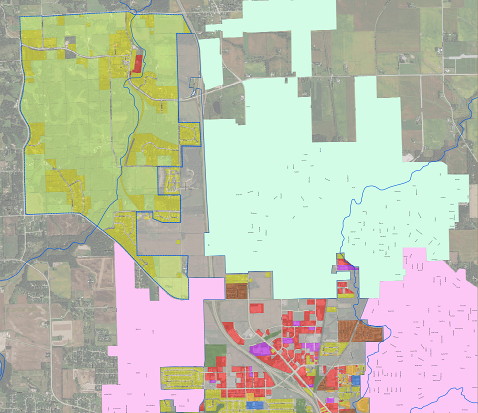
The pink area is Cedar Rapids, while the seafoam green is Robins. The multicolored area at bottom center is Hiawatha, while the yellow-green-tinted area to the northwest is the area Hiawatha has planned for future annexation. The place where the pink crosses I-380 is the north half of what will become a Tower Terrace Road exit in 2022.
What about that strip between the tinted areas and I-380, you ask? Ah, here’s where it gets weird. In 2008 or 2009 — before the 2010 census, because of the lines the legislative districts use (PDF) — Hiawatha took that escape hatch and annexed land running along the west side of I-380. Then, in 2014, it went even further north (PDF), using the interstate’s right-of-way to skirt a development and annex more land up the side, clear past the County Home Road exit. Driving Center Point Road to Tower Terrace Road to Edgewood Road connects old Hiawatha to new, but not without passing through a bit of Cedar Rapids first.
That brings us back to that swath of yellow (developed) and green (undeveloped) land bounded by Tower Terrace Road, Feather Ridge Road, Midway Road, and the present strip of Hiawatha. Much of this is forested creek bottom. But one major part of it is not, for that area of yellow touching that spot of red in the north is the unincorporated village of Toddville. There is no set timetable for changes — and I would argue that Hiawatha should annex the already-developed areas closer in first — but it means that at some point in the future, Hiawatha’s thinking about pulling Toddville in.
There’s one more spillover effect. Whatever’s intended for the lion’s share of that “future plans” area, and also the northern third or so of Robins, including everything along County Home Road, will go into the Alburnett school district. It’s really fun to be a Pirate when the booty comes to you.
Third in a series.
The dam broke just after the 1990 census.
West Des Moines had a small spot in Dallas County right before that — a portion tucked south of University Avenue that included the Des Moines Golf and Country Club — but there was very little going on north and west of I-35/80. That was soon going to change, big time.
In 1990, Waukee went forward with plans to annex land along University Avenue up to the Polk County line, and Clive, afraid of being boxed in, countered with annexation plans of its own. When combined with a state law change regarding annexations taking effect during this period, a lawsuit resulted that wasn’t settled until 1994. According to an appendix to the federal 1992 Economic Census, Urbandale and Grimes also annexed into Dallas County in May 1990 and April 1991, respectively. The land rush was on. Walnut and Boone townships have been having their rural portions squeezed slowly, and not so slowly, out of them since, as that area became THE hottest growth spot in Iowa.
Source note repeated: The following statistics come from the Census Bureau’s final yearly intradecade percentage growth estimates for the 1990s and 2000s, and the 2017 data used for the 2010s. All years are fiscal (starting July 1 of the preceding calendar year).
Dallas County started the 1990s with 29,755 people. In 1991 it posted a 2.77% gain; only 18 other counties had growth estimated above 1%. Two years later, Louisa County barely had a bigger percentage gain. After that, though, from 1994 through 2017, Dallas County’s growth has reigned supreme in Iowa, and often second place isn’t even close. (Since 2001, second place has been Johnson eight times, Story four, Warren three, Buena Vista one, Calhoun one.) Dallas, Johnson, Linn, Polk, and Warren haven’t had a down year in that entire span.
Dallas County’s growth is so astronomical compared to others that it’s casting a greater shadow over the state as a whole. In every population estimate since 1988, Iowa has never lost people. But since 1993, the yearly percentage increase has passed 0.6% only once, 2006 (0.61%). If you take Dallas County out of the equation entirely, in the 1990s the state growth rate was lower by about 0.03% per year. In the 2010s so far, the rate of growth for the other 98 counties combined is 0.08% to 0.11% less per year.
Yesterday I noted Cherokee County has lost 2700 people, or nearly 20 percent, since 1990. Well, Dallas County added 2700 people in fiscal 2014 alone — to a total population more than six times Cherokee’s. Since 2010, a population equivalent to that of Winneshiek County has moved there.
With the most recent estimates, Dallas County has slightly more people (87,235) than Adair, Adams, Union, Clarke, Lucas, Monroe, Taylor, Ringgold, Decatur, Wayne, and Appanoose counties combined (86,933). Dallas County has about as many people as Cherokee, O’Brien, Clay, Buena Vista, Ida, Sac, and Calhoun counties combined (87,825). And so on.
Dallas County as a whole has added two-thirds of a state House seat, with two more years of estimates ahead of the 2020 census. (Of course, Perry is also a factor, not just the suburbs, lest I be accused of omission through ignorance.) No wonder a seat there is so attractive to Chris Hagenow.
Assists for this blog post come from two ISU Community and Regional Planning master’s theses: “Annexation in Iowa: an analysis of the Iowa annexation statutes” by Robin Renae Habeger, 1997, and “Using the Land Evaluation and Site Assessment (LESA) technique in the rural-urban fringe: A case study of Dallas County, Iowa,” by Brian Ray Schoon, 1991.
Second in a series.
On a national level, the 1980s had plenty of positives after a bumpy early start. In Iowa, though, like the rest of the Farm Belt, those bumpy years were part of a precipitous fall that, arguably, much of the state hasn’t been able to completely pull out of.
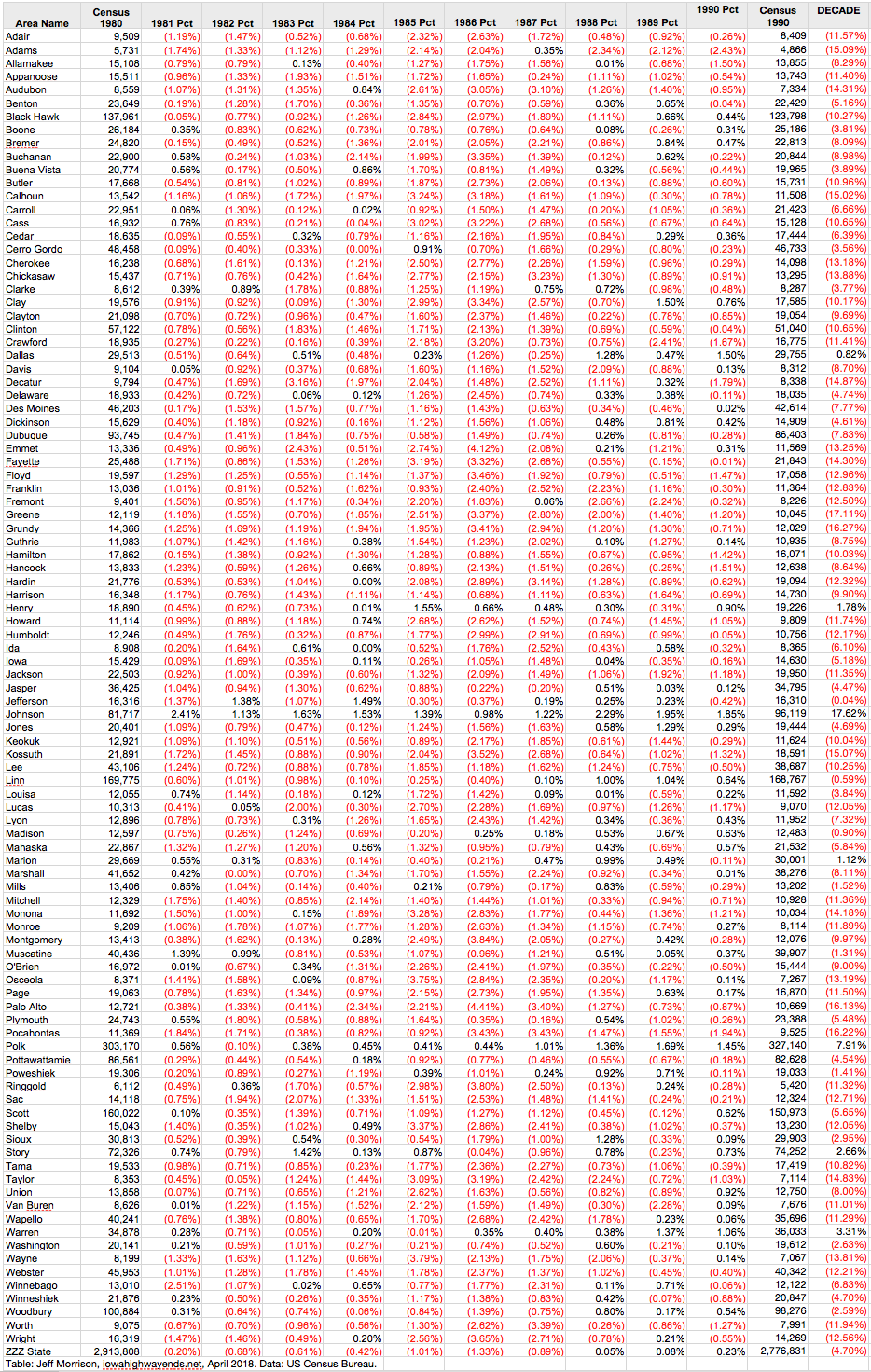
Here, the numbers skim the surface of the story. Viewed from an abstract level, the yearly census projections show nearly nothing but pain. (Remember, officially these were fiscal year estimates, shown here by percentage increase and decrease.)
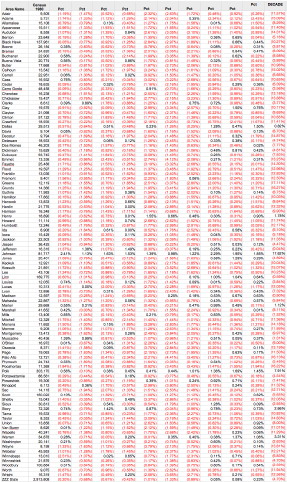
(Intentionally scaled too small to read, to draw attention to the sea of red. Rightmost column is decade overall. The full-size version is here.)
Statistics that tell the story:
First in a series.
The Census Bureau released its 2017 county-level population estimates in April. It’s not a full decade, but it is seven data points, and the trend for rural counties may be even worse than it was.
The following statistics come from the Census Bureau’s final yearly intradecade percentage growth estimates for the 1990s and 2000s, and the 2017 data used for the 2010s. (Fortunately, the last was easy to obtain from the Census Bureau; the Iowa State Data Center has been next to useless for raw data since the decade began.) All years are fiscal (starting July 1 of the preceding calendar year).
While Dallas County keeps winning (more on that in another blog post), much of the rest of the state loses…and loses…and loses. Here’s a sample of what it looks like for 2011-17 (with decade bolded at end), with Dallas County’s absurdities in the center row.
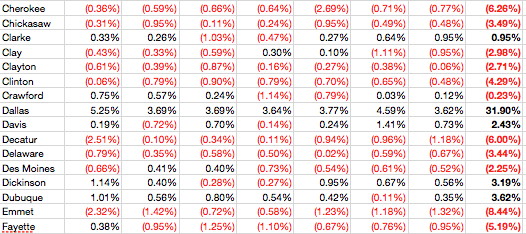
Most of those losses are below 1 percent, but that isn’t a salve. If you are, say, a county of 14,000 people in 1990 and lose an average of three-quarters of 1 percent a year for 20 years, then you become a county of 12,000 people. And if you’re still losing, 11,000 is getting closer than you’d like. You are, in fact, Cherokee County. Cherokee County has been on a once-interrupted losing streak for more than a quarter-century, losing 2700 people, or nearly 20 percent, since 1990. (That interruption was the April 2010 hard count vs. the July 2009 estimate, a nine-month period that in a sense reset the projections.)
In the 1990s, only three counties never had an estimated increase, while six more only had one. In the 2000s, that jumped: 12 never grew, and 13 only grew once. In the 2010s so far, a whopping 21 counties have never had an increase, and 25 more have only one positive year. There’s still time for those last two numbers to shrink, but not much.
The 1980s dip in real population, not just a lower percentage growth, has had repercussions to this day. To think about it compound interest-wise: If, starting with the 1980 census, the state as a whole grew by 1% a year, Iowa would have had 4,210,675 people in 2017 —likely good for six U.S. House members. At HALF a percent a year, it would be 3.5 million. Even if we moved that baseline forward, from the 2000 census, 1% growth would have led to about 3.47 million in 2017, and half a percent, a bit under 3.19 million.
But none of that came true. Instead, Iowa in 2017 had an estimate of around 3.146 million — an average 0.28% increase per year over a 27-year period, or 0.46% per year in a seven-year period starting in 2010.
In the first half of the 2010s, North Carolina grew a total of 4.3%, South Carolina grew 4.5%. Utah and its comparatively smaller 1.72% average growth rate this decade will be enough to pass Iowa even sooner than I thought should its gangbusters 2016 and 2017 numbers hold up.
Tonight, the Tama County Farm Bureau celebrates its centennial with a dinner at the Traer Memorial Building. The Iowa Farm Bureau also turns 100 years old this year. Iowa Farm Bureau president Craig Hill will speak tonight.
The Farm Bureau organization and county Extension offices were co-organized until a “divorce” in 1951.
But the reality of rural life in the Midwest, school officials say, is that younger people are fleeing. They want Starbucks and Thai restaurants, plentiful jobs and high-speed internet, and when they start families, they want schools with amenities and big, thriving athletic programs.
“In any small community, anywhere in this country, our kids grow up and move away,” said Mark Strozinsky, a River Valley school board member. “They go to college and get a job, but it’s not here, because the opportunity is not here. So who’s left here? Grandma and Grandpa.”
(Don’t read the comments. Never read the comments.)