Mar 21

Marking the Marathon to Marathon


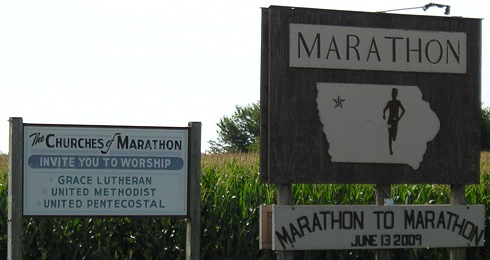
July 23, 2009: Welcome sign for Marathon at the south end of former IA 390. Nearly a decade later, the paint on the church sign had noticeably faded.

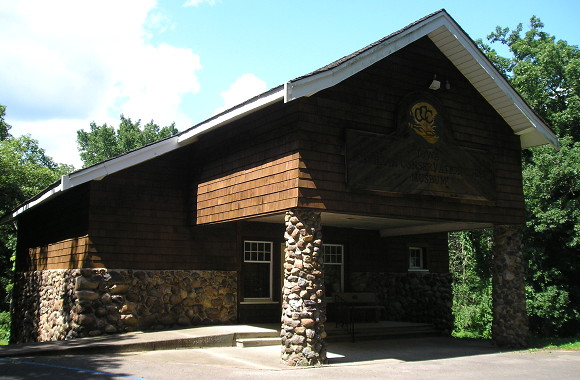
It’s 16 years to the day since I set foot in Marathon in the first of now four visits. The first time, I wasn’t sure where the exact end of IA 390 was, two more were pass-throughs while I traveled IA 10 and M54 nearby, and the most recent was last year, after I knew for sure the endpoint and also wanted to photograph the school (now the community center). As it turned out, I had the endpoint guessed correctly earlier, but the key shot was out of focus, hence a surprisingly high number of visits to a map dot in northwest Iowa.

This post is about the giant sign at the junction with IA 10. For years it gave the date of the next Marathon to Marathon, a 26.2-mile run from Storm Lake. But that event has been discontinued with a phrase to strike fear into the hearts of small towns everywhere: “We have run out of volunteers.”

Rather than let the date of the last marathon sit at the bottom, falling increasingly in the past, here’s a suggestion to keep the spirit alive: Place the years of the run, “1996-2017”, there instead. It would be a fitting reminder of the event. And then, if it ever starts up again, there will be a sign waiting for it.

Posted in Iowa Miscellaneous | Comments Off on Marking the Marathon to Marathon
Mar 20

When Clear Creek was rural

(An unintended companion piece to yesterday’s blog post.)

During the 1980s, the Clear Creek school district was in dire straits. They couldn’t get money for nothin’.

In 1989, Clear Creek cancelled its football season a week before it began, leaving the Eastern Iowa Hawkeye Conference in the lurch. The Cedar Rapids Gazette said there were 141 students in the entire high school.

The district stretching from the west edge of Iowa City, and Jones Boulevard in North Liberty, over to the Johnson/Iowa county line had aging facilities in Oxford, Tiffin, and even Cosgrove, a map dot 11 miles due west of Kinnick Stadium.

Voters shot down four bond issue proposals in three years. A stripped-down, $800,000 addition in Oxford that did not close the existing school finally made it across the finish line in 1985.

A bit later in time, the Amana school district was looking for a partner. Geographically, Williamsburg would have been a better fit. But Amana Superintendent Gary Pittman told the Gazette, “We found that the only school interested in sending students back to Amana was Clear Creek.”

Clear Creek and Amana began sharing in 1990, with a combined enrollment a shade under 1000 students. The school in Cosgrove closed.

About five years later, word came that a giant mall was being proposed for the outskirts of Coralville. The western third of the mall fell inside the recently reorganized Clear Creek Amana School District.

Clear Creek Amana has a different bond issue problem now: Voters can’t approve them fast enough. The most recent is for $36 million, 45 times the amount that scraped through in Clear Creek 30-plus years ago. Another planned for 2022 is for replacement of the high school built in 2009, which then would be used for lower grades. An additional 1040 students (80 kids x 13 grades), as are expected over the next five years, would itself constitute the 110th-largest district in the state, enough for a Class 2A football team.

By percentage, Tiffin is the fastest-growing city in Iowa.

Posted in Schools | Comments Off on When Clear Creek was rural
Mar 19

Clay Central-Everly losing high school, junior high


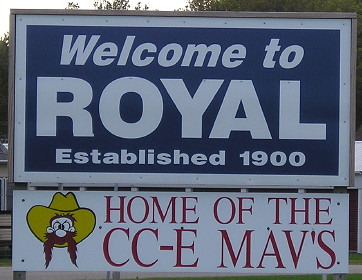
October 3, 2016: The welcome sign for Royal, pop. 446, former end of IA 240 and soon-to-be-former football field for Clay Central-Everly.

For the tenth time this decade, an Iowa district is closing its high school without getting any students in return.

The Clay Central-Everly school board on March 11 voted to “tuition out” students in grades 7 through 12. (Stories: KIWA, Spencer Daily Reporter, KTIV.) As mentioned here earlier, the district has been considering its options. The more recent stories show a split among the district’s residents about which school to join with. That means that there won’t be any formal whole-grade sharing deal, at least for 2019-20. (The only quasi-similar situation right now is Hamburg, which is “tuitioning out” its students to Sidney but doesn’t have a whole-grade-sharing agreement.) The survey also showed that only about three-fifths of students would be coming back.

The four-way preference split reflects a problem shrinking districts are going to be having more often: In many cases, going with one neighbor will not be a good fit for at least some of the geographical area. CCE is an L-shaped district that wraps around Spencer (a district that expanded southeastward when it got the north half of South Clay). There are parts of CCE that are closer to high schools in Hartley and Sioux Rapids.

The board has not decided which town (Everly or Royal) will lose its school building, though. Just because elementary grades are being retained does not mean the current setup will remain. This happened in the Harmony district, where Bonaparte Elementary was closed and students moved to the isolated building on County Road J40.

The decision means that last fall’s CCE homecoming court will be the last for the Mavericks. It also means the end of a sports lineage that included the 1960s Everly Cattlefeeders girls’ basketball teams, winners in 1966 and runners-up in 1968 against Union-Whitten.

Clay Central-Everly’s enrollment is 312. Clear Creek Amana, CCE’s almost-neighbor alphabetically but polar opposite in every other way, added 377 students in two years.

(h/t two readers reassuring me I’m not screaming into the void)

Posted in Schools | Comments Off on Clay Central-Everly losing high school, junior high
Mar 18

Viking Road SPUI construction restarting

According from a press release from the DOT, this week is when construction will resume on IA 58 at Viking Road. The two-year project to run the highway under grade and form a single-point urban interchange is expected to end around this Thanksgiving.

A rendering of the completed interchange (PDF) is on the first page of this newsletter from the city of Cedar Falls last year.

Posted in Construction | Comments Off on Viking Road SPUI construction restarting
Mar 15

The road to Backbone State Park

OLYMPUS DIGITAL CAMERA
July 29, 2017: The Iowa Civilian Conservation Corps Museum in Backbone State Park shows off the contributions the New Deal program made to Iowa’s state parks and natural resources. Backbone, Iowa’s first state park, celebrates its centennial next year.

At the end of 1926, Iowa had a network of newly signed highways. The brand new federal system linked the state from coast to coast and from the Dominion of Canada to New Orleans and the Gulf of Mexico (at the expense of the auto trails, which would dry up in the next five years).

The October 1926 renumbering included the introduction of the round shield with “IOWA” at the top. Ducking just under the wire for inclusion were #152 (a spur to Murray, signed at the same time US 34 was signed south of town), #153 (Wyoming to Oxford Junction), and #154 (the road that was superseded by IA 187 at the end of 1980).

In the remaining three years of the decade, nine new routes would be assigned, while additions to the system and construction changed the routing of others. The first true addition has a little bit of mystery at the beginning and a large mystery at the end.

On May 3, 1927, the Iowa Highway Commission added a road to the north entrance of Backbone State Park to the primary system. At the time, a month could pass between approval of a road in the system and assigning it a number, and another month or more before it was signed in the field, and still more time if construction was involved.

This tiny road was given a number that, months earlier, had run the length of the state: IA 19. Why 19? This ties in to my previous post: The westernmost extension of US 18 came after all the highway signs were put up in October. That meant that not only was #19 newly available, but the #19 shields could be shipped across the state for use. IA 19 had to be designated before September 20, 1927, when a memo explicitly said #104 was the only unused number, save for #24 which had been replaced by #2 a month earlier and had lots of signs.

The November 15, 1927 meeting of the Clayton County Board of Supervisors mentioned a minor change in IA 13 southeast of Strawberry Point. The change took the road off what today is East Mission Road running east out of Strawberry Point and put it on the modern alignment of IA 3/13, including the intersection of the road to Backbone, marked as IA 19 on the 1928 map.

That would have been the end of the story…but there’s one more thing.

In 1957, when the Highway Commission started reassigning numbers to get out of the way of the new interstate system, IA 19 was redesignated IA 410. There was no reason for this to happen. The online route description mentions a letter that, if it was on the microfilm, I missed despite going through the whole roll twice. The small number on a small road was replaced with a large number on a small road, and there it stayed until the Second Great Decommissioning.

The online addition of route descriptions answered the question about another spontaneous renumbering of a road to a state park: IA 162 became IA 322 because “two to three trucks per week” mistook the turn for US 169 half a mile away. Were drivers mistaking the beginning of IA 19 for the turn of IA 13? For now at least, the issue remains a mystery.

(Sources: Highway Commission microfilm viewed more than a dozen years ago and online Clayton County Register archives viewed more than a dozen days ago.)

Posted in Highway Miscellaneous | Comments Off on The road to Backbone State Park
Mar 14

The west end of US 18 that officially wasn’t


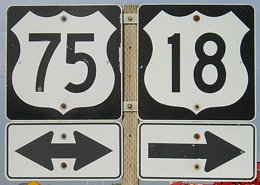
September 17, 2007: Westbound US 18 at US 75 in Sioux County. There are some ag-related businesses here, half a mile east of the unincorporated village of Perkins (which consists of a few houses and a salvage yard).

I have wondered if it would ever be possible to track down the status of US 18 in the fall of 1926, given the many documents that showed the highway was scheduled to end at US 75 but by every 1927 map had it already continuing into South Dakota.

As late as Oct. 4, 1926, the Iowa Highway Commission declined to join the South Dakota Highway Commission in requesting that US 18 be extended west to US 85. That was coming right up against the installation of the route markers in Iowa, which began about a week later and was completed Oct. 16 (as Jason Hancock learned a long time ago). This was on the early end of signing across the country, working off plans that had been two years in the works.

Now, thanks to a short front-page article in the Sioux County Index of Hull*, I have the best confirmation we’re likely to get that US 18 was SIGNED to end at US 75 for a brief period in late 1926. According to the story, the extension was approved at the AASHO meeting of November 11, 1926, which is considered to be the official birth of the federal highway system.

Black Hills Highway
O.H. Hetli, State Engineer, of South Dakota, was present at a government meeting of State Highway Engineers in Pinehurst, North Carolina, on Monday. In the interests of the Black Hills Hiway, Mr. Hetli asked that Federal Highway No. 18 be extended from Perkins Corner, west through Inwood over the Custer Battlefield Hiway, across South Dakota over the C.B.H. into Wyoming to the point where it intersects with U.S. No. 85, which then takes it into Denver.
— Sioux County Index
, Nov. 26, 1926

US 18 would have been signed into South Dakota by the end of the year, since 1927 maps and the Highway Commission’s service bulletin all say so. To make a comparison that no one would have understood 90 years ago, Iowa’s October signage was based on a software “late beta” before the release of Version 1.0.

So, for a few short weeks at the end of 1926, the equivalent of the assembly shown here read “End 18.” After that was changed, for about three years, 18 and 75 went a mile north, then three miles west, heading north on K42 toward Doon. Then they split and 18 went west on A42 to Inwood and 75 angled northeast toward Rock Rapids.

Ironically, through all the early preparation and fine-tuning of the system on both the state and national levels, it appears no one ever looked at the maps and said, “Hey, wait a minute. US 218 is based on an even number and is going north-south. What’s up with that? Why isn’t it US 265?”

*via Advantage Preservation, whose OCR-based microfilm scanning is THE GREATEST THING SINCE TABBED BROWSING.
Posted in Highway Miscellaneous, Maps | Comments Off on The west end of US 18 that officially wasn’t
Mar 13

Significant part of country already ‘ahead of time’


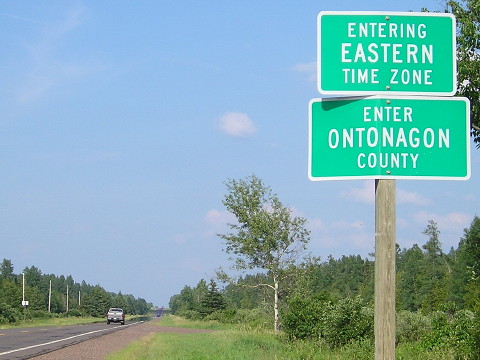
July 15, 2013: The westernmost highway entry into the Eastern Time Zone, MI 28 in the Upper Peninsula, is farther west than a lot of Illinois. Longitudinally, it’s roughly on par with Sterling, less than 30 miles from Clinton. It’s a good deal farther north, of course, but does this really look like 5:30 to you?

Once again, but this time with some additional politicians on board, they want to mangle clocks in the United States even more.

It is bad enough to have Daylight Saving Time spread across March and cover Halloween (now much of trick-or-treating is done in dusk or even daylight hours). It would be much worse to run it all year.

Sunrises would be exceptionally late in Iowa during winter under permanent DST — an entire month after 8:30, according to KCRG. Any state above 40° North latitude should oppose the idea. But there’s another argument against such a move: Significant portions of the country are in time zones that do not match their geography.

If time zone lines hewed closer to where they should, in 15-degree longitudinal increments with the “solar noon” in the middle, the contiguous United States would have dividing lines at 82.5° W, 97.5° W, and 112.5° W. Instead, they are up to hundreds of miles west.

This pair of tweets shows when “solar noon” happens across North America with and without DST. All the parts that are in orange are, quite honestly, in the wrong time zones. That includes huge swaths of Texas and the Great Plains, a good chunk of Idaho, the eastern part of the Florida Panhandle, eastern Kentucky and Tennessee, half of Ohio, and all of Indiana and Michigan.

DST puts solar noon more than an hour and a half behind clock noon in some places; permanent DST would make that a year-round problem. Florida’s House tried to make it even worse with a bill that would have put the rest of the Panhandle in Eastern Time.

(You know who would really be screwed with permanent DST? Canada.)

The change that is needed is not permanent DST. It’s smart DST, which would mean restoring pre-2007 (at least) calendar changes — something more difficult to regulate with a couple zillion more computers in Americans’ pockets and purses than there were then — and realigning time zone boundaries to better match the sun. Yes, I’m still in favor of changing the clocks.

At the very least, the Louisville area, Indiana, and much of Michigan’s Upper Peninsula (if not all of Michigan) need to be wrenched into God’s Own Time Zone where they belong. Move the lines all the way over up and down the country and maybe we can get broadcasters to acknowledge that a world exists outside of Eastern Time.

Posted in Geography, Maps | Comments Off on Significant part of country already ‘ahead of time’
Mar 12

Hancock photos sprinkled across pages

I raided Jason Hancock’s Flickr galleries (with his permission) to see if there were any gems that could augment these pages. They were taken at various points in the past decade, but they’re new here.

At least one new photo, although usually only one photo, has been added to: US 34US 136Business 61 Davenport (IA 461), 25, 32, 44, 83, 90, 105, 192. More photos were added to the Iowa side of I-129 as well.

Jason also had good coverage of the I-380/IA 100 volleyball interchange, which is a tricky one to do for a single driver, showing the replacement of Cedar Rapids with Iowa City on the BGSs. I used that opportunity to rewrite the text for IA 100 to reflect its completion to US 30.

Posted in Highway Miscellaneous | Comments Off on Hancock photos sprinkled across pages
Mar 11

License Plate Letters — HUG

OLYMPUS DIGITAL CAMERA
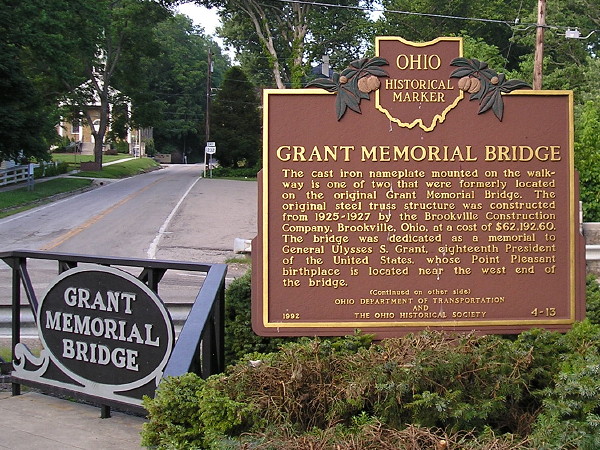
July 7, 2008: The US 52 bridge in Point Pleasant, Ohio, is the Grant Memorial Bridge, named for its most famous son. US 52 hugs the north bank of the Ohio River from Cincinnati to Huntington. Grant also lived in Galena, Illinois.

After not noticing new sequences for a while, I saw a spate of them in the past week or so. We’re almost through the H’s in Iowa.

But what does this have to do with the 18th president? Well, Ulysses S. Grant is not his birth name. He was born Hiram Ulysses Grant. I had read he didn’t like the initials HUG, but now I see sources that say the name change relates to Grant’s congressman misstating his name in the application to West Point.

Last year an annotated version of Grant’s memoirs was published to high acclaim.

Posted in License Plates | Comments Off on License Plate Letters — HUG
Mar 08

Four, count ’em four, visits to Dows


September 11, 2014: Eight years after starting its partnership with CAL, Dows started sending students to Clarion-Goldfield, one of the few times a school switched sharing arrangements before eventual consolidation.

(TLDR: I added a bunch of photos to the IA 72 page, including a bunch from July 2011 that I edited in August 2012.)

I have been to Dows four times for Iowa Highway Ends.

The first time, 2003, was on the way to a North Tama football game at Sheffield. It was after class on the Friday of Labor Day weekend, but hitting both Randall and Dows to get photos for IA 383 and IA 72 added a couple blocks to my growing website and I discovered a unique case of a highway whose east end faced west.

The second, in 2011, was a minor detour after a hotel stay in Lake Mills (with themed rooms) and a day that was mostly occupied with the Surf Ballroom and Music Man Square.

I swung by for the school in 2014 after the news that the Dows school district would merge with Clarion-Goldfield and its century-old building would close. That trip was to tackle a batch of tiny towns primarily in the north half of Humboldt County.

And then, in one of my few trips last year, I looked up what I could use better or updated photos of in north-central Iowa and traveled the old route of IA 72 from US 69 to I-35 one more time. (Still think Wright County’s motto can be “I can see for miles and miles and miles…”)

I think I’ve covered just about every angle, but who knows. If there are other places I’ve been to that many times specifically for trips, I might post about those too.

UPDATE 5/24: Clarified caption. Also, Marathon is a four-timer.

Posted in Iowa Miscellaneous | Comments Off on Four, count ’em four, visits to Dows